
SIFF 2021: Little Girl

RIDM 2020: Petite Fille – Cinetalk.net

As governments across the globe are taking steps to deny trans children the medical care that can save them from enduring serious dysphoric damage, Sébastien Lifshitz offers his documentary Little Girl as a positive, humanizing counter argument. To capture the personal and emotional turning point in Sasha’s life, the documentary is shot intimately. While the mom will occasionally speak directly to the camera to fill in her thought process, the camera also lingers on Sasha playing and just being a normal little girl.

From as early as age three, Sasha has told her parents that she was going to be a girl when she grew up. Now at age eight, they have decided that telling her no and making her cry is only doing more harm than good. They allow her to be herself during family times. Her bedroom transforms into a little girl’s, and her closet fills with dresses. Unfortunately, for the time being, she is forced to pretend to be a boy for both school and ballet class. The dissonance that this is plaguing Sasha results in her mother taking her to the doctor to discuss transition options.

Like with my earlier review for Valentina, this is where I admit that as a trans woman myself, the rest of the review is going to end up extremely personal. I am incapable of assessing this subject on a purely objective level. The first meeting between Sasha, her mother, and her new doctor is some of the most emotional storytelling I have ever seen. The camera holds a tight closeup of Sasha’s face. Her timid, single syllable answers to the doctor need to be flushed out by her mother so she can nod in agreement. The tears that well up in her eyes are a mixture of pain from admitting that pretending to be a boy in public is emotionally scaring and joy as the doctor assures her that being trans is normal and that she can present as a girl full time. The mixture of pain and relief in this moment resonates as a fulcrum for the rest of Sasha’s journey.

Medical documents in hand, Sasha enters another relatable step in transitioning: self-actualization. In the shots of her in ballet or school previously, Sasha seldom smiled. Up until receiving the doctors note she only looked happy while at home being herself. Once she received her medical form and started being herself full time, she was always beaming. This moment is special for any trans person. Going out in public even for the most menial tasks without worrying about being seen is liberating. By capturing these moments, the positive impact on Sasha’s life could not be clearer.

My personal bias on the topic is going to heavily bias my feelings towards this film. If I were to say anything negative it would be that the score is unnecessarily melodramatic at times and mixed a little loud. That small misgiving aside, Little Girl was an amazing and important documentary for this time. It clearly shows the life affirming impact that acceptance and appropriate medical care can have for trans youths.

SIFF 2021: Bebia, à Mon Seul Désir

Bebia, à mon seul désir' Review - Variety

In her first feature – Bebia, à Mon Seul Désir – Juja Dobrachkous explores themes of tradition and familial ties. Shot in brilliant black and white photography, the film relies heavily on local ritual to illustrate a young woman’s emotional struggle with the family that she abandoned.

Upon the passing of her grandmother Bebia (Guliko Gurgenidze), the estranged teen Ariadna (Anastasia Davidson) returns home to take part in the funeral. While undergoing preparations, for the ceremony, Ariadna is confronted with her role in Georgian burial tradition. As the youngest member of the family, it is her job to run a thread from the deathbed to the burial sight so that Bebia’s soul can find its way to the body’s resting place. For Ariadna, this means a 25-kilometer trek through untouched woods and hills. Ariadna being both largely removed from the family and a non-believer in the religious aspect is reluctant to go, but eventually resigns when subjected to enough pressure.

The standout of the film is without question the gorgeous black and white cinematography of the Georgian countryside shot by Veronika Solovyeva. The vastness of many of the shots reflect the smallness of the young woman both literally and figuratively. The extended scenes of silent walking through these shots while meticulously unspooling thread creates a hypnotic effect. These moments perfectly transition into flashbacks where Ariadna grapples with her relationship with Bebia. The interplay between walking and flashback work in perfect unison, but the same interplay that is present in the time before and after her meditative hike are less successful and lengthy.

There is a lot to appreciate in Dobrachkous’s debut feature. Bebia, à Mon Seul Désir is full of mature visual flare, and the stronger moments display advanced storytelling techniques and a deft hand for implementing metaphor. While the film was a bit overlong, and the less essential moments could have used some significant tightening, the good overshadows the lesser parts. As a filmmaker, Dobrachkous shows significant promise and will likely be an arthouse staple for years to come.

SIFF 2021: Summertime

Summertime

Three years removed from his breakthrough film and indictment of Oakland gentrification Blindspotting, director Carlos López Estrada sets his sights a few hundred miles south for another story of the underrepresented in an increasingly white city. While Blindspotting sported a traditional narrative structure, in Summertime, Estrada channels his experiences directing music videos for a more multimedia viewing experience. Jumping between dozens of characters, the film intertwines poetry, music, and dance for a unique storytelling medium.

Taking place over a single day in L.A., the film is an ensemble production of 25 people just trying to get by in a town that increasingly caters to the upper class. Each person deals with their own personal struggles and breaks into a revelatory poem when pushed beyond what they can endure. Tensions build for each character until many of the plotlines come to a head in a Smiley’s burger joint where a surprise visit, from the only characters who have aged more than a day, delivers an over-the-top ending to the film.

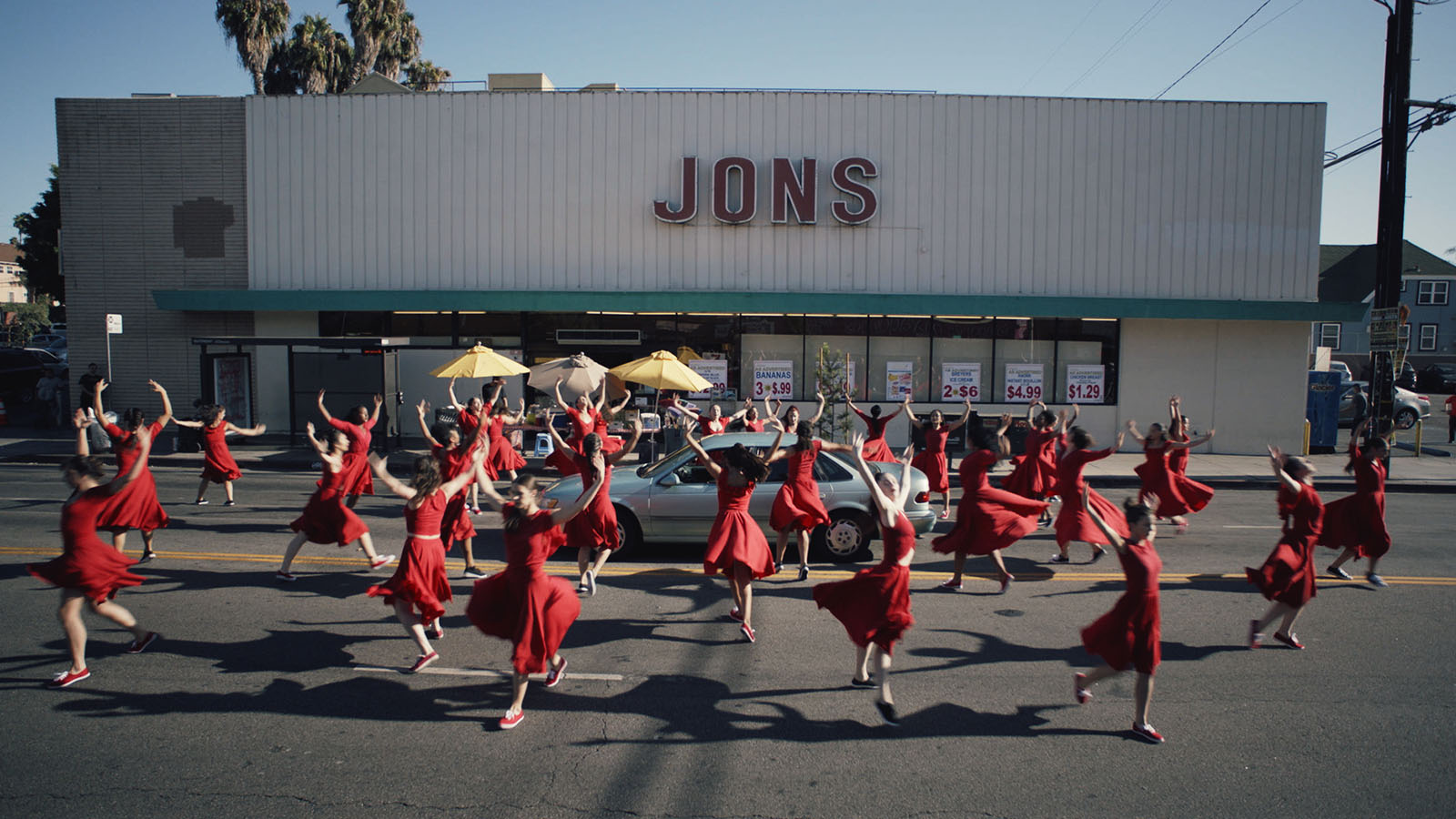
Can a gimmick make a movie? There is a lot to enjoy in Summertime. The poetry is moving and well performed, and the standout dance scene staring women in red dresses is beautiful. However, as a film, Summertime feels slight. A complex narrative is not necessary for a film to be successful, but this film is lacking in any depth. The excessive scope of the film leaves little time for nuance; each character is simplified down to one or two quirks that could be shared in the five minutes on screen that everyone gets. The poetry does offer some thematic continuity, but the film never stops feeling like a collection of Estrada’s music videos.

Estrada desired to create a fully unique film in Summertime, and in that he succeeded. The collection of poems is a strong basis, and the musicality of the productions flows well. Unfortunately, the film’s lack of depth results in it having little staying power. The themes are oversimplified and the screenplay, outside of the poetry, is exceedingly clunky. Summertime is an enjoyable watch in the moment, but one that inevitably leaves the viewer hungry for something more substantial.

SIFF 2021: Charter

charter | Sundance Institute

A mother’s bond with her children is precious, and any barricade between them can be detrimental to the well being of both parties. Director Amanda Kernell’s sophomore outing Charter deals with the psychological trauma stemming from the separation of mother and child.

Amid an ugly divorce and custody battle, Alice (Ane Dahl Torp) is awoken one night by a call from her son Vincent (Troy Lundkvist) crying. Her ex-husband Mattias (Sverrir Gudnason) intercepts the call and hangs up before Alice can decern what is wrong. In fear for Vincent and her teenage daughter Elina (Tintin Poggats Sarri), Alice travels to their home, and after days of Mattias denying her access to see them picks them up from school and absconds with them for a chartered holiday in the Canary Islands.

There is much that goes unspoken in the film to its benefit. The reason that Vincent called Alice crying in the middle of the night is never expressly given. Similarly, there are indications that Elina may be at the receiving end of some sort of abuse from her father, but no matter how much she and her mom reconcile, Elina never admits her father has done anything wrong. In this way, Alice becomes a bit of an unreliable narrator. She is doing what she genuinely believes to be in the best interest of her children, but whether they need saving is never expressly stated. The only thing the film shows Mattias doing that is unquestionably wrong is attempting to kiss Alice after she has already pushed him away once.

The success of Charter rests squarely on the back of its lead actress, and Torp proves more than capable lifting the load. Separated from her children, Alice experiences extreme lows which Torp actualizes miraculously. Coupled with excellent makeup giving her heavy bags under her eyes, she expresses pain perfectly. Conversely, when Alice is reunited with her children, Torp shows how loving a mother her character can be. Between joyful karaoke sessions and loving embraces in the face of disaster, Torp delivers s full realized character.

Buoyed by an excellent lead performance, Kernell’s Charter is a devastating exploration of the pain suffered by a woman separated from her children. Narrative details are blurred just enough to paint Alice as a potentially unreliable narrator, but while the story’s reality may be intentionally opaque the adoration between the characters is real and believable. Charter is an excellent drama in every aspect.

SIFF 2021: Bad Tales

Bad Tales (Favolacce) - film review on DMovies

Twin brothers Damiano and Fabio D’Innocenzo take a provocative look at the quiet horrors of suburbia in Bad Tales. This subject area is well suited for excessively dark satire, Todd Solondz has made a career out of it, but balancing the twisted nature of these films with the perfect amount of levity is imperative in creating a watchable film. Too much levity can come across as meanspirited at best or as an endorsement of atrocities at worse, conversely not enough levity results in a deeply unpleasant viewing experience. The Fratelli D’Innocenzo hope that with Bad Tales they created a film that land in the perfect middle.

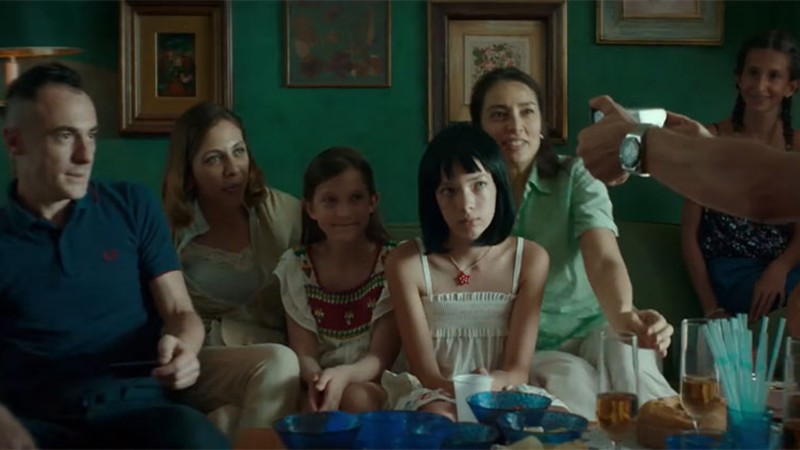
The film follows the summer vacation through the beginning of the school year for a few families living in the suburbs outside of Rome. The Placido family is helmed by the patriarch Bruno (Elio Germano) who has a hair trigger for abusive tirades against his two children, Dennis (Tommaso Di Cola) and Alessia (Giulietta Rebeggiani). The Guerrini family consists of the unemployed Amelio (Gabriel Montesi) and his son infected with the measles Geremia (Justin Korovkin). The kids in these families as well as a handful of others attempt to have a normal childhood, but the passive aggressive and repressive suburbia upbring leads them into dark decisions unbeknown to the checked-out parents.

Bad Tales is a perfect example of a film that is greater than the sum of its parts. There were many aspects of the film that did not work. For a film that takes place in the heat of summer and relies on the simmering heat as a narrative device, the film inexplicitly employs a cooling color correction. This decision was distracting throughout. Additionally, for as dark as the subject matter gets at times, The D’Innocenzos offer little humor to cleanse the palate from the harshest moments. This leaves many stretches of the film to feel sluggish as things get increasingly worse. Fundamental issues like these should be a significant hinderance to the film, yet while they are still apparent, when considering the film as a whole, it works despite these issues.

The Fratelli D’Innocenzo state their claim as Italy’s provocateurs with their second film Bad Tales. While their relative inexperience betrays itself in some of their technical and screenwriting decisions, the pair show a lot of promise through their ability to deliver a successful product, issues notwithstanding. Bad Tales is a good though imperfect satire form a pair of filmmakers to watch going forward.

SIFF 2021: There Is No Evil

There Is No Evil - An interview with director Mohammad Rasoulof - VIFF 2020  - Set The Tape

Mohammad Rasoulof like his filmmaking compatriot Jafar Panahi has been under legal scrutiny by the Iranian government over his films. This trouble has advanced to the point that There Is No Evil had to be shot in secrecy and is banned from screening in Iran. Consisting for four stories containing capital punishment in Iran, the Golden Bear winning film’s controversy in its home country is immediately apparent.

The anthology film contains four stories with state executions near the center. The first is of a man for whom executions have become a part of his everyday job. The second is of a man who runs when forced to do his first execution. The third is a story of a man who unknowingly executes a friend of his girlfriend, and the final a story of a man dealing with the repercussions of declining to execute anyone years prior.

While on the surface each story is connected through the capital punishment through line, themes of freedom and personal choice are just as pertinent to the films message and reflect the director’s legal status more aptly. An Overzealous execution policy is just a symptom of a government who believes they can control every aspect their people’s lives.

At two and a half hours long, the film’s breadth is its biggest weakness.  While the four parts share the thematic consistency, in both pacing and quality they are very uneven. This results in some of the lesser moments dragging and cause the film to feel each of its 150 minutes. Each story clocking in at 35-40 minutes a piece also hinders the films composition. At that length, the stories stand on their own in a way that is not as conducive for an anthology film. In most aspect there just appears to be too much film.

Excessive length aside, There Is No Evil, delivers upon Rasoulof’s directorial intentions. Through different viewpoints he creates a fully actualized condemnation of the country attempting to silence him.

SIFF 2021: Valentina

OUTshine Film Festival - Valentina

Uprooting your life and moving to a new town as a teen is tumultuous in the best of circumstances. Learning a new city and making new friends so late in one’s schooling is asking a lot of a young adult. In Cássio Pereira dos Santos’s Valentina, the titular character is forced to endure this hardship while also balancing getting ahold of her estranged father for important paperwork and keeping her gender assigned at birth a secret.

Valentina (Thiessa Woinbackk) and her mother Márcia (Guta Stresser) are forced to leave the larger city, where Valentina has found a level of acceptance, so that Márcia can start a new job as a nurse. In one of their first days in the new city, both women visit the local school to enroll Valentina who and ensure that she can register under her social name. As part of the registering, Valentina is also encouraged to attend summer school as she missed a year due to details unspoken but likely related to her transition. In these classes she meets Júlio (Ronaldo Bonafro) and Amanda (Letícia Franco) whom she becomes fast friends with, but regardless of their friendship, Valentina keeps the fact that she is transgender a secret because acceptance is never a given.

This is the part that I admit in full disclosure that as a trans woman myself, my feelings on the treatment of Valentina are going to supersede all other aspects in filmmaking when reviewing this film. Thankfully, Valentina treats its protagonist, and the actress who played her, with the upmost of respect. First and foremost, the actress Thiessa Woinbackk is a young trans woman herself. The casting decision is the bare minimum that needs to be done when making a film about the trans experience, but enough people fail at it that I am calling it out. Even beyond that, the material is extremely courteous of Valentina. Trans bodies are almost always commodified and exploited, but the film does not go out of its way to sexualize or objectify her. When given an opportunity to undress the character for a medical examination, Valentina declines and the film never broaches the idea again.

While the respect for its trans character is a welcome relief in any film, Valentina is especially impressive in its capturing of the experience. The singular moment that stood out as a film talking with its trans actor to create something that feels real happens at the darkest point of the film. Valentina having been first outed and then threatened is assaulted while out for a run one evening. Rather than doing any bodily harm to the young girl, the masked men cut off a handful of her hair. For many trans girls, the hair is the first part of their body that can help alleviate body dysphoria. By attacking this symbol of femininity nothing graphic needed to be done. The emotional devastation was sufficient to get the point across.

As countries continue to take steps demonizing trans people and legal restricting a young trans person’s access to healthcare, positive representation becomes increasingly important. Valentina can help fill the void of positive portrayals of trans girls. Staring a brilliant young trans woman, the film paints a picture of a young girl who wants nothing more than to live her life as a normal teen. Valentina is a nearly perfect piece of transgender representation, and Woinbackk has the makings of an excellent queer star.

SIFF 2021: Goddess of the Fireflies

Goddess of the Fireflies

Angst, rage, and experimentation are essential components to a great coming-of-age story. In her early 90s period drama, Goddess of the Fireflies, Anaïs Barbeau-Lavalette delivers on these pillars of young adulthood with excess. Leaning heavily into the grunge aesthetic of the era, Barbeau-Lavalette delivers on the teen spirit that Kirk Cobain would recognize, for better and for worse.

Catherine (Kelly Depeault) begins her 17th year on the planet under less than stellar circumstances. Her parents cap off her family celebration with squabble ending in property destruction and at school she is mocked by the burnout crowd she idolizes. After one humiliation to far, Catherine becomes determined to fit in with the people she wants and drops some of her birthday money on mescaline. From that moment on, Catherine takes control of her life even if by doing so she turns down some self-destructive paths. The blur of sex and drugs that follows encapsulates the joys of life experienced by someone to young to comprehend consequences.

When dealing with stories about young people experimenting with sex and drugs, there is a fine line between preachy and glorification that needs to be carefully skirted to deliver the most effective story possible. Barbeau-Lavalette avoids either pitfall by not denying the joy Catherine experiences while high but also providing serious consequences. Her addiction to drugs is undeniable, but while her home life is crumbling to pieces her burnout friends offer her a needed familial support. They may use drugs in excess as an unhealthy vice, but her friends Marie (Éléonore Loiselle) and Keven (Robin L’Houmeau) have an undeniable positive impact on her life. Even when reality catches up to the group and the negatives consequences of their lifestyle materializes, Catherine can go to this group for support more than her parents.

The late teens is a time rife for finding oneself, and experimentation of all manners is an important aspect of this time. When capturing this age on screen, it is important to not overly focus on the result of any one experimentation. Growing up is all about the journey both good and bad. Barbeau-Lavalette wonderfully captures this nuance in Goddess of the Fireflies by putting her characters forward. Catherine’s highs and lows are given equal weight in the film, and while the climax offers a definitive answer as to the result of fully embracing the excess, walking down that path had significant positives on her life as well. The film acknowledges that a blend is always the most fulfilling solution when growing up.

A 2021 Film Journey: Day 98 – Day 108

I’m combining all of these days together because I’m attending the Seattle International Film Festival. Instead of a daily blog format, I’m writing individual reviews for every film that I watch. This post will just bee to ensure there’s some consistency when looking at the project as a whole and will have a quick personal blurb followed by a link to the individual reviews for each day.

Day 98 – First day of SIFF and I tried to hit the ground running. I made it through 4 films today including The Pink Cloud which was the film I had heard the most buzz for going into it.

The Pink Cloud (2021, Dir. Iuli Gerbase)

I’M FINE (Thanks for Asking) (2021, Dir. Kelley Kali and Angelique Molina)

Summer of 85 (2020, François Ozon)

The Dog Who Wouldn’t Be Quiet (2021, Dir. Ana Katz)

Day 99 – Only three movies for the second day of SIFF, but today’s lot included one of the longest films in the festival as well as the film I was inspired to write the longest review over.

Goddess of the Fireflies (2020, Dir. Anaïs Barbeau-Lavalette)

Valentina (2020, Dir. Cássio Pereira dos Santos)

There Is No Evil (2020, Dir. Mohammad Rasoulof)

Day 100 – It feels somewhat anticlimactic to be hitting this milestone and treating it as a blurb in the midst of this aggregate post, but with 4 movies watched and a review written for each, today’s already been a long writing day. The only thing I really have to add is that this project has been amazing for me, and I feel much better 100 days later for undertaking it.

Bad Tales (2020, Dir. Damiano and Fabio D’Innocenzo)

Charter (2020, Dir. Amanda Kernell)

Summertime (2021, Dir. Carlos López Estrada)

Bebia, à Mon Seul Désir (2021, Dir. Juja Dobrachkous)

Day 101 – I’m not going to lie, I definitely underestimated the amount of work writing a review for this many films was going to be. It’s definitely slowing my watching progress (I assumed that weekends I could probably fit in five films when I only got through three today). I’m going to keep this up as much as I can, but wow am I exhausted.

Little Girl (2020, Dir. Sébastien Lifshitz)

Get the Hell Out (2020, Dir. I.-Fan Wang)
—– Also includes Mom Fight (2019, Dir. Mickey Finnegan)

Slalom (2021, Dir. Charlène Favier)

Day 102 – I definitely should have taken the week off of work. This has been an exhausting endeavor. The blog posts that I’ve done for this project thus far has not prepared me for the extend of writing I’m doing for this, but if I can at least keep making it through two movies a day I’ll call it a success.

Beans (2021, Dir. Tracey Deer)
—– Also includes Bub (2021, Dir. Oriwa Hakaraia and Te Mahara Tamahana)

Waikiki (2020, Dir. Christopher Kahunahana)
—– Also includes PIIKSI/Huia (2021, Dir. Joshua Manyheads and Cian Elyse White)

Day 103 – A busy day at work again kept me limited to two viewings. Like I mentioned yesterday. If I can routinely make it through 2 movies with reviews while working full days, that’s a win.

Sweat (2020, Dir. Magnus von Horn)

The Earth is Blue as an Orange (2020, Dir. Iryna Tsilyk)

Day 104 – Another busy one today, but I made it through another 2 films. The festival fatigue is really hitting (even with it being exclusively virtual), but I’m still glad I’ve kept this up even if the reviews come increasingly late.

Strawberry Mansion (2021, Dir. Kentucker Audley and Albert Birney)
—– Also includes The Other Morgan (2021, Dir. Alison Rich)

Wisdom Tooth (2019, Dir. Liang Ming)

Day 105 – I managed to suppress a bit of the festival fatigue today by watching the first film of the night outside on my balcony. The fresh air really helped. Today’s offerings were very uneven. One film that I did not connect with and the other that jumps into the to tier of the ones I’ve seen for the festival.

Rebel Objects (2021, Dir. Carolina Arias Ortiz)

Topside (2021, Dir. Logan George and Celine Held)
—– Also includes Huntsville Station (2020, Dir. Chris Filippone and Jamie Meltzer)

Day 106 – This was a surreal day for me involving this project. Earlier in the week, my review of Valentina got the notice of the film’s twitter account. That made me feel great, but I realized it was just free PR for the film. Today’s engagement level was different. The positive review I gave for Too Late resulted in not just a retweet from the film’s account, but retweets from the director stating that I made her happy cry and a DM from the lead actress left me flabbergasted. This is the best I’ve felt in a long time.

Too Late (2021, Dir. D.W. Thomas)
—–Also includes Unholy ‘Mole (2019, Dir. David Bornstein)

The Spy (2019, Dir. Jens Jonsson)

Day 107 – The second to last day of the festival and even though it was a weekend I’m approaching the end of the list of films I pegged for watching, so I let today be a relatively light day before a final push tomorrow.

The Teacher (2019, Dir. Ming-Lang Chen)

Ma Belle, My Beauty (2021, Dir. Marion Hill)

Day 108 – The last day of SIFF. For today only, I chose to adjust my schedule a bit. I had been writing each film’s review before proceeding the the next, but for the final day I watch movies straight through so I could get as many in before the end of the festival as possible. I’m happy with the decision even if it means I’m going to be juggling multiple projects for the next couple days.

Fly So Far (2021, Dir. Celina Escher)

The Perfect Candidate (2021, Dir. Haifaa Al-Mansour)

God Exists, Her Name is Petrunya (2019, Dir. Teona Strugar Mitevska)

Son of Monarchs (2021, Dir. Alexis Gambis)

SIFF 2021: The Dog Who Wouldn’t Be Quiet

The Dog Who Wouldn’t Be Quiet is an absurdist drama by Argentinian filmmaker Ana Katz. In it, she uses a listless protagonist as a vessel for a variety of vignettes exploring universal truths while maintaining a dry sense of humor throughout. Coincidental parallels in the film to worldwide pandemic offer an unexpected connection to some of the more absurd premises. All of this is enhanced by gorgeous black and white cinematography and a screenplay that constantly builds upon itself.

Sebastian’s (Daniel Katz, the director’s brother) dog will not be quiet while Sebastian is at work, and she is driving the neighbors crazy. Sebastian rectifies this issue by taking his dog with him to work which promptly results in his firing. From there, Sebastian goes on an increasingly absurd journey including a stint working with a collective of communist farmers and eventually getting married (his wife is portrayed by Julieta Zylberberg) and having a child during a worldwide emergency where all air more than four feet off the ground is toxic to breathe. Through each of these events, Sebastian maintains a positive demeanor and is always there to help anyone in need.

The risk in films that are as episodic as The Dog Who Wouldn’t Be Quiet is that if the through line is not strong enough, the film falls apart. Ana Katz was able to avoid that misfortune by making Sebastian’s unbridled optimism and philanthropy act as a constant straight man for the absurd situations Katz writes for him. This grounded presence also helps in processing the more extreme scenarios. As the film flirts with surrealism, the audience can look to Sebastian for a baseline while the absurdist atmosphere envelopes them.

Through a collection of head scratching vignettes, Ana Katz exposes a multitude of human insecurities in her film The Dog Who Wouldn’t Be Quiet. Buoyed by a tightly focused screenplay and a lead performance tailor made for the feature, The Dog Who Wouldn’t Be Quiet delivers everything that can be asked of a film this disconnected from the Hollywood cinematic scene. It is well worth the 73 minutes for anyone looking for something unique.