The Best Films of 2023

I’m so late this year, I’m sorry. But It’s finally list time again! I love films and I love sharing my love of films with others. As I’ve done for the past decade plus, I’ve put together a list of what I consider to be the best films of the year that just ended. I put this off as long as I did so that I could see The Zone of Interest, but honestly I had a lot to catch up on after mental health issues kept me from seeing most of the year end films. Of the films on this list, 10 of them were directed by women, which is quite a high percentage considering what the wide release percentage of women directors tends to be. As far as regrets go, there were two Argentinian films I wanted to watch before putting together this list, The Delinquents and Trenque Laquen, but at 3 and 4 ½ hours a piece, they just weren’t in the cards this year. Additionally not being in one of the major markets, Seattle is only so big, I was unable to see The Taste of Things and Perfect Days. Both open here in mid-February, but I didn’t want to be that delayed in putting out my list any further. Now without further ado, the list.

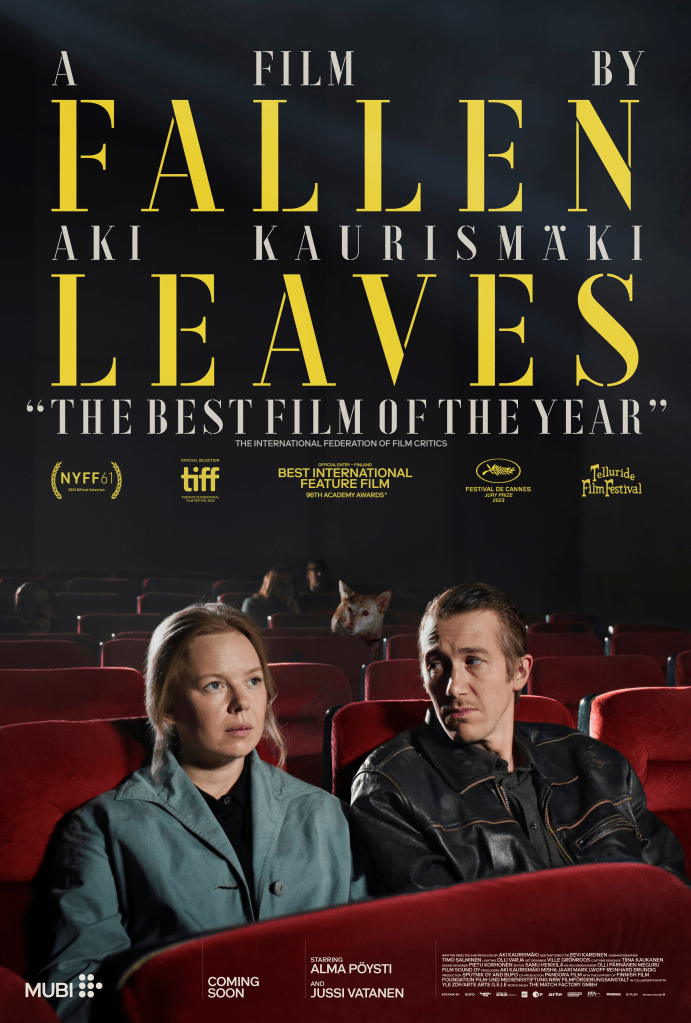
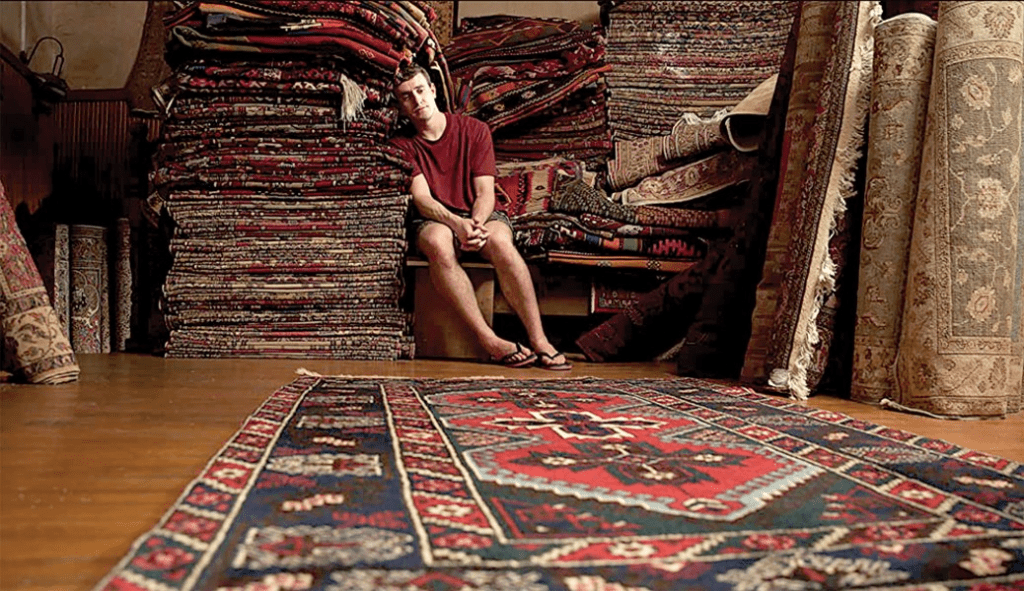
25. Fallen Leaves (Dir. Aki Kaurismäki)

Finnish director Aki Kaurismäki is the master of the dry, social commentary comedy, and his most recent film Fallen Leaves fits into that category and excels while doing so. A love story between two miserable, working-class people, Fallen Leaves captures the desperation for connection that can plague the underserved. Ansa (Alma Pöysti) may not especially like Holappa (Jussi Vatanen), but that does not stop her from falling in love in service of no longer being alone. Patently ridiculous and lovingly poignant, Kaurismäki delivers a great film about living the best life one can.

24. All Dirt Roads Taste of Salt (Dir. Raven Jackson)

It did not take long for the pretentious side of my list to show its face. All Dirt Roads Taste of Salt is definitely not for everyone, but for those willing to put up with a meandering, vibes over narrative approach to filmmaking, Raven Jackson’s film will be a blessing. The story of a Black, Mississippi woman that spans decades speaks to moments that make a life. Methodical in its pacing, All Dirt Roads Taste of Salt feels almost Malickian and I say that in the best way possible.

23. The Holdovers (Dir. Alexander Payne)

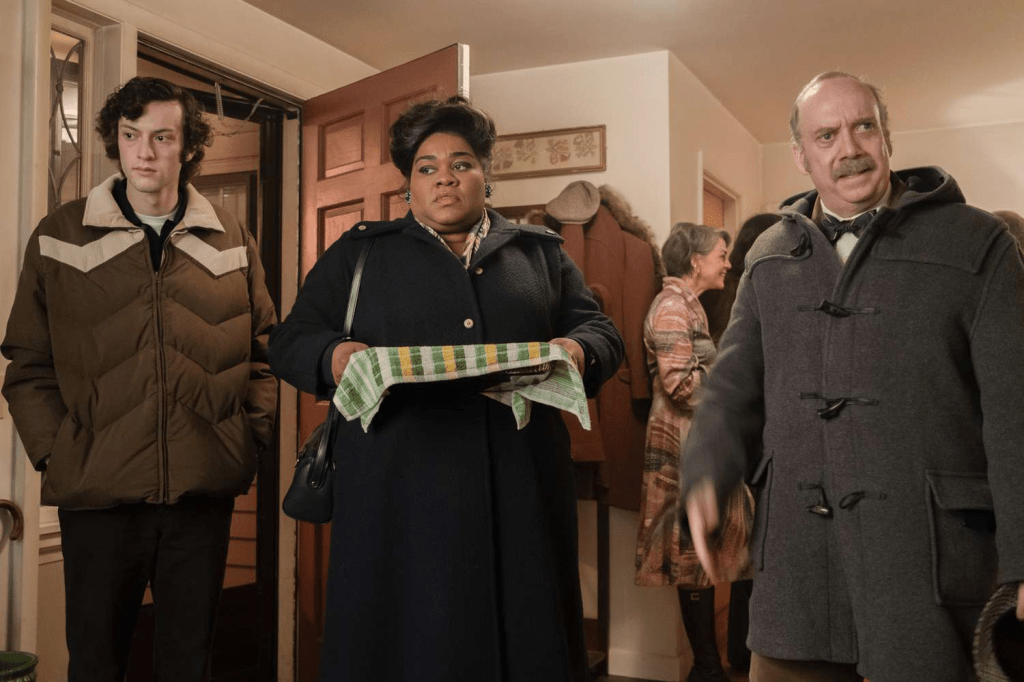
Alexander Payne and Paul Giamatti reunite 19 years after Sideways to create the most quintessentially winter film of the year. While Giamatti may bring the star power to the film this place on the list is essentially a Da’Vine Joy Randolph recognition. She plays Mary, a cafeteria worker who is staying over at the school for the holidays as a way of grieving her son’s passing. Her performance is devastating as she slowly breaks down as the holiday break continues, and she will almost certainly walk away with an Oscar this year as the lone winner for the film.

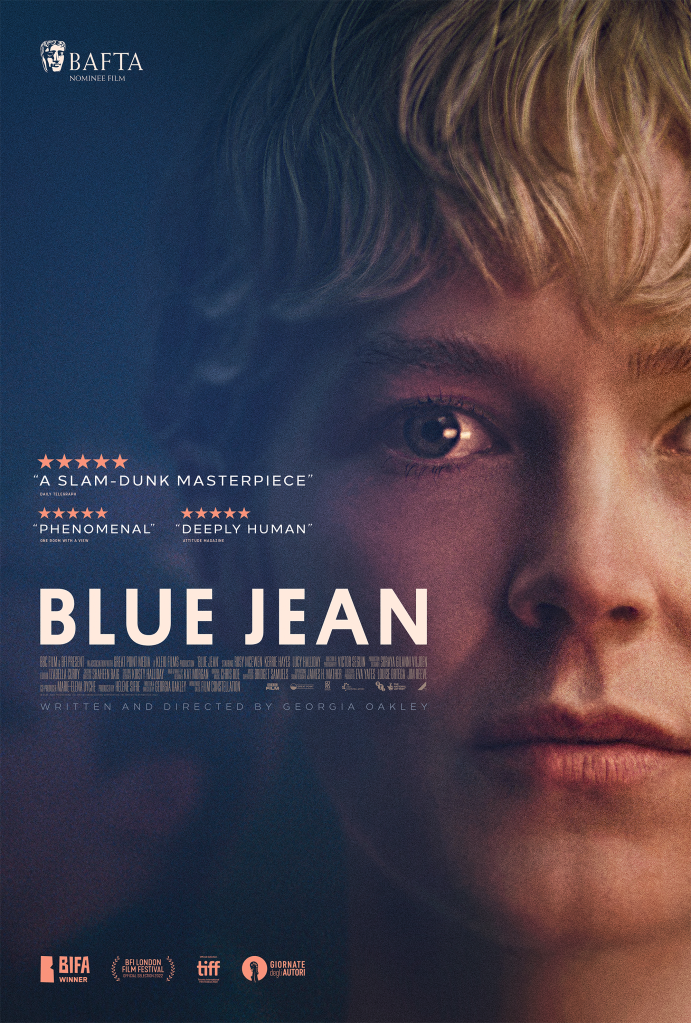
22. Blue Jean (Dir. Georgia Oakley)

While it is true that many lesbian films end up being period pieces, most of them take place well before the Thatcher era where Blue Jean does. Rosy McEwen plays Jean a physical education teacher who needs to hide her homosexuality from her place of employment less risk being fired because of the archaic Tory laws. McEwen is the highlight of the film as she captures the strife of a women unsure with how to proceed as herself. A solid screenplay also heightens McEwen’s performance in this underseen gem.

21. Barbie (Dir. Greta Gerwig)

While many people were skeptical of a movie based on Barbie, I had faith in Gerwig’s direction to deliver something special, and I feel confident that I won that bet. Some may scoff at the feminism 101 speachs that inhabit the film but remembering that this film is a PG-13 film that many teens will watch should absolve that critique. Outside of the philosophical arguments about the film, Barbie is just outright fun. Margot Robbie and Ryan Gosling are both exceptional, and the return of the dream ballet in “I’m Just Ken” was the most entertaining moment in film this year.

20. R.M.N. (Dir. Christian Mungiu)

Christian Mungiu, acclaimed director of 2007’s 4 Months, 3 Weeks and 2 Days, returns to the big screen with the slowest of burns R.M.N. The film explores human nature when confronted with the unknown. Matthias (Marin Grigore) is the unlikable protagonist at the center of the film. He has extramarital affairs, is less than understanding of his scared son, and takes a passive approach to the racism that has infected his town. Yet through these unlikable eyes, the story has a strong sense of right and wrong and stands with those who need it most. Undeniably a slow watch, but the payoff is well worth the commitment.

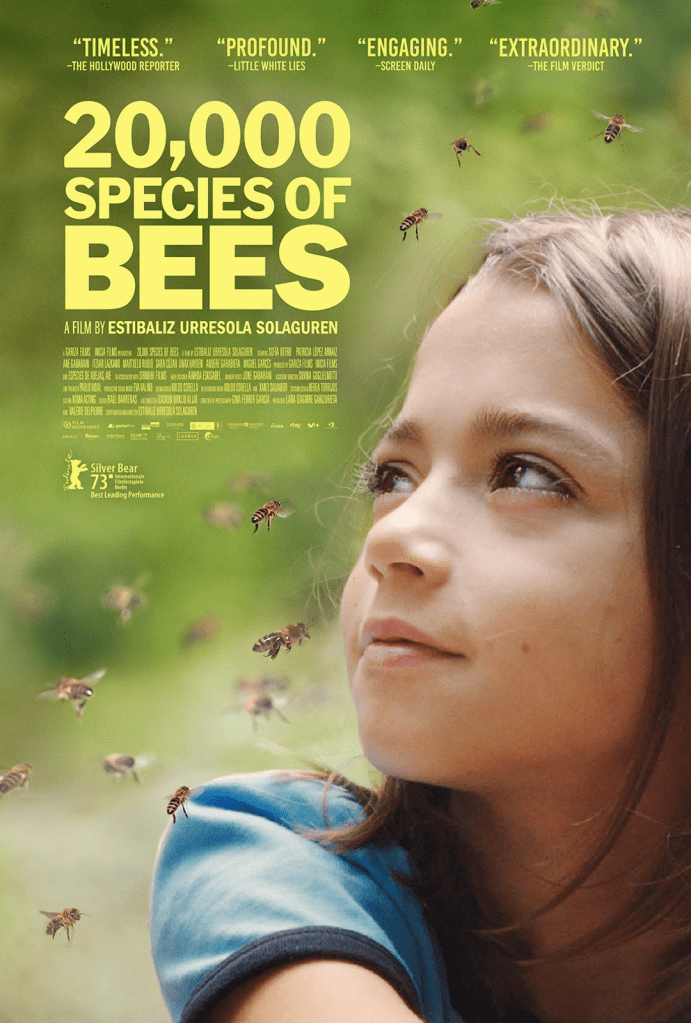
19. 20,000 Species of Bees (Dir. Estibaliz Urresola Solaguren)

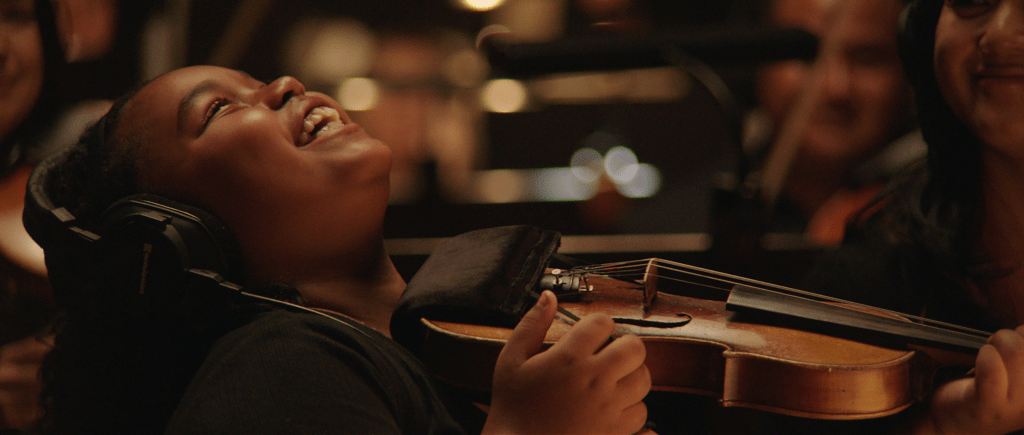
Possibly the least traditional entry onto my list, 20,000 Species of Bees was a SIFF discovery for me, and one for which I was clearly the target audience. The film is about Lucía (Sofía Otero) an eight-year-old who is just coming to terms with her gender identity and her mother Ane (Patricia López Arnaiz) learning to accept her daughter for who she is. As a trans woman, I found the story to ring exceptionally true. Lucía’s inner conflict with whom she was reminded me of my own, and Ane’s reluctance followed by eventual acceptance felt like what I wished would have happened for me. Extremely emotional and expertly acted, 20,000 Species of Bees is a film to look out for if it ever receives distribution.

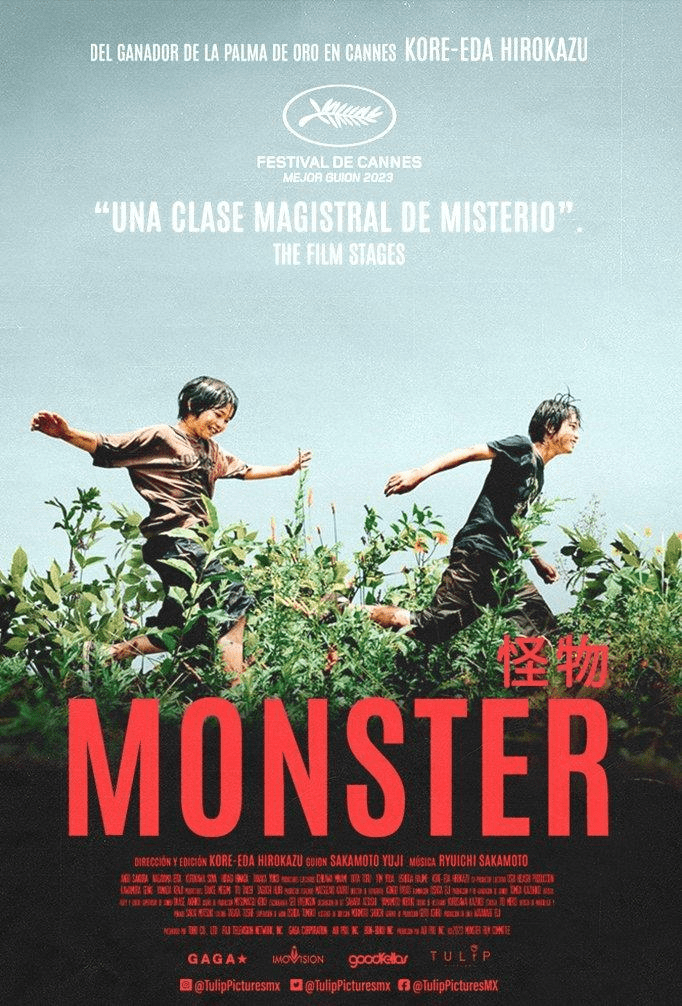
18. Monster (Dir. Hirokazu Kore-eda)

A modern day Rashomon (Dir. Akira Kurosawa, 1950), Monster is acclaimed Japanese director Hirokazu Kore-eda’s tale on perspective. When her son Minato (Soya Kurokawa) starts acting strangely, his mother Saori (Sakura Ando) is understandably concerned. Starting with her perspective, Kore-eda slowly unravels the mystery behind Minato’s strange behavior. And while the principle view point may shift at various times throughout the film, it is Ando’s performance as the mother desperate to find out what is wrong with her son that shines through.

17. Poor Things (dir. Yorgos Lanthimos)

I never would have guessed that the man who directed Dogtooth (2009) would become one of the most well known and acclaimed directors working 15 years later, but Lanthimos has managed to tap into the weirder aspect of the cultural mind. Poor Things is another film that should not have mass appeal, but we are better off because it does. Emma Stone is excellent as Bella Baxter, the Frankenstein’s Monster stand in of the mad genius Dr. Godwin Baxter (Willem Dafoe). Stone plays Bella as an infant minded creation all the way to a wise beyond her years independent woman and is convincing at all stages of that development. A wickedly devious performance for a wickedly devious film.

16. Are You There God? It’s Me, Margaret. (Dir. Kelly Fremon Craig)

I am a sucker for a good coming of age film, and that is exactly what Kelly Fremon Craig delivered with Are You There God? It’s Me, Margaret. The adolescent girl’s coming of age film seems to be Craig’s forte as this film follows up her 2016 debut The Edge of Seventeen. While Abby Ryder Fortson is great as the titular Margaret, it is Rachel McAdams, playing Margaret’s mother Barbara, who steals the show. Craig rightfully expands Barbara’s role from what it was in the book, and McAdams delivers wonderfully on the expanded material.

15. Showing Up (Dir. Kelly Reichardt)

As far as current actor director pairs go, it is hard to pick a pair much better than Michelle Williams and Kelly Reichardt. Williams is able to thrive under Reichardt’s deliberate pacing and muted direction to portray characters still filled with the depth normally ascribed to showier performances. Showing Up is a look at the less glamorous side of being an artist. Working hard for little acknowledgement and fighting hard for every bit of exposure. The film may well be too slow for most viewers, but for those willing to sit with a movie and take it at its own pace, it is an excellent watch.

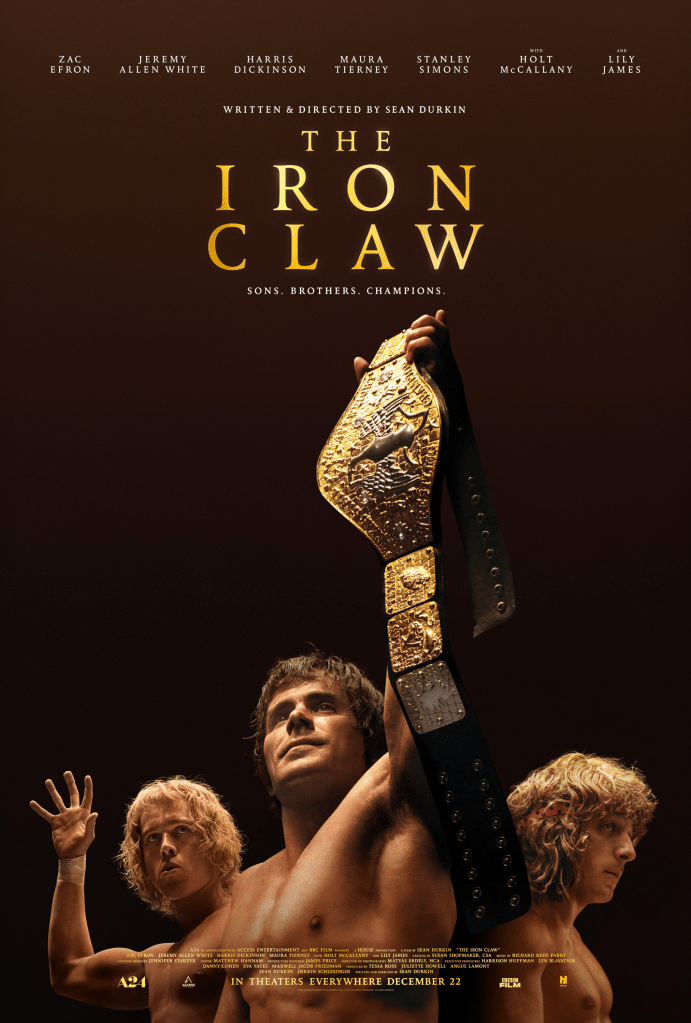
14. The Iron Claw (Dir. Sean Durkin)

I have never watched a single wrestling match in my life, but one does not need to in order to find the latest Sean Durkin film The Iron Claw fascinating. The tragic story of the Von Erich brothers lends itself perfectly to the silver screen. Durkin is masterful at slowly teasing the dark side of things out from his subjects and he does just that from this film. He lets the unease slowly build before exposing the devastating truth of the Von Erich curse. As the eldest (living) brother Kevin, Zac Efron proves that he is more than just a pretty face, but an excellent actor as well. His performance is what allows the audience to maintain hope despite all of the tragedies the film portrays.

13. May December (Dir. Todd Haynes)

Director Todd Haynes reunites with Julianne Moore and works with Natalie Portman and Charles Melton for the first time to deliver a story based largely on the Mary Kay Letourneau scandal from the late 90s. In this film Moore plays the Letourneau stand in Gracie seemingly happily married to her victim Joe (Melton) 20 years after the abuse. Portman’s Elizabeth throws a wrench into their lives when she comes to observe Gracie in service of performing as her in an upcoming film. Haynes’s film is filled with melodrama and camp in a way that heightens the absurdity of the situation (even if based on real life). All three actors put in exquisite performances in a film that leaves them all questioning the relationship at the center of their connection.

12. Afire (Dir. Christian Petzold)

German auteur Christian Petzold’s most recent film Afire is a haunting look at someone so blinded by a self-imposed sense of obligation that he misses out on the small wonders of life in front of him. Leon (Thomas Schubert) is an asshole, even if deep down he does not want to be. On a trip with his friend Felix (Langston Uibel), they meet Nadja (Paula Beer) who attempts to befriend Leon even if Leon’s instincts keep ruining things. All this happens under the threat of impending wildfires which threaten to ruin the three’s holiday. Poignant and contemplative, Afire is another excellently realized film for Petzold.

11. Beau is Afraid (Dir. Ari Aster)

Ari Aster follows up is two highly acclaimed horror films (2018’s Hereditary and 2019’s Midsommar) with something completely different in Beau is Afraid. While the most recent film could maybe be classified as a horror film, that would be more in the horrific root word than what the genre has come to mean. Joaquin Phoenix gives a terrifying performance of Beau, a man plagued with anxiety. Phoenix’s performance and Aster’s direction combine to create a perpetual feeling of unease as reality is blurred under Beau’s anxious delusions.

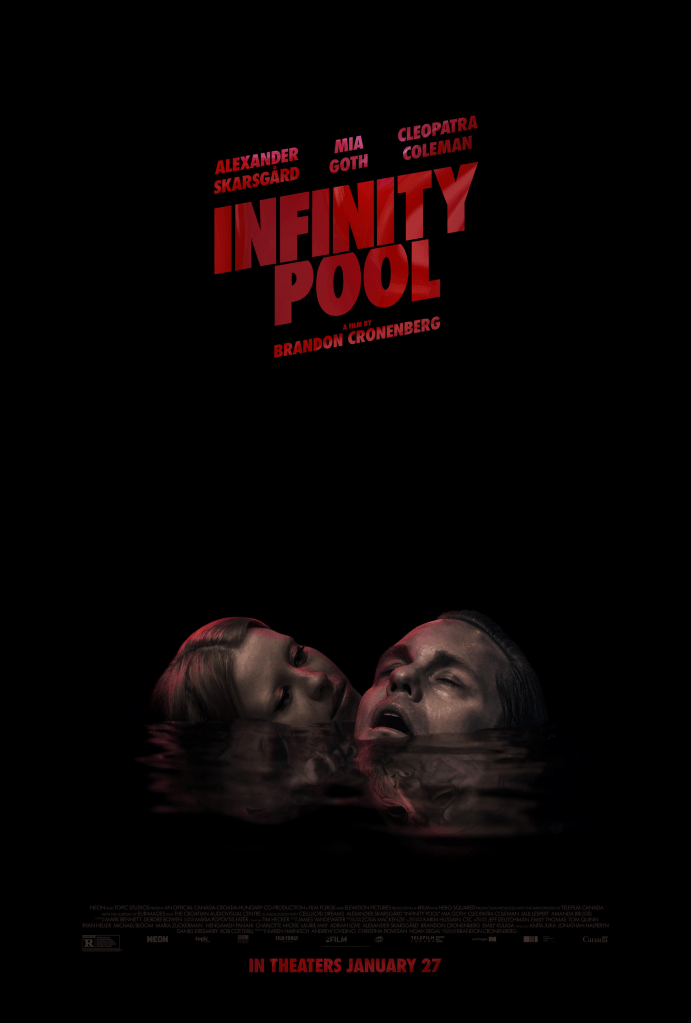
10. Infinity Pool (Dir. Brandon Cronenberg)

The best horror film of the year continues to prove that Brandon Cronenberg is more than just a nepo baby, he is an excellent film maker with his own style. Infinity Pool lingered with me, the creepy imagery, the complex themes, and especially the supporting performance from Mia Goth. The film is dark and twisted in a way that lingers in the mind for weeks after viewing. Alexander Skarsgård is excellent as the slimy failed author James, and as mentioned, Mia Goth as Gabi is impeccably deranged.

9. Asteroid City (Dir. Wes Anderson)

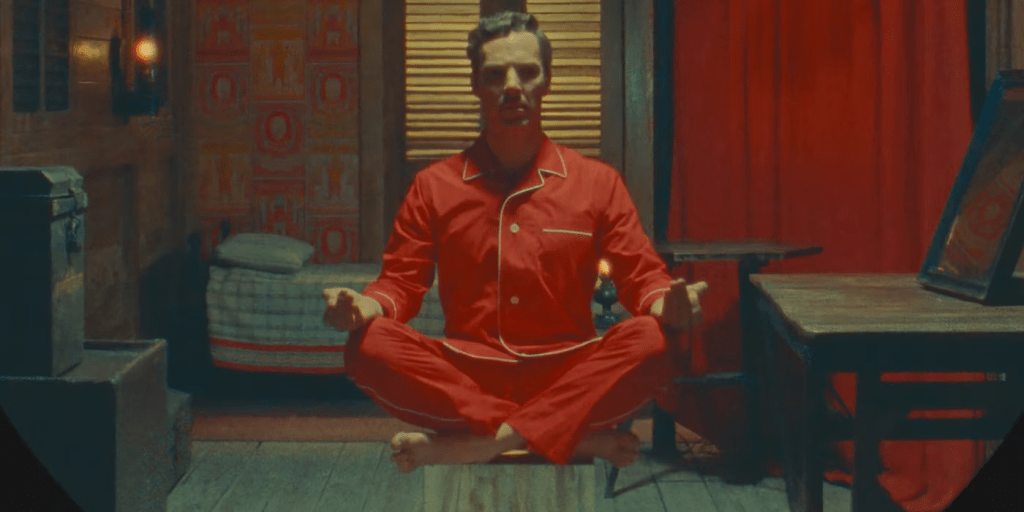
If you think Wes Anderson’s style is a little bit too much, then this is not the film for you. However, if you want to see Wes Anderson dive into his style headfirst and make the most Wes Anderson film ever, then you need to see Asteroid City. Consisting of multiple layers of storytelling, the film is a complex narrative that I’m still grappling with after only one watch. The innermost layer of the film, the one in color, is filled to the brim with interesting acting decisions and Anderson’s trademark production design. Yet it is the combination with the outer layers that elevate Asteroid City into one of Anderson’s best.

8. Killers of the Flower Moon (Dir. Martin Scorsese)

It is sacrilege to say this as a cinephile, but Scorsese has never really been my cup of tea. I respect him as a film maker, and I’ve never disliked his movies, they just have not resonated with me the way they do for most. That said Killers of the Flower Moon spoke to me in a way that most of his more recent films have not. While much of the film does fall in the bad men doing bad things that many of his films fall into, the inclusion of Lily Gladstone as Mollie Burkhart won me over. By centering on the victim, he made a film that resonated much more with me. Scorsese’s undeniable prowess with directing combined with a sympathetic co-lead make this one of his best films. I only wish that Gladstone appeared on screen more.

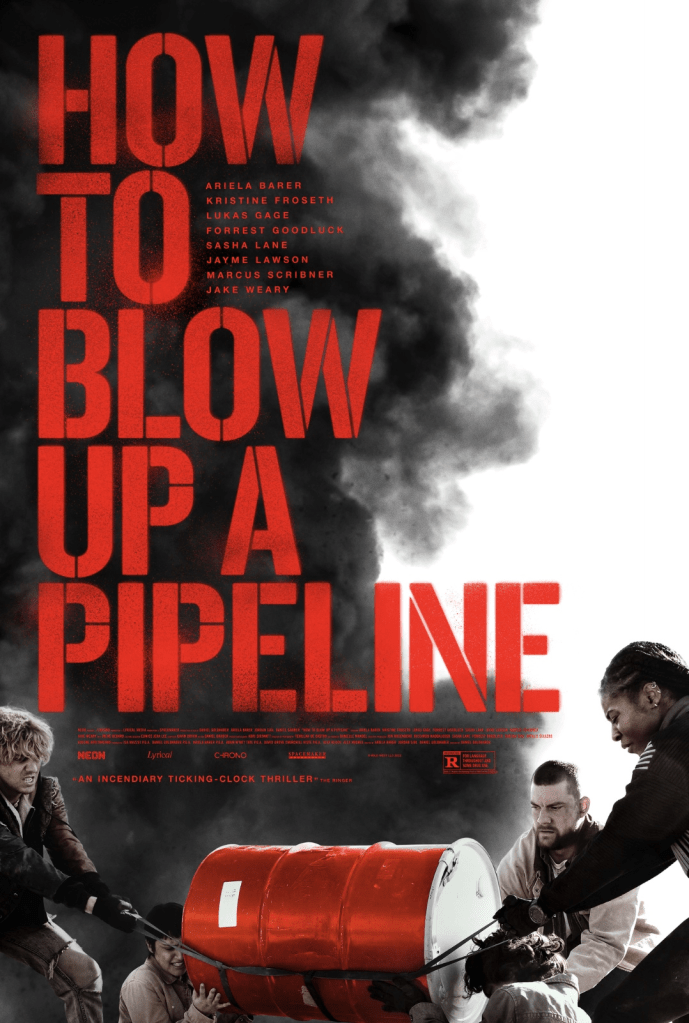
7. How to Blow Up a Pipeline (Dir. Daniel Goldhaber)

We’ve reached the point in our climate dystopia where our films can paint ecoterrorists as both the protagonists of a film and completely in the right. How to Blow Up a Pipeline is an incredibly tense thriller about a band of people whom all for different reasons believe that the destruction of an oil pipeline in Texas will serve their causes. Goldhaber cuts back and forth between the ecoterrorists’ past that motivated them to join this cause with the building of bombs and act of blowing up the pipeline. The film is remarkable in its ability to build tension and speak to a necessary issue in today’s world.

6. Anatomy of a Fall (Dir. Justine Triet)

The Palme winning Anatomy of a Fall cemented itself this year as one of the greatest courtroom dramas in cinema history. Sandra Hüller is impeccable as a wife who is under suspicion of killing her husband. She skirts the line in her performance such that the audience can never be certain if she is innocent or guilty. Much of that uncertainty is also due to Triet’s remarkable direction. The use of audio recordings of a fight between Hüller’s Sandra and her husband Samuel (Samuel Theis) is a linchpin of the film. It both represents a possible motive for Sandra and questions if normal marital fights can be used to incriminate. Triet delivers a complex picture of marriage and the court system.

5. A Thousand and One (Dir. A.V. Rockwell)

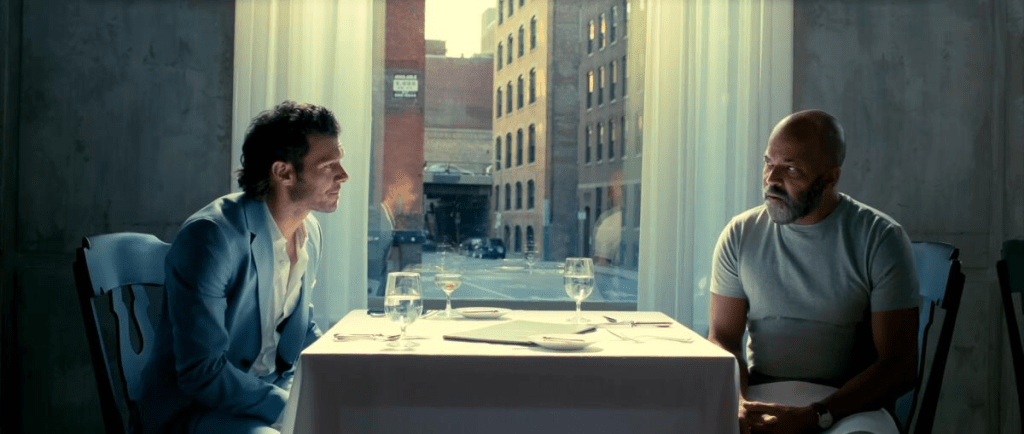
Sundance Grand Jury: Narrative winner A Thousand and One snuck up on me for how good it was. Similar to 2016’s Moonlight (Dir. Barry Jenkins), A Thousand and One explores the Black experience of a young man through various points in his life. Rockwell’s film, however, uses these time skips to show the evolving relationship between a boy and his mother played wonderfully by Teyana Taylor. Her performance is one of the best of the year, as she manages to capture Inez’s change over the decade while still making each era feel like the same person, just with more years of experience. I’d also like to call out Gary Gunn’s score for the film which was my favorite of the year.

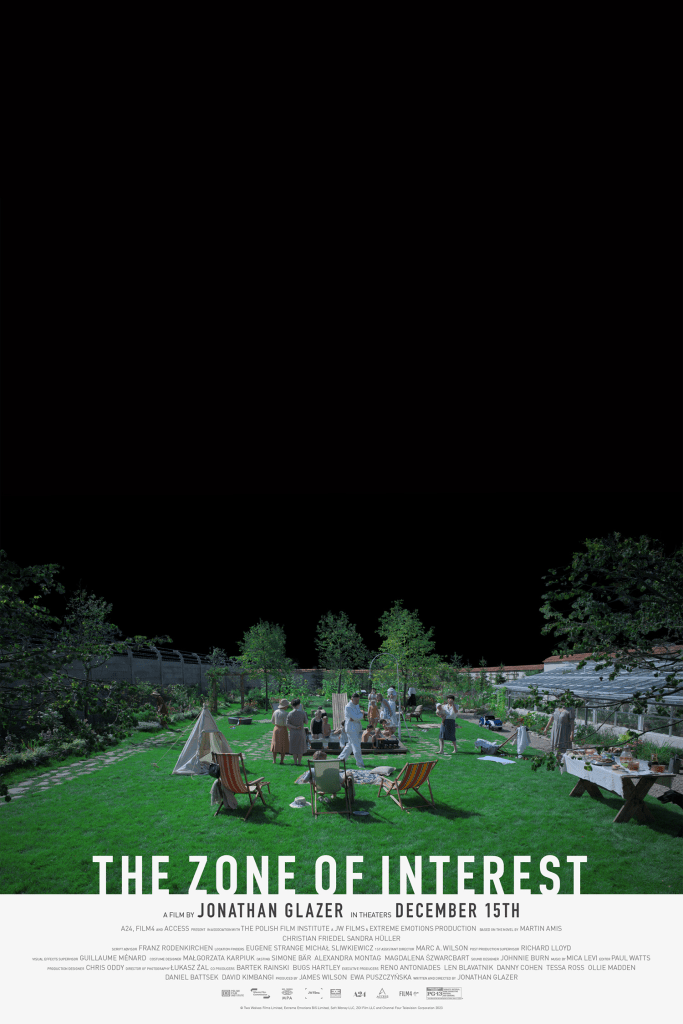
4. The Zone of Interest (Dir. Jonathan Glazer)

The second of Sandra Hüller’s Oscar worth performances this year, Jonathan Glazer’s follow up to the haunting 2014 Under the Skin is no less shaking. Taking place in an estate sharing a wall with Auschwitz, The Zone of Interest manages to capture the horrors of the Holocaust without showing a single frame of the violence inflicted upon its victims. Instead, everything is conveyed through sound design and the acting of the guilty family. The sound design is in particularly remarkable, and while I don’t think it is the frontrunner, I will be very upset if it’s snubbed on Oscar nomination morning. While the sound design may be the most apparent standout of the film, the entire thing is meticulously put together in a way to leave the viewer in devastated silence.

3. The Blue Caftan (Dir. Maryam Touzani)

What at its heart is a love triangle film between a married couple and the worker they hire to work at their apparel shop, The Blue Caftan is an exceptionally warm watch that can’t help but fill the viewer with love. While Youssef (Ayoub Missioui) would be seen as in interloping home wrecker in most films, here he and his relationship with Halim (Saleh Bakri) is understood by Halim’s wife Mina (Lubna Azabal) and the three of them end up in a familial relationship where each clearly cares about the rest. A complex romance, The Blue Caftan was an amazing watch that stuck with me even as a mid-SIFF watch.

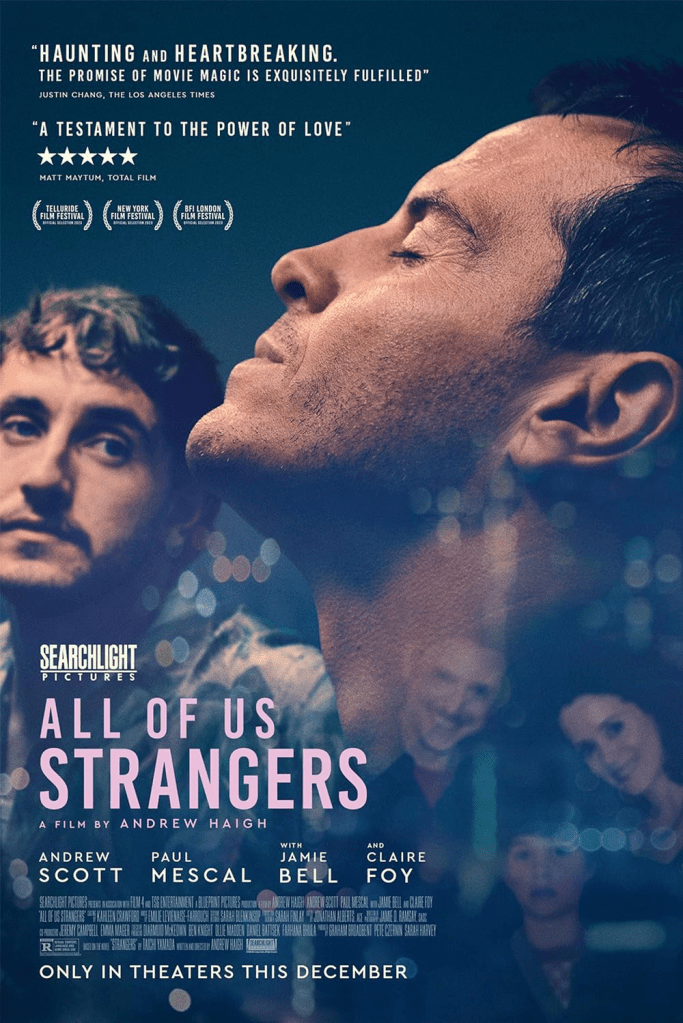
2. All of Us Strangers (Dir. Andrew Haigh)

One of the last films I saw in my 2023 film catch up, All of Us Strangers came awfully close to being my number one. The film is an exploration of a man’s struggles with his queerness due in large part to never being able to tell his parents who he was. Haigh lets Adam (Andrew Scott) process that longing by creating a world where his parents still live in their childhood home having never aged since they passed when he was 12. These scenes are intercut with his burgeoning relationship with Harry (Paul Mescal) which grows as Adam is able to process his identity with his late parents. The film hit me especially hard as a queer person who is struggling with processing her past, but even without that personal connection the film would rank high on this list.

1. Past Lives (Dir. Celine Song)

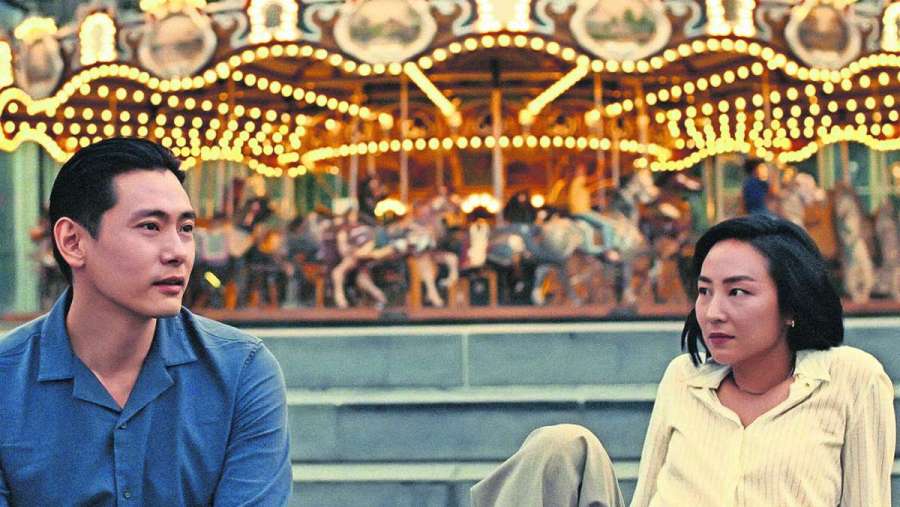
I managed to catch Celine Song’s directorial debut at the opening night gala for SIFF (The Seattle International Film Festival) and while she could not directly talk about her captivating screenplay – it was the midst of the writer’s strike – one couldn’t help but see the brilliance in her that lead to such a perfect screenplay and perfect movie as she addressed the pack room of viewers stunned in silence. Past Lives is both a romance and not at the same time. It captures the longing that exists when considering the potential loves that we never had, and how even when we are happy in our current lives those memories persist. Greta Lee is revelatory as a woman who is happy in her current life, married to a man she loves, but is taken by the remembrance of a boy she used to know. The movie feels like the inverse of Linklater’s Before films and deserves to be seen with the same reverence.

SIFF 2023

After taking 2022 off for personal reasons, I have purchased my first (non-digital only) full series pass to my local film festival, SIFF2023. Over the 2 ½ week runtime of the festival, I watched 33 features and 1 short in person along with another 11 features and 5 shorts online as part of the virtual fest. In lieu of full reviews for all films (which would take me months), I wanted to share my quick thoughts on everything that I saw.

Past Lives (Dir. Celine Song)

As beautiful as it is made out to be, Past Lives explores the space between platonic and romantic relations. It ponders what could have been and romanticizes the past while accepting that the present reality can also be beautiful. For her first time behind the camera, Celine Song possesses a preternatural instinct for creating an emotionally devastating piece of cinema. The closing seconds of the film were some of the most tear-jerking seconds of cinema in recent memory. I left the theater ugly crying all the way to the after party.

★★★★★

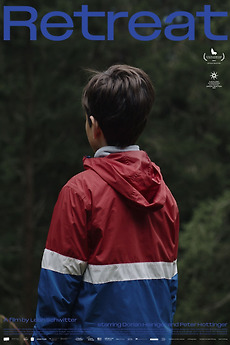
Retreat (Dir. Leon Schwitter)

An inauspicious start to the first proper day of the film festival, Retreat was beautifully shot but lacking substance. A little character motivation from the father besides, “things are bad” would have gone a long way. The ending was significantly darker than I was expecting and left a bit of a bad taste in my mouth.

★½

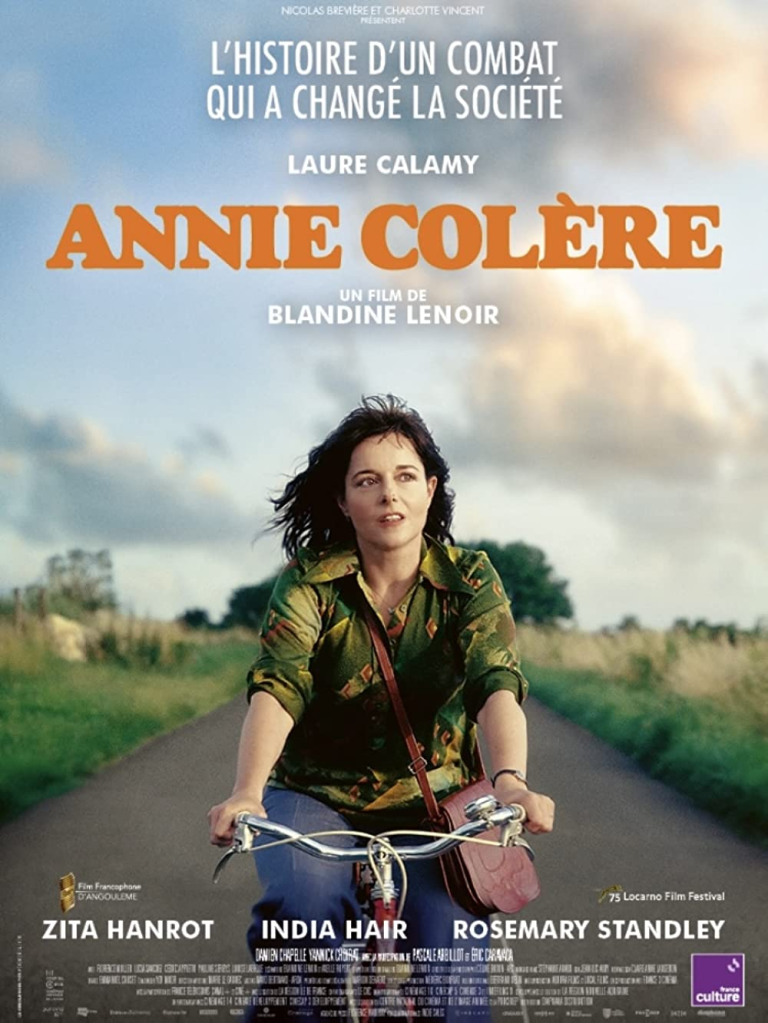
Angry Annie (Dir. Blandine Lenoir)

In the wake of the overturning of Roe, a slew of abortion related historical dramas have come out. Angry Annie is a solid outing in that undertaking with a stellar performance by Laure Calamy as the titular woman. And while it falls a little to trap of telling over showing in its later moments, it’s still a wonderful timely telling of a story that needs to be told at this point in time.

★★★

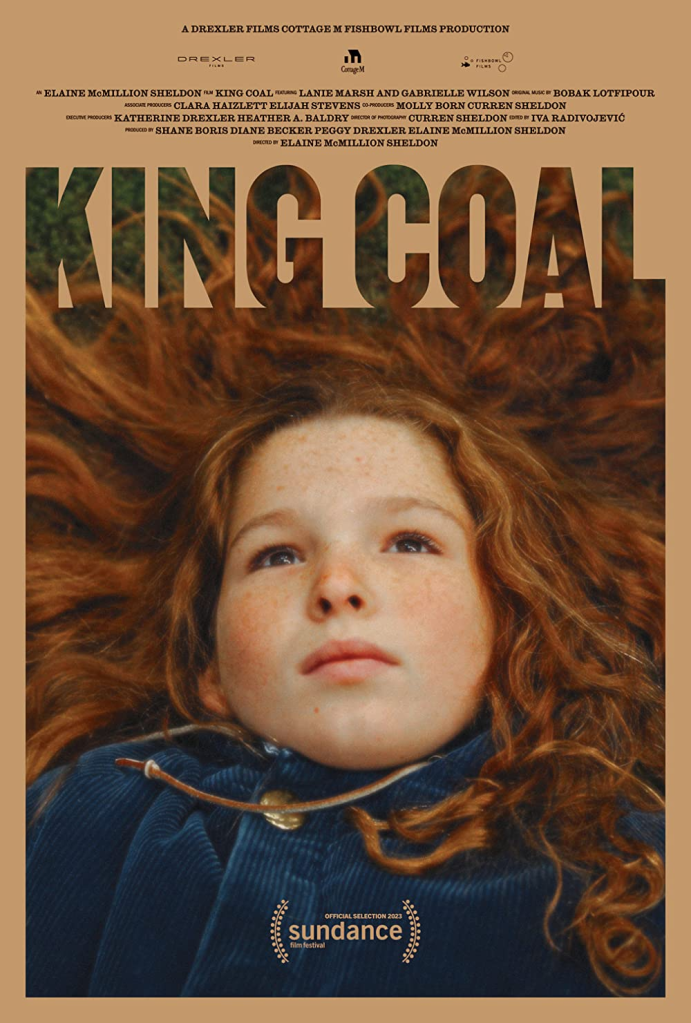
King Coal (Dir. Elaine McMillion Sheldon)

A documentary on the cultural significance of coal to the Appalachia region, and the hole that the decreased reliance on the fossil fuel has on the people who live and work there. By focusing on a pair of young girls who are seeing the world around them change as quickly as they are, King Coal stays grounded in a unique perspective.

★★★½

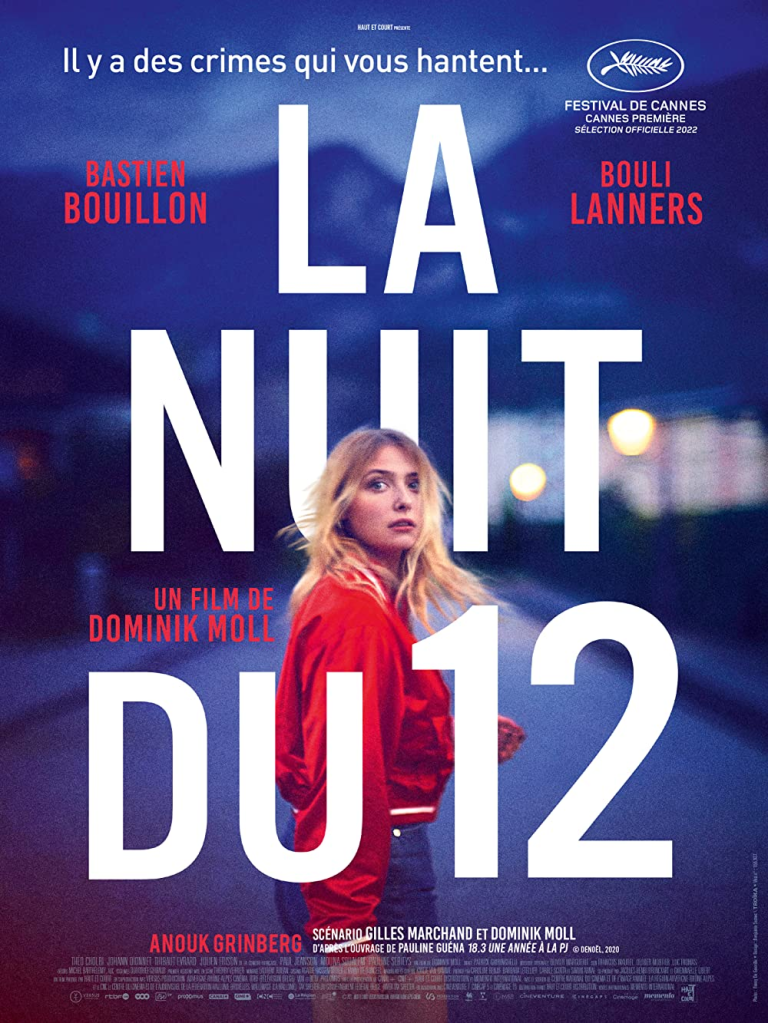
The Night of the 12th (Dir. Dominik Moll)

The multiple César winning The Night of the 12th is an intriguing police procedural about an enigma of a real-life case. The film is well acted and keeps viewers on the edge of their seat as each additional ex-boyfriend appears more guilty than the last. While the film was very good, I don’t believe it lives up to the award winning hype.

★★★

The Eight Mountains (Dir. Felix van Groeningen)

The beautiful Cannes winner tells the story of two male friends who’s destiney is tied together in the mountains around where they met as children. The film had the best cinematography of the festival, but its two-and-a-half-hour runtime was longer than necessary and the film declined to end at many natural concluding spots.

★★½

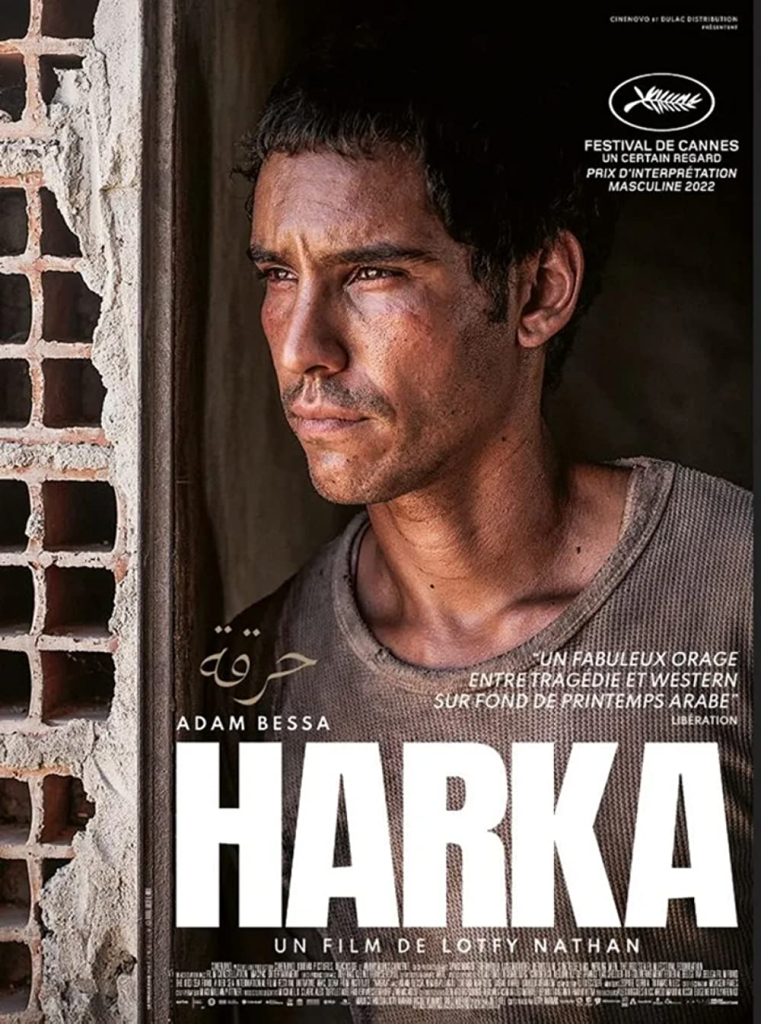
Harka (Dir. Lotfy Nathan)

Harka was a very dark portrayal of poverty in Tunisia. Really strong design decisions stood out in this dirty drama. The filthiness of Ali’s (Adam Bessa) single shirt and construction zone turned one room home created the depressing tone for the film. The ending was exactly what it had to be, but the added surrealism to the moment sells the film.

★★★

Falcon Lake (Dir. Charlotte Le Bon)

Falcon Lake presents its traditional coming of age story as if it were a horror film. Editing and score decisions amplify this decision, and the horror aesthetic works well for the adolescent story as that time can feel like a horror movie at the time. The young Joseph Engel and Sara Montpetit put in solid performances and sell the mysteries of adolescence.

★★★★

Year of the Fox (Dir. Megan Griffiths)

A rough first outing with a really stilted screenplay and dialogue left this coming-of-age film feeling hollow. The voice over from Ivy (Sarah Jeffery) was exceptionally detrimental to the film. I unfortunately have very little positive to say about the film, but I know others enjoyed it so take that as you will.

Filip (Dir. Michal Kwiecinski)

With a stellar lead performance by Erk Kulm as the titular Filip at the center of it, Filip was a great WWII drama that focused on the life of a Jewish Pole living undercover in a Nazi occupied hotel. The film takes a unique look at WWI by focusing on the life of people livening under occupation but not in the camps.

★★★

And the King Said, What a Fantastic Machine (Dir. Axel Danielson)

A documentary about the power of cameras and media. And the King Said, What a Fantastic Machine is filled with intriguing imagery, though the message of the film gets a little blurred. The film becomes less about the power of the camera and more about the power of televised fascism.

★★½

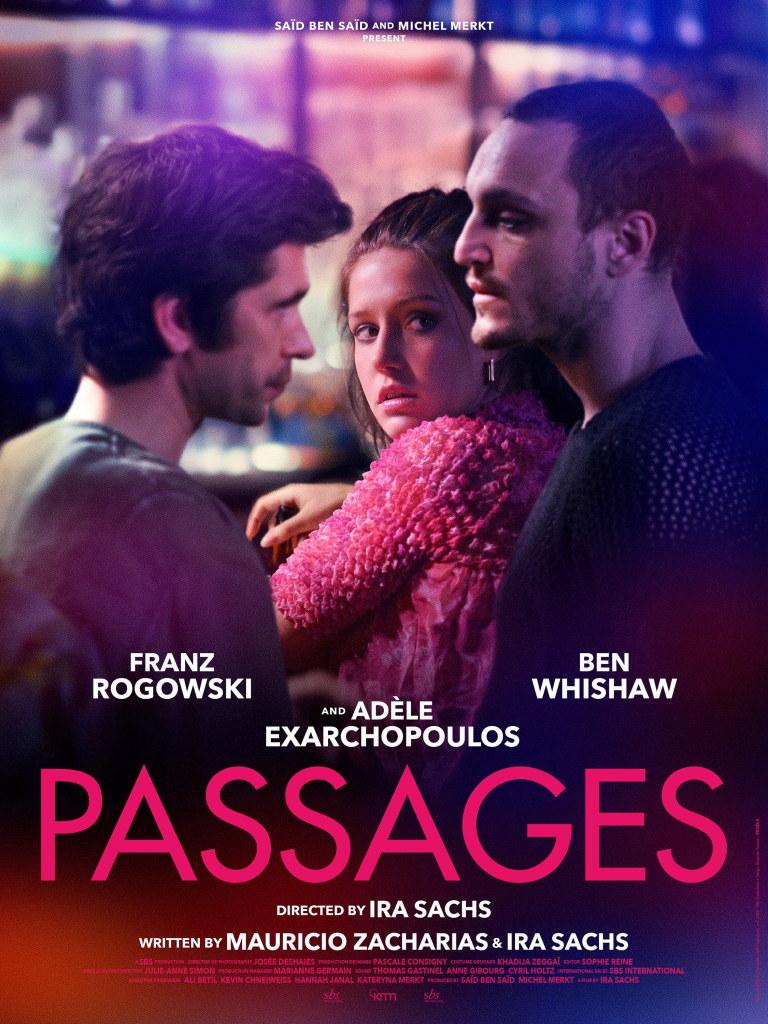
Passages (Dir. Ira Sachs)

Ira Sachs continues to be an enigma to me. I have wanted to like all his films, and I have never disliked any of them, but I have also yet to feel a real connection to one. Passages was no different, as the sex filled, love triangle drama was intriguing if not engrossing. The complexities of being a bisexual man exploring sex with women for the first time in years makes for a solid story; it just didn’t resonate with me.

★★½

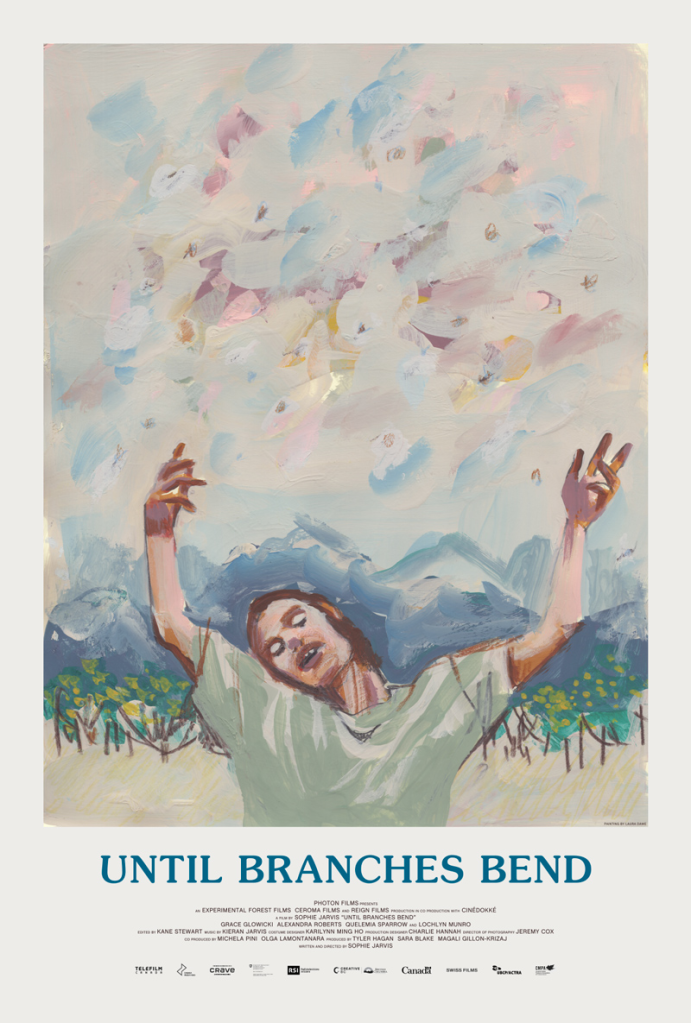
Until Branches Bend (Dir. Sophie Jarvis)

This Erin Brockovich story lives entirely on the lead performance of Grace Glowicki as Robin, a woman who finds a beetle inside a peach and creates an uproar over it. Glowicki is wonderful in the film, and she manages to encapsulate the uncertainty of the reality she lives in when the tow around her starts to gaslight her on what she saw.

★★★

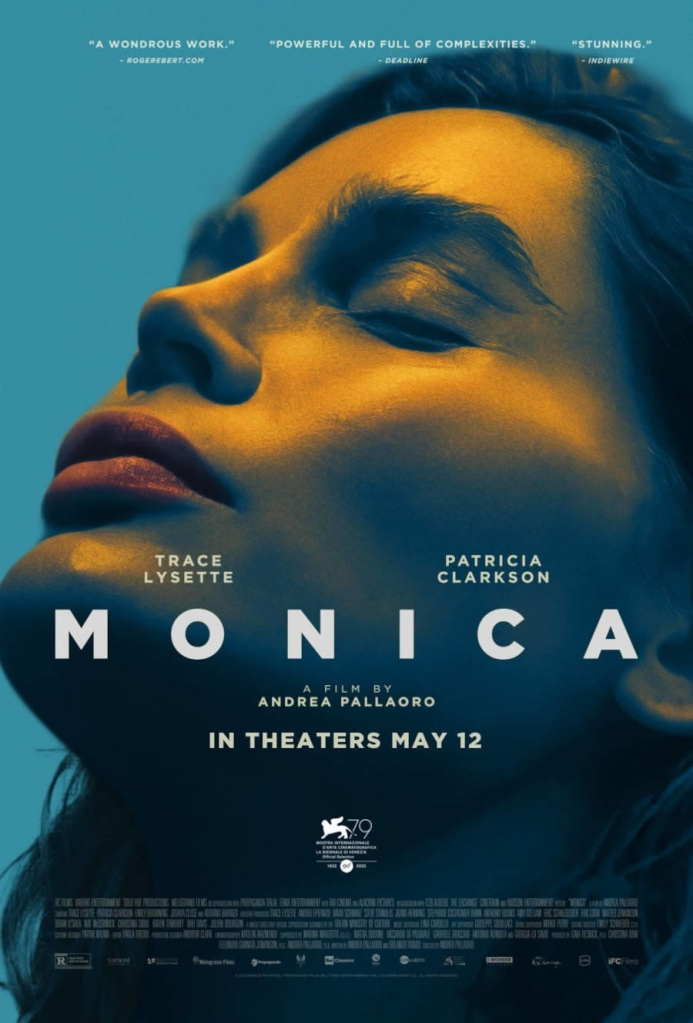
Monica (Dir. Andrea Pallaoro)

The first of three trans related films I went out of my way to see explores a trans woman’s connection to her mother even years after abandonment. By staying hidden throughout her visit Monica (Trace Lysette) is allowed a small amount of closure, but the distance never closes in a way that hits close to home.

★★★½

A House in Jerusalem (Dir. Muayad Alayan)

A ghost story that isn’t scary and a pro-Palestine narrative that is completely buried, A House in Jerusalem misses the mark on most axes.

★½

Matria (Dir. Álvaro Gago Díaz)

Matria reminded me of a Dardenne Brothers film. A story of a working-class woman forced to endure extreme circumstances but still finds a way to preserver. The moments of joy she allows herself while the world around her crashes is the highlight of the film.

★★★½

Motherland (Dir. Hanna Badziaka and Alexander Mihalkovich)

Two very different documentaries combined into one messy one, Motherland firstly tries to tell the story of bullying in the Belarusian army, but through lack of access to any of the violent acts resorts to additionally focusing on a group of boys partying after being enlisted but before entering the army. The two stories don’t mesh and make for a confusing 90 minutes.

★★

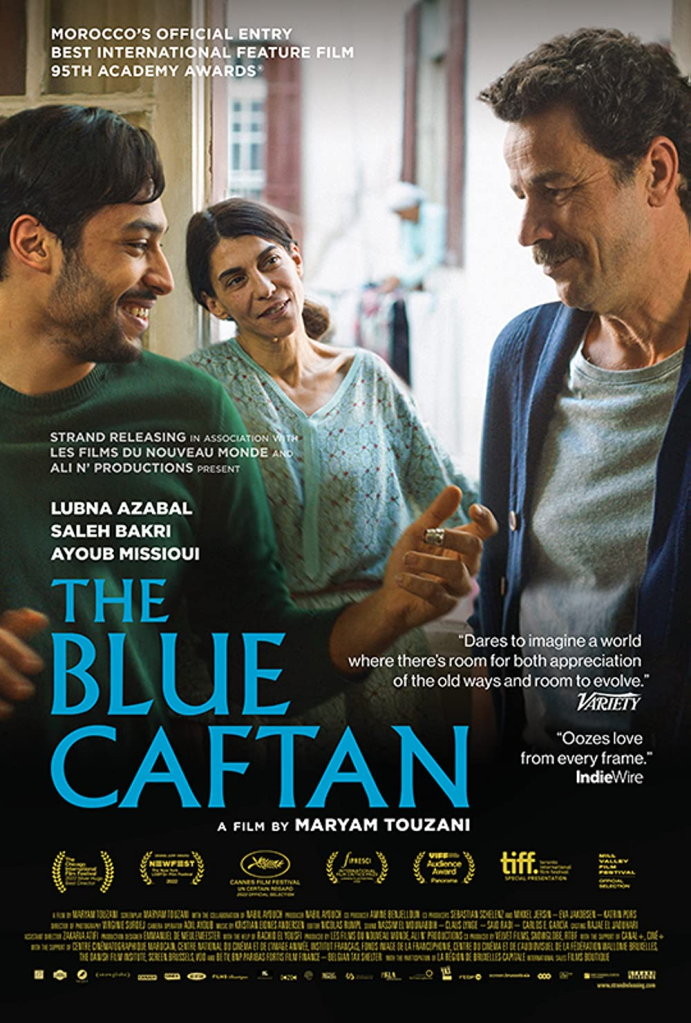
The Blue Caftan (Dir. Maryam Touzani)

Breathtakingly beautiful, The Blue Caftan lives in closeups in soft focus of the three lead actors Lubna Azabal, Saleh Bakri, and Ayoub Missioui along with longing shots of the gorgeous fabrics and threads used to make the handmade caftans. What is obsessively a love triangle story is filled with love and adoration between all three characters. The Blue Caftan is destined to go down as one of the year’s finest films.

★★★★½

Hole in the Head (Dir. Dean Kavanagh)

My one walk out of the festival, Hole in the Head attempted to be Dean Kavanagh’s version of My Winnipeg, but without the style and skill of a Guy Maddin, the film rends itself unwatchable.

½

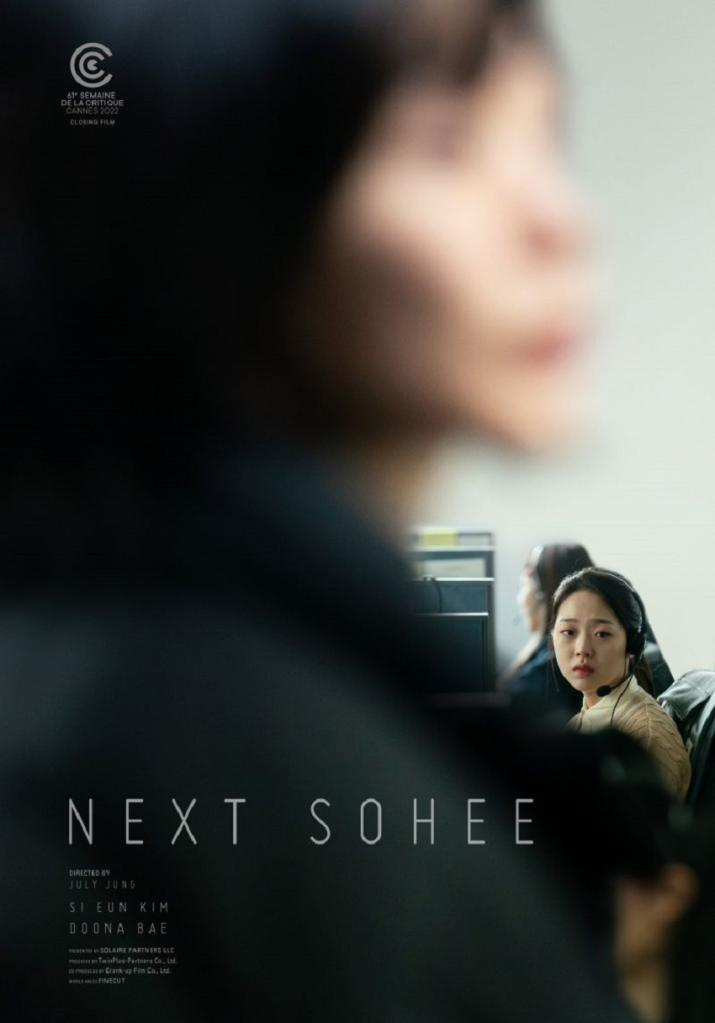
Next Sohee (Dir. July Jung)

The story of a young, South Korean woman who kills herself under the pressure of an externship at a call center and the woman detective who follows her case, Next Sohee plays out as two separate stories stapled together. While each are excellent on their own, the combining of the two was a little inelegant.

★★★

Confessions of a Good Samaritan (Dir. Penny Lane)

Penny Lane’s documentaries are always an enjoyable, highly stylized bit of fun and Confessions is no different. Her most personal film to date perfectly captures her neurosis as she goes through the process of donating a kidney to a stranger. Funny and well edited Lane continues to be a director to seek out.

★★★½

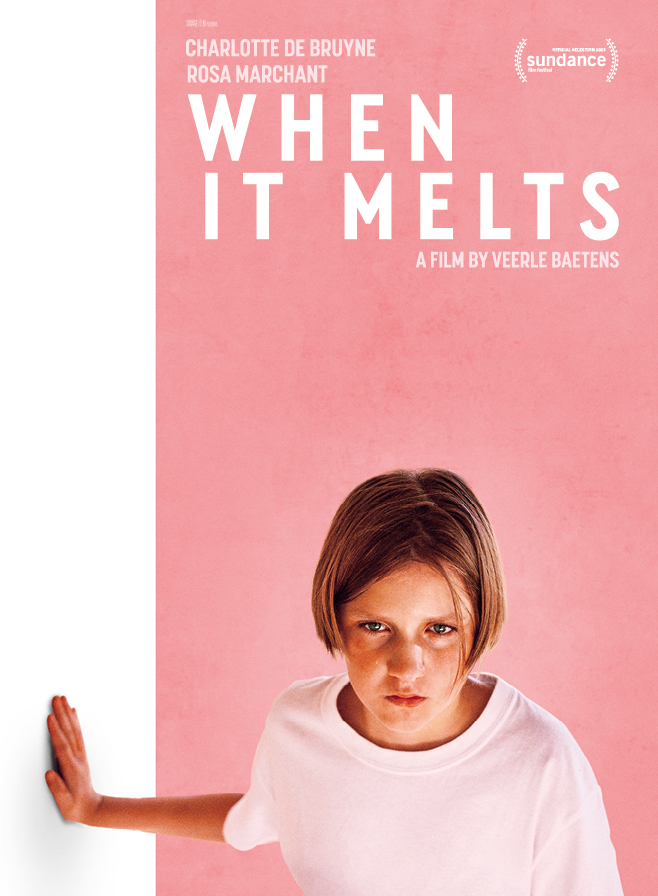
When it Melts (Dir. Veerle Baetens)

The darkest film of the festival, When it Melts explores the long-lasting effects of childhood trauma. By cutting back and forth between Eva as an adult (Charlotte De Bruyne) and a child (Rosa Marchant) Veerle Baetens tells a twisted story that can only end in one way and that way is devastating.

★★★

Other People’s Children (Dir. Rebecca Zlotowski)

A loving tale of a woman who becomes attached to her boyfriend’s young daughter; Other People’s Children is heartwarming. Virginie Efirais excellent asRachel the women in question, and her connection not just to the young Leila, but all the young people in her life make her the ideal mother just without a child of her own. My only complaint is that the film could have used another round of editing, the epilogue in particular either needed to be cut or more flushed out beforehand.

★★★½

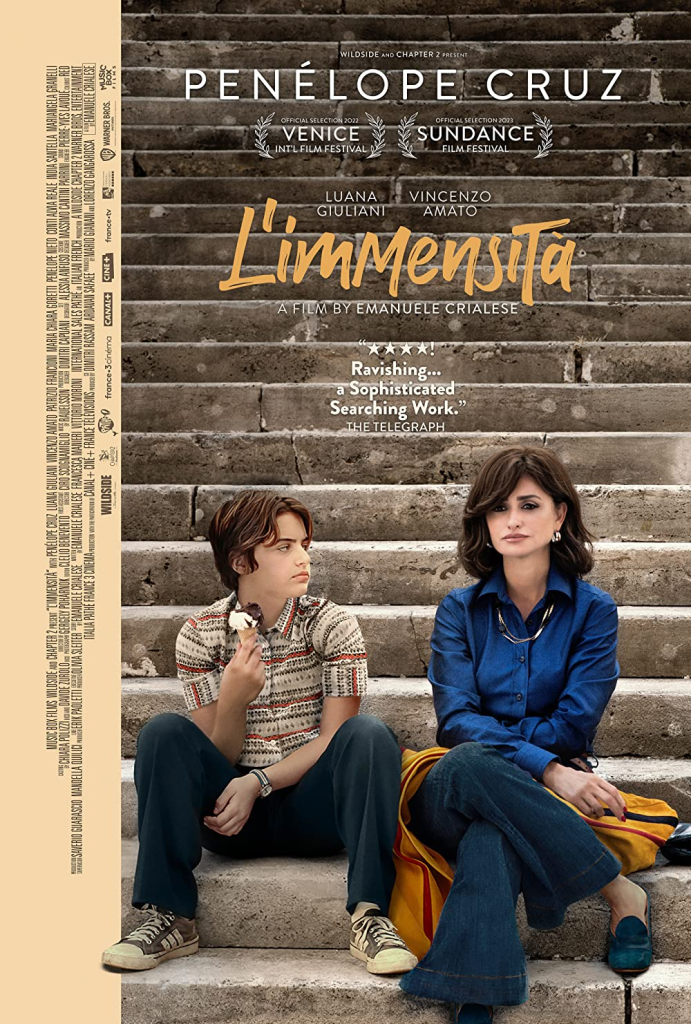
L’ immensità (Dir. Emanuele Crialese)

Penélope Cruz as the mother of a trans boy, what’s not to love? Unfortunately quite a lot as L’ immensità just didn’t quite hit. With three out of nowhere musical numbers, and an occasional glimpse into fantasy, this film didn’t know what it wanted to be and failed for that.

★½

Plan 75 (Dir. Chie Hayakawa)

Set in near future Japan, Plan 75 proposes a world where the elderly can choose to be euthanized to help remedy a society that has aged. Given that premise, the film explores it from three viewpoints, Michi (Chieko Baishô) a woman considering signing up for the program, Hiromu (Hayato Isomura) a man signing people up for the program, and Maria (Stefanie Arianne) a woman working at a facility. The film plays with the moral implications of the program in a way that doesn’t judge but makes you think.

★★★★

20,000 Species of Bees (Dir. Estibaliz Urresola Solaguren)

It may have taken me a few days to realize it, but 20,000 Species of Bees was my favorite film of the festival. Whether or not it is the best film of the festival may be up for debate, but nothing hit me personally. Estibaliz Urresola Solaguren manages to perfectly capture the mix of confusion and gender bliss that a young trans person experiences while figuring out who they are. Sofía Otero plays the 8-year-old Lucía beautifully. I’m starting to tear up just thinking about the film I love it so much.

★★★★½

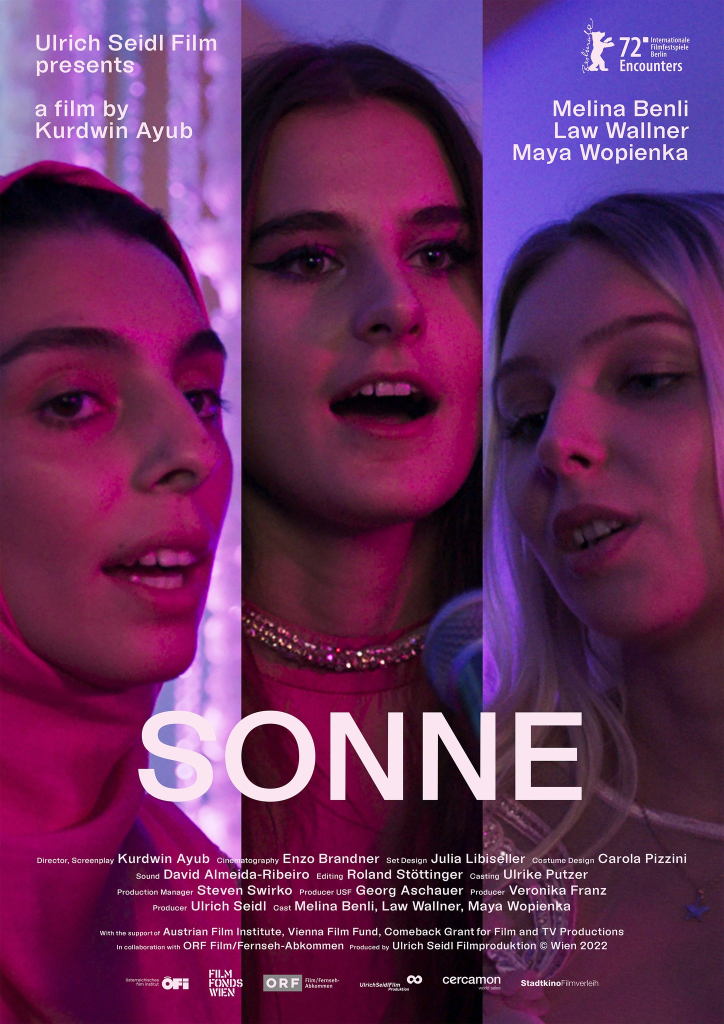
Sonne (Dir. Kurdwin Ayub)

This film baffled me. It centered around an Iraqi teen Yesmin (Melina Benli) living in Austira. She and her friends do teen like things include making a viral video of them singing Losing My Religion by R.E.M.. Weirdly though the film introduces plot points throughout the film without ever following up on them. Near the end I finally started getting on board with the all vibes no plot follow through but it ended before I could entirely get it.

★★

Ernest and Celestine: A Trip to Gibberitia (Dir. Julien Chheng and Jean-Christophe Roger)

An absolute delight, the sequel to 2012’s Ernest and Celestine has just as much if not more heart. The bear and mouse pair get into more adventures in Ernest’s hometown of Gibberitia where music has been banned, and obviously that means the score and diegetic music are the highlights of the film.

★★★★

Let the River Flow (Dir. Ole Giæver)

Let the River flow is the tale of Ester (Ella Marie Hætta Isaksen), a Norwegian passing Sámi woman who embraces her indigenous identity to join a resistance against a dam that threatens Sámi land. A moving tale against colonialism and about finding power in who you are.

★★★½

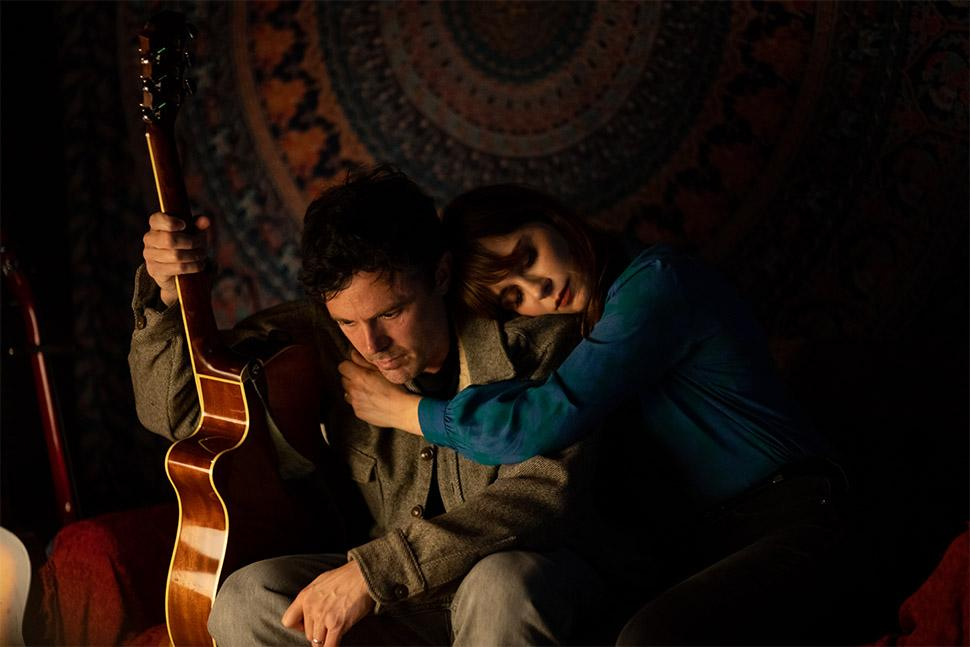
Dreamin’ Wild (Dir. Bill Pohlad)

Bill Pohlad, the Love & Mercy director returns for another music biopic, this time about the Emerson Brothers. Headlined by Casey Affleck who is as sure a bet for a great performance as there is in Hollywood today, the film captures the unbelievable story of the two brothers as they learn their 30-year-old album has become one of the hottest tickets in the music industry.

★★★½

Blue Jean (Dir. Georgia Oakley)

Lesbianism in the era of Margaret Thatcher, Blue Jean tells the story of a gay gym teacher who while in a loving relationship finds the need to keep things hidden to keep her job. When she sees one of her students at the gay bar with her, she needs to balance being a good gay role model with protecting herself. This dichotomy is perfectly realized in the excellent film by Georgia Oakley.

★★★½

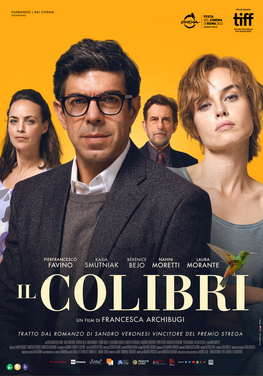
The Hummingbird (Dir. Francesca Archibugi)

The first half of The Hummingbird showed great promise from director Francesca Archibugi. The editing between timelines was seamless and orchestrated wonderfully to create a coherent story despite taking place in half a dozen eras. Unfortunately, the second half introduced more plotlines that were not as interesting, and the tight editing fell away.

★★½

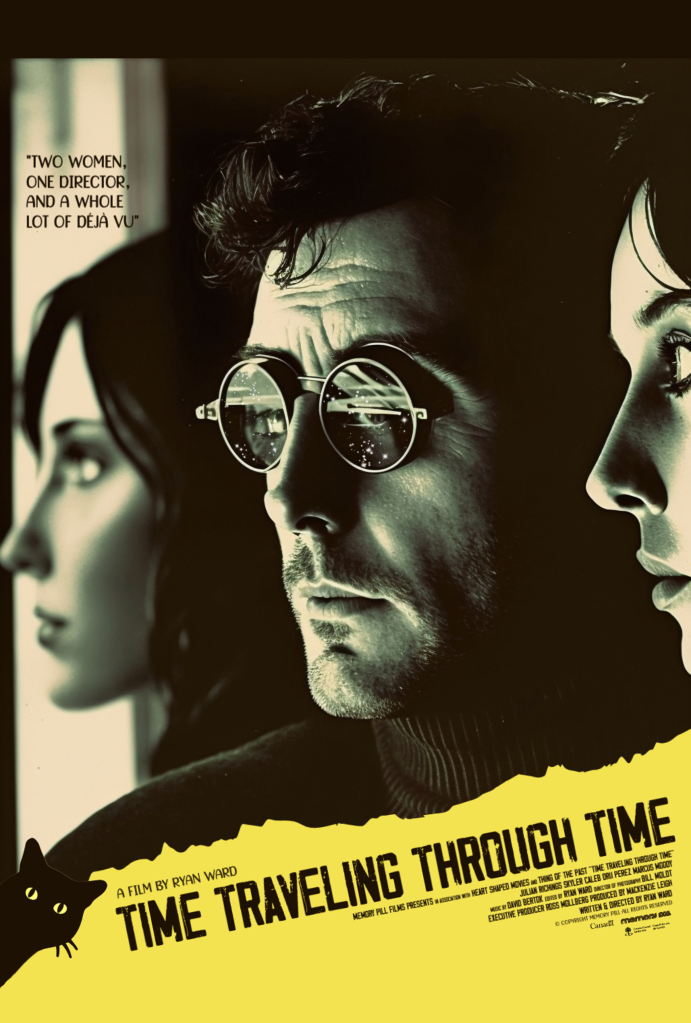
Time Traveling Through Time (Dir. Ryan Ward)

A comedic, short homage to Chris Marker’s La Jetée is more interesting in premise than in practice.

★½

LOLA (Dir. Andrew Legge)

My final in person film of the festival was a packed house to see this black and white science fiction. The women lead super geniuses who invent a form of time travel and use it to change the outcome of WWII was unique and a great while not the absolute best film of the festival was a fun way to close it out.

★★★

26.2 to Life (Dir. Christine Yoo)

Rehabilitiation stories are something I’m always open to receiving, and 26.2 to Life does a great job of humanizing the inmates at San Quentin State Prison. Christine Yoo uses the running program as a gateway to investigate the lives of the men who use it as an escape and a way to stay connected to life.

★★½

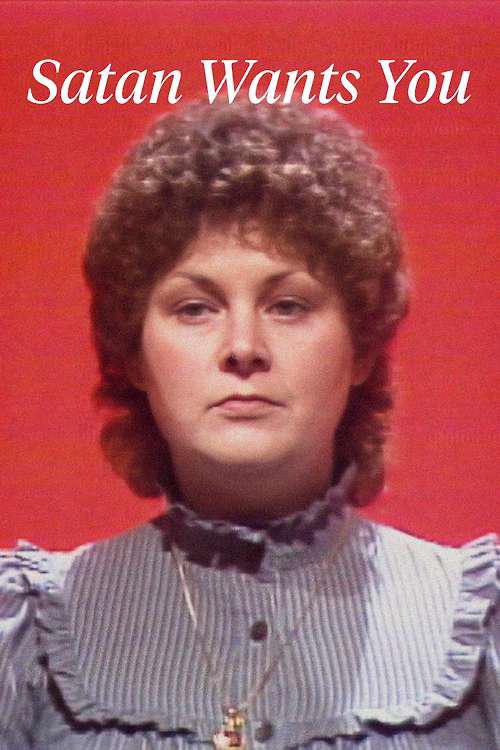
Satan Wants You (Dir. Steve J. Adams)

An intriguing documentary on the satanic panic scare and its source – The 1980 memoir Michelle Remembers, Satan Wants You as a rather cut and dry talking head documentary, but the subject matter is what draws you in.

★★½

Inglorious Liaisons (Dir. Chloé Alliez)

A unique depiction of teenagers (all portrayed by painted electric plugs and on/off switches). The short portrays what it’s like to be a closeted lesbian when everyone around you pushes you to get together with the cute boy.

★★★

Now I’m in the Kitchen (Dir. Yana Pan)

A very short sketchy animation about a woman remembering the impact her mother had on her through the catalyst of the kitchen.

★★★

The Voice in the Hollow (Dir. Miguel Ortega)

Very interesting art style, but a pretty bland story.

★½

Europe by Bidon (Dir. Samuel Albaric and Thomas Trichet)

A rather boring animated short of a man trying to immigrate to Europe.

★½

Pipes (Dir. Kilian Feusi, Jessica Meier, and Sujanth Ravichandran)

A very short, animated film of a bear fixing pipes in an underground gay club. Funny and sex positive.

★★½

Egghead & Twinkie (Dir. Sarah Kambe Holland)

Zoomer Scott Pilgrim but make it gay. I enjoyed Egghead & Twinkie substantially more than I thought I would. Not all the sequences worked as well as others, but it was still a fun coming of age story with a lot of style and a lot of heart. A great promise at what Zoomer cinema will look like.

★★★

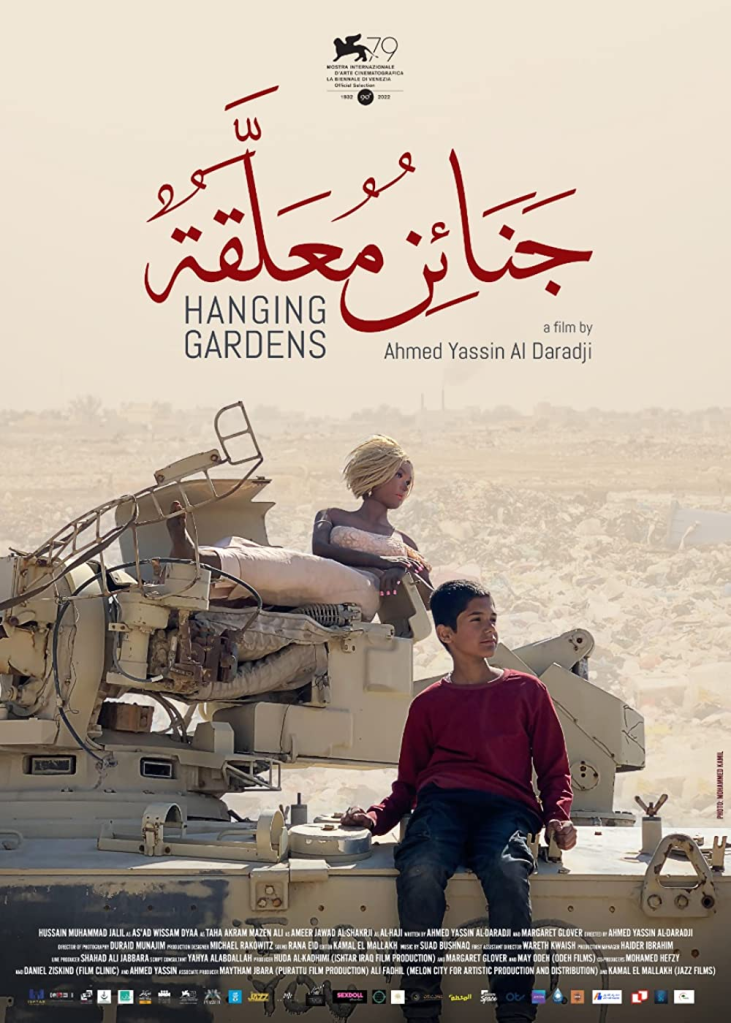
Hanging Gardens (Dir. Ahmed Yassin Aldaradji)

What if Lars and the Real Girl, were about a very young Iraqi boy. That’s essentially the premise of Hanging Gardens where the young As’ad finds a sex doll and sells the use of it for money while slowly becoming over protective of his findings.

★★★

Bad Press (Dir. Rebecca Landsberry-Baker and Joe Peeler)

An eye-opening documentary about something I knew nothing about (the lack of freedom of press in most Native American territories). The film follows a story of one papers struggle after their nation repealed the freedom of press act.

★★★

Adolfo ( Dir. Sofía Auza)

Everyone wants to make the next Before Sunrise, and few people succeed. Adolfo is an overly quirky version of the trope does not end up as one of the better ones.

★½

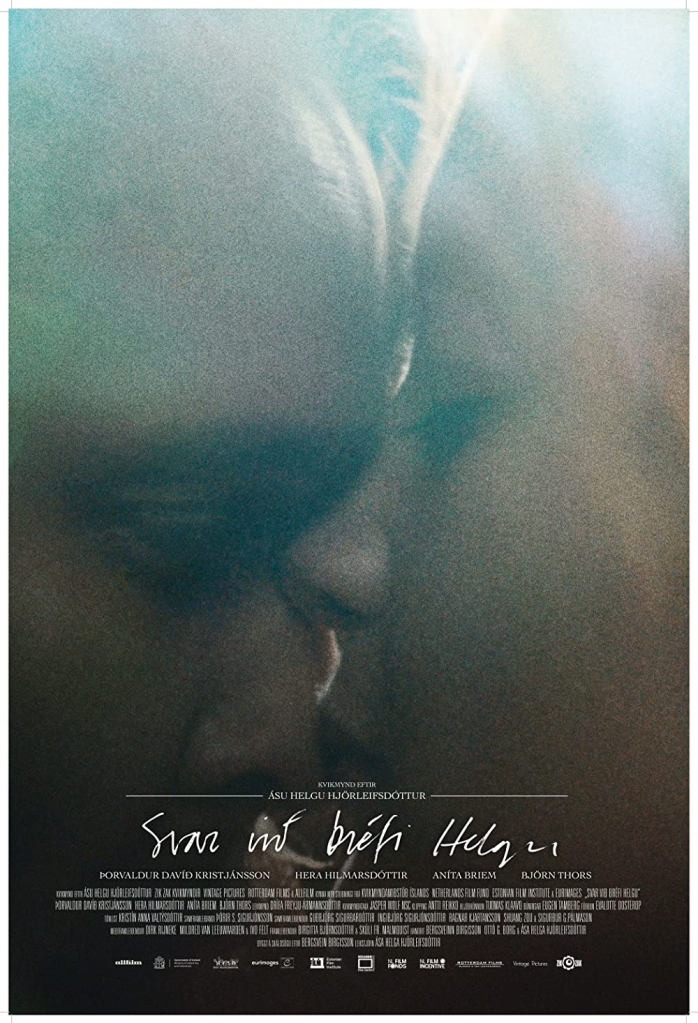
A Letter from Helga (Dir. Ása Helga Hjörleifsdóttir)

A Letter from Helga is a very slow film, and while that’s not a death knell for me – many of my favorite films would qualify as slow cinema – If you can’t create the right mood the slowness becomes boring. Unfortunately, Ása Helga Hjörleifsdóttir’s latest outing falls into the boring camp.

★★½

Le Coyote (Dir. Katherine Jerkovic)

A man agrees to take on the son of his heroin addicted, estranged daughter while she goes to rehab in this quiet, understated film. Very slow and very quiet to the point of it being distracting watching at home as pat of SIFF’s virtual festival.

★★

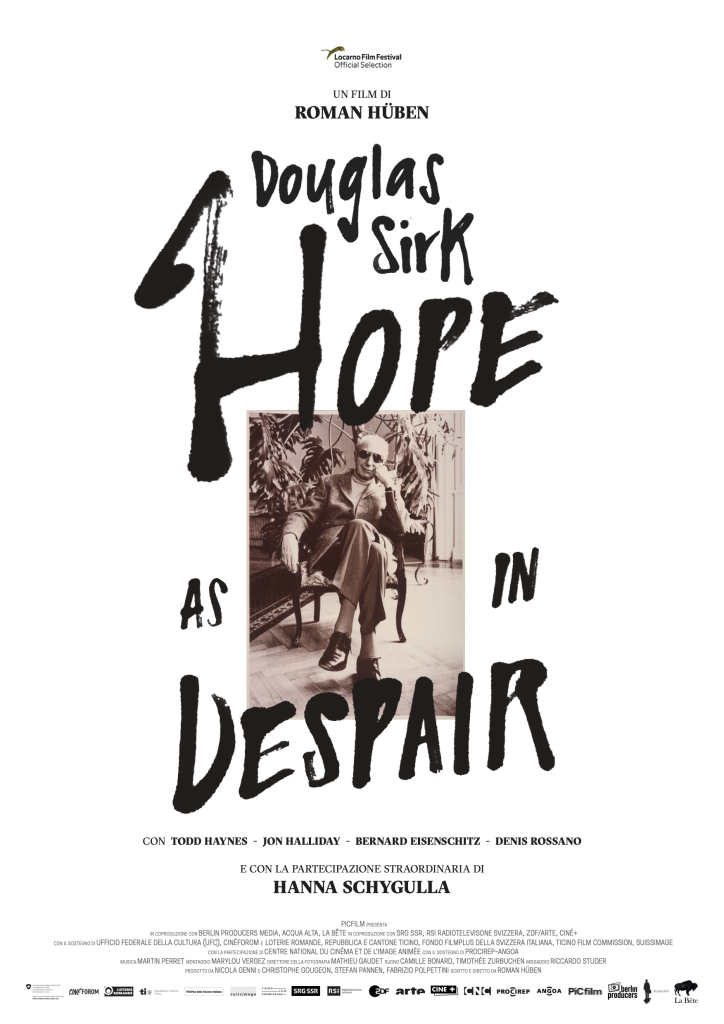
Douglas Sirk – Hope as in Despair (Dir. Roman Huben)

An extremely dry documentary about the renowned melodrama filmmaker, Douglas Sirk. I love Sirk and am interested in learning more about him, but even with that I struggled to pay attention to the film it was so barren of style.

★½

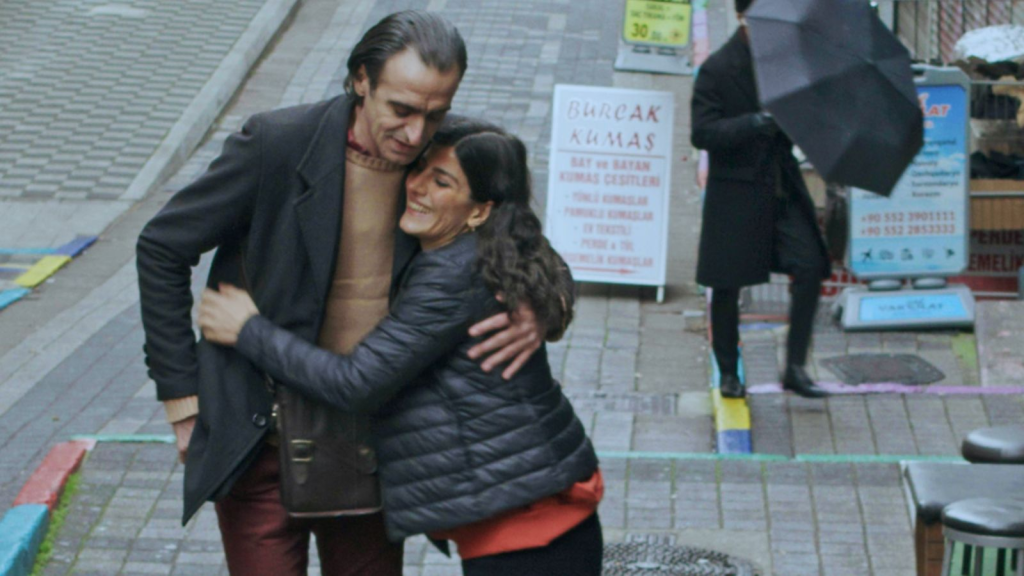
Snow and the Bear (Dir. Selcen Ergun)

In a part of Turkey where winter never seems to end a nurse Aslı (Merve Dizdar) arrives in a small town where the local doctor is unable to reach and begins her compulsory service. The film is a perfect watch on a scorching hot summer day as director Selcen Ergun captures the cold in a way that will chill anyone to the bone.

★★★

20 Days in Mariupol (Dir. Mstyslav Chernov)

Horrific and gruesome, 20 Days in Mariupol uses its unprecedented access to war torn Ukraine to create a moving documentary. That said, outside of proximity, the documentary doesn’t bring anything new to the medium. Still a miraculous story to tell.

★★★
Oscar Predictions and Picks 2023

I love the Oscars. For the past six years, I have made it my goal to watch every single film nominated for an Oscar, and while it took me until today to do so, I’ve once again made that goal. This year I’m not posting my non-nominated picks, but just assume I’d have Aftersun listed for all eligible categories. Now, in time for Sunday’s ceremony, here are my predictions and my personal picks for this year’s event.

Short Film, Live Action

My Prediction: Le Pupille
My Pick: The Red Suitcase

It’s hard to predict against a film that has major representation in this category, and Le Pupille’s Disney backing as well as Alice Rohrwacher behind the helm should see it an easy win. If I had a vote though, I’d be going for The Red Suitcase, one of the best tension building exercises of the year.

Short Film, Animated

My Prediction: The Boy, The Mole, The Fox, and The Horse
My Pick: My Year of Dicks

Similar to the Live action category, it’s hard to predict against Idris Elba’s voice acting in The Boy, The Mole, The Fox, and The Horse even though I found it overly saccharine, but My Year of Dicks was a really fun watch and gets my nod.

Short Film, Documentary

My Prediction: Stranger at the Gate
My Pick: Haulout

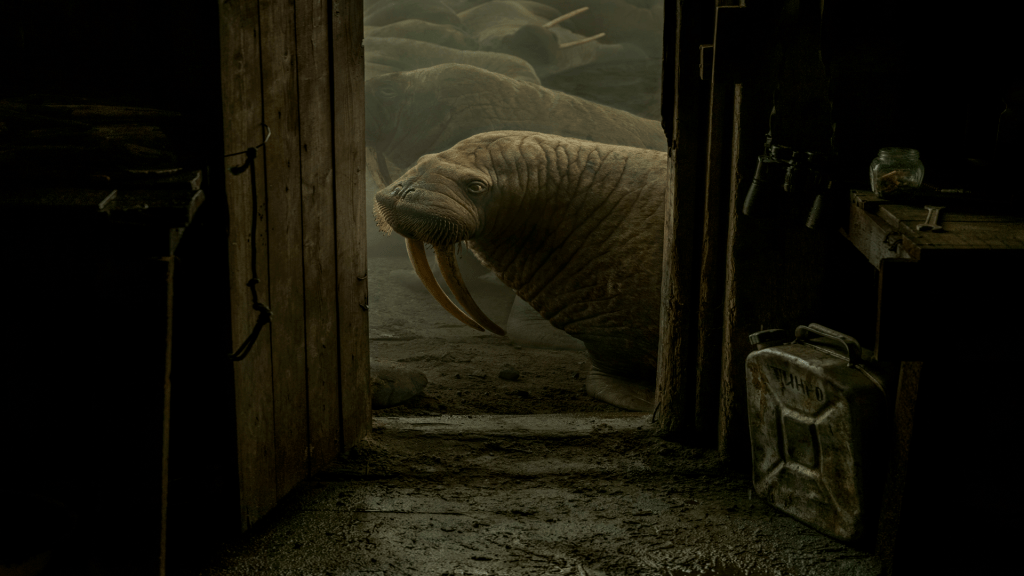
Much like the other short categories, I’m assuming the award goes to the film with the biggest name (Stranger at the Gate is executive produced by Malala). My personal favorite however is Haulout, an interesting take on the climate documentary.

Visual Effects

My Prediction: Avatar: The Way of Water
My Pick: Avatar: The Way of Water

I genuinely can’t imagine leaving the theater after seeing Avatar: The Way of Water and not asserting that it has the best visual effects of the year.

Costume

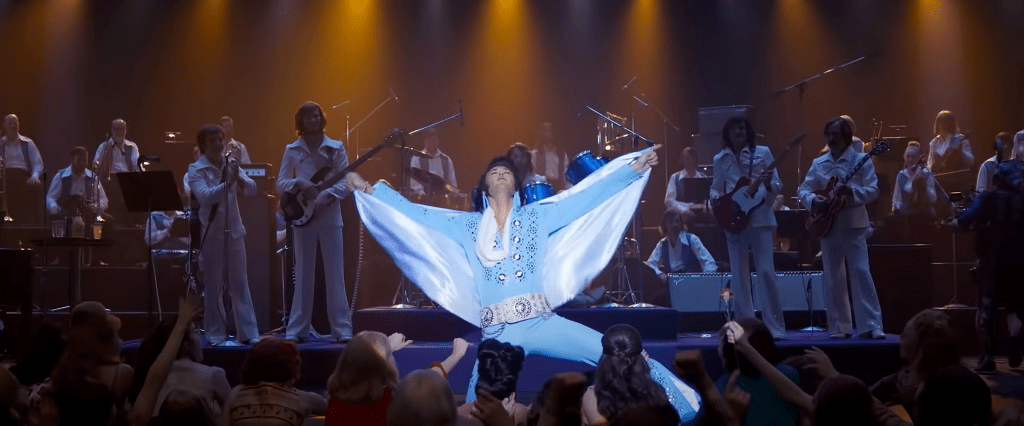
My Prediction: Elvis
My Pick: Babylon

While I loved the classic Hollywood cosutmes from the Babylon, betting against Catherine Martin (Elvis) is never a good bet.

Makeup and Hairstyling

My Prediction: Elvis
My Pick: Elvis

The best actor race plays out in makeup and hairstyling as well as both actors find themselves covered in prosthetics during their respective movies. I’m leaning towards an Elvis win as that’s the more beloved film, and the aging of Austin Butler will likely garnish more votes.

Production Design

My Prediction: Babylon
My Pick: Babylon

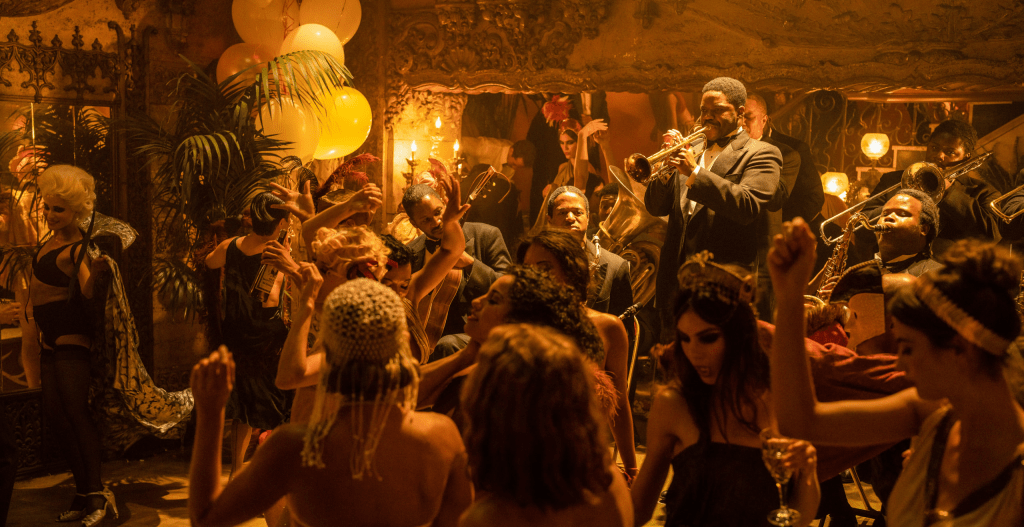
While Babylon may have been met with lukewarm responses, it seems to be a favorite for the production design award with its recreation of classic Hollywood.

Sound

My Prediction: Top Gun: Maverick
My Pick: All Quiet on the Western Front

This race may end up being closer than most people think, but I do believe Top Gun: Maverick will pull out this (and maybe only this) Oscar, even though All Quiet on the Western Front is my favorite and is nipping at its heels.

Original Song

My Prediction: Naatu Naatu (RRR)
My Pick: Naatu Naatu (RRR)

I normally hate picking this category, as I feel that I have a good eye for what makes a film good, but this category is about the quality of the song. That said, this year is an obvious pick as RRR will win the award for it wonderful Naatu Naatu which it’s performance should be a highlight of the evening.

Original Score

My Prediction: Babylon
My Pick: Babylon

I know it’s been losing ground and hasn’t won all the precursors, but I don’t want to live in a world where Justen Hurwitz’s score doesn’t win.

Editing

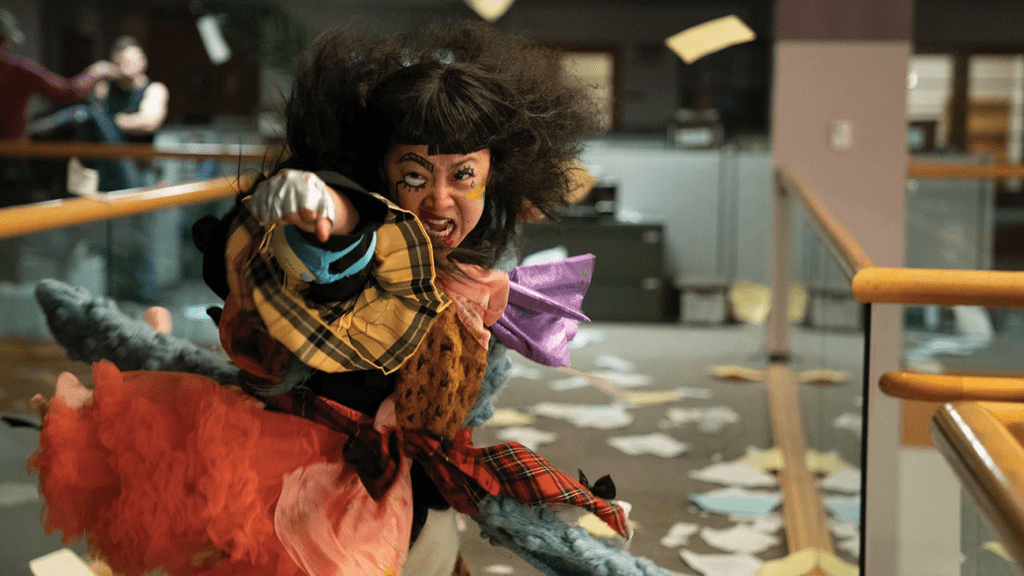
My Prediction: Everything Everywhere All At Once
My Pick: Everything Everywhere All At Once

As we get closer and closer to Oscar night, it really appears that Everything Everywhere All At Once will walk away from the night with quite the haul of gold statues and editing will be the hallmark that it’s happening.

Cinematography

My Prediction: All Quiet on the Western Front
My Pick: All Quiet on the Western Front

All Quiet on the Western Front is an extremely beautiful film and should run away with the Oscar over Elvis.

Documentary Feature

My Prediction: Navalny
My Pick: All the Beauty and the Bloodshed

Navalny hits well in the current cultural zeitgeist as the war in Ukraine passes the 1-year mark and the discontent with Russia remains at an all time high. I personally loved Laura Poitras’s All the Beauty and the Bloodshed, but it’s odds of winning are very low given the narrative.

Animated Feature

My Prediction: Guillermo del Toro’s Pinocchio
My Pick: Turning Red

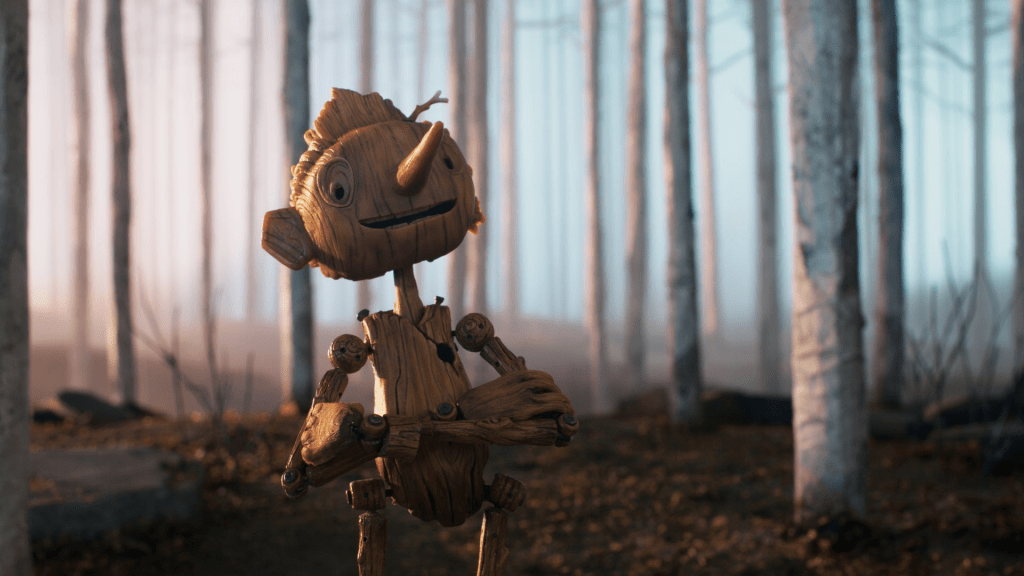
The year that the Disney/ Pixar monopoly on this category will finally come to an end, is the only year that I wish it would win. Guillermo del Toro’s Pinocchio is a beautiful dark fairytale that is a deserving winner, but I loved the unabashed period allegory that was Pixar’s Turning Red.

International Film

My Prediction: All Quiet on the Western Front
My Pick: The Quiet Girl

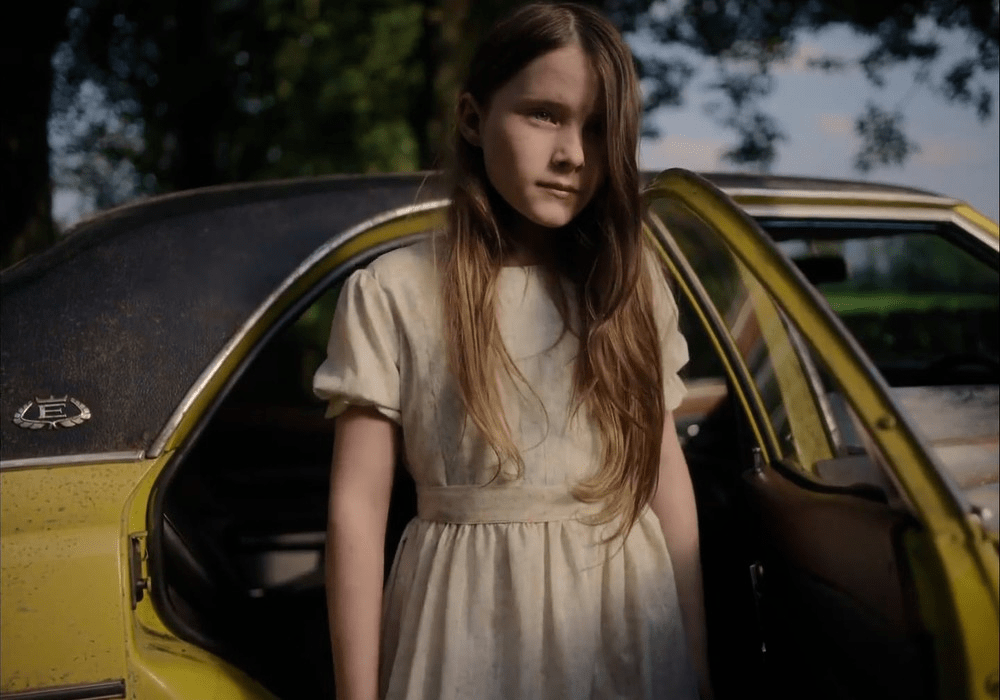
This category is getting to be one of the easiest to predict. The picture that receives a bunch of nominations outside of this category will be the one to win, and this year that goes to All Quiet on the Western Front. And while I did very much enjoy that film. Ireland’s pastoral The Quiet Girl moved me in ways that the war film was incapable of.

Adapted Screenplay

My Prediction: Women Talking
My Pick: Women Talking

I really loved Women Talking and was saddened by it’s relative poor performance at this year’s Oscar nominations (though the best picture nod was a welcome surprise). Sarah Polley’s screenplay was the highlight of the film and should result in her winning the Oscar.

Original Screenplay

My Prediction: Everything Everywhere All At Once
My Pick: Everything Everywhere All At Once

With a heavy emphasis on the word “original” Everything Everywhere All At Once will continue its domination of the night by winning a screenplay award.

Supporting Actor

My Prediction: Ke Huy Quan (Everything Everywhere All At Once)
My Pick: Ke Huy Quan (Everything Everywhere All At Once)

Even though he didn’t win all of the precursors (what was that BAFTAs?), the most obvious award of the night goes to Ke Huy Quan for his wonderful performance in Everything Everywhere All At Once.

Supporting Actress

My Prediction: Jamie Lee Curtis (Everything Everywhere All At Once)
My Pick: Kerry Condon (The Banshees of Inisherin)

I just don’t see a Marvel film winning an acting award, and I think Bassett should be happy with just the nomination given how much of a long shot it was. With her win at SAG I think Jamie Lee Curtis is in the best position to win this category even though I personally think Kerry Condon was the best part of Banshees and would love to see her win.

Lead Actor

My Prediction: Austin Butler (Elvis)
My Pick: Paul Mescal (Aftersun)

The 3-way race between Butler, Farrell, and Fraser (my personal choice of Paul Mescal was never in contention) finally comes to an end, and while at many times this looked like Fraser’s to lose, I think the general animosity towards The Whale will end up being his downfall, and the much more loved Elvis will see Austin Butler his first win.

Lead Actress

My Prediction: Michelle Yeoh (Everything Everywhere All At Once)
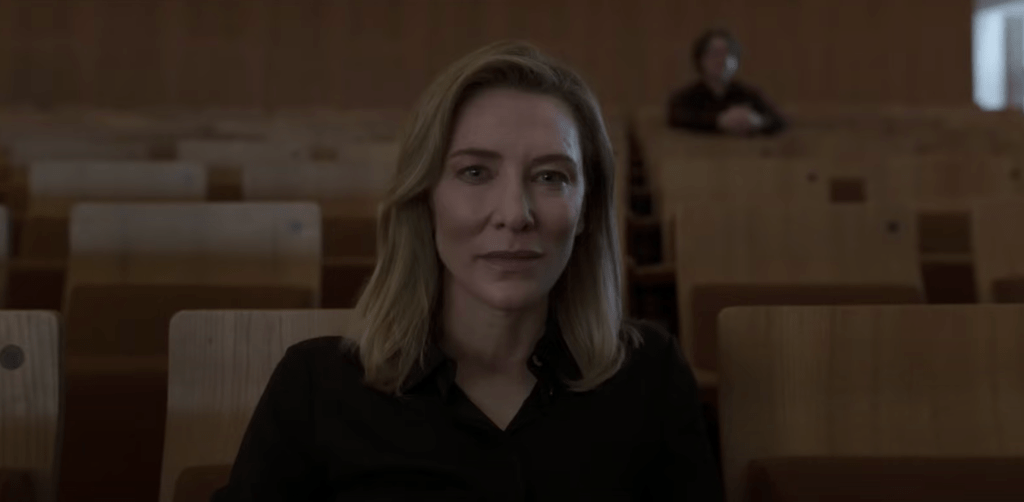
My Pick: Cate Blanchett (TÁR)

The hardest category to pick this year is Lead Actress where Michelle Yeoh and Cate Blanchett are locked in a 2-horse race for the gold. While I and I believe the majority of Oscar voters believe that Blanchett’s performance was superior, Yeoh being a part of the Best Picture winner (spoiler) and having various narratives on her side will I believe push her over the edge to the win, but I won’t be the least surprised to hear Blanchett’s name called.

Director

My Prediction: Daniel Kwan and Daniel Scheinert (Everything Everywhere All At Once)
My Pick: Todd Field (TÁR)

When Daniels won the DGA, they assured themselves this win. The film is a glorious piece of direction balancing the originality of its script with some spectacular performances. I personally would have voted for TÁR as Todd Field created a deep nuanced feature about the current world, but I don’t begrudge the Daniels their win.

Picture

My Prediction: Everything Everywhere All At Once
My Pick: TÁR

Capping off an award heavy night will be Everything Everywhere All At Once winning the night’s final and biggest award. Some people are trying to predict Top Gun: Maverick as a black sheep contender, but with EEAAO winning PGA, SAG, WGA, and DGA it is all but impossible for anything else to win including my personal favorite TÁR which much like director will lose to the Daniels behemoth.

No Bears: #FreeJafarPanahi

Director Jafar Panahi, who is currently imprisoned in Iran for 6 years, made another film wherein Panahi plays himself in a exploration of Iranian culture. The film takes place in two locations, a town on the edge of the Iranian Turkey border where Panahi is staying and a city in Turkey where the film Panahi is directing remotely is shooting.

Jafar Panahi is staying in a town with questionable internet coverage, despite the sheriff assuring him the coverage was impeccable. Unable to connect and continue directing his newest film across the border, he explores the village that he is staying in with his camera in toe. He wanders above the buildings and takes pictures of those he meets or sees.

That night, his assistant director arrives with a hard drive of the daily shoots. The two take a drive and discuss Panahi’s inability to leave the country and the negative impact that it is having on the filming process. They come across the road that the local smugglers use and Panahi and his assistant drive down the road and flirt with the idea of smuggling the director across the border. Panahi decides he is unwilling to do so and returns to his temporary home in the village.

The next day, Panahi is confronted by some men from the town insisting that he took a picture of a certain couple, and that the picture can be used as evidence against them. The women in this village are betrothed to someone at birth, and the belief is that this woman has been with a different man. Panahi assures the men that he has no such picture. They leave, but clearly are unpersuaded.

The drama that Panahi experiences in the village in which he is staying is mixed with the drama from his film. In the film a couple are attempting to procure passports to escape the country and fly to Europe to begin a new life. The couple comes to odds when one of them acquires a passport, but the other does not. Their love is tested by this potential distance between them.

No Bears attempts to draw a comparison between the couple in Panahi’s film and that of the star-crossed pair in the village which he is staying. In this point the film fails to deliver what it set out to do. Because Panahi is the sole viewpoint, the stories of the four lovers are underdeveloped. The couple in the village is especially underserved as they are not even the secondary point of view of their own story. Instead, the film focuses on what the men of the village think about them.

The other goal of No Bears that Panahi succeeds on is a critique of the culture in both the small village but also in the region at large. Panahi leaves no question that he is against the assigning of marriage partners at birth. He brings such up at a ceremony where he is required to swear that he is telling the truth. On the larger scale though, No Bears accuses the government of not providing for their people and entrapping them in the country.

Panahi’s output since his initial arrest in 2010 has centered around the director playing himself and that conceit has allowed him to take exceptionally personal shots at the country that imprisoned him. No Bears is another film along that line, and while it gets a little lost in some of its side stories, the film is solid. Not Panahi’s best but a strong addition to this phase of his career.

#FreeJafarPanahi

★★★½

Infinity Pool: A Wild Premise and the Modern Horror Queen

Brandon Cronenberg, son of acclaimed Canadian director David Cronenberg, returns for his third feature film Infinity Pool. Brandon follows in his father’s footsteps in making science-fiction/ horror hybrids, but while David’s films make heavy use of practical effects for literal horrific imagery, Brandon’s films exist in the more theoretic though they are just as visceral. Infinity Pool continues in that tradition by utilizing a low-concept premise to deliver something devilishly twisted.

James and Em Foster (Alexander Skarsgård and Cleopatra Coleman) are on vacation in a swanky beach resort in an extremely poor country. James is a writer infamous for one book six years ago who has been surviving off his wife’s fortune in the years since. One morning near the end of their trip, James meets Gabi (Mia Goth) who along with her husband Alban (Jalil Lespert) become quick friends of the couple.

The two couple borrow a car and go for a joy ride outside of the resort, something which is expressly forbidden, and have a day of drunken partying on a beautiful, deserted beach. After nightfall, they head back to the resort with James, the most sober, behind the wheel. A glitch in the car’s lights leaves James temporarily unable to see, and it is in that moment that a local happens to cross the street in front of the car. Visibily shaken, James and Em want to inform the authorities, but Gabi and Alban, having been to the resort before refuse saying they do not want to end up in jail in such a backward country.

The next morning, James and Em are awoken to violent raps on their door, and it appears that they were unsuccessful in evading the law and James is forced into custody. In custody and staring down a serious punishment, Infinity Pool introduces the science-fiction element that becomes the crux of the remainder of the film.

Infinity pool gets extremely dark through it’s science-fiction element and it is when the film delves deep into those themes that is at its best. The conundrum proposed to James while he is in the foreign jail is innovative and his robotic response to the decision leaves Em, and the audience, uneasy of his coldness. While this piece of science fiction is revisited on a couple of occasions, it is never as dark as the first visit, and the revisits are less purposeful. The film could have definitely explored the consequences of the punishment more, but instead it occupies its time with other less interesting debauchery.

It should come as no surprise after her work last year that Mia Goth is the standout performer of the film. Her ability to be over-the-top and unhinged makes her the modern-day queen of horror. Gabi goes from the girl next door persona to a deranged gun wielding maniac, Mia Goth can do both with great prowess.  

Infinity Pool belongs to a relatively modern subgenre of horror. One in which the goal is not to scare its viewers, but instead to shake and unsettle them. Brandon Cronenberg successfully creates those feelings, and while the premise could have been explored more deeply, the horror queen herself Mia Goth makes what made it to screen ever entertaining.

★★★

Living: More than Just a Lead Performance

Oliver Hermanus’s Living is a remake of Akira Kurosawa’s 1952 Ikiru, a film which this reviewer has shamefully never seen. The film has been bubbling in the Oscar conversation for a few select categories for months now, but upon wide release it seems that it’s being underdiscussed if anything.

Bill Nighy stars as Williams, the head of the Public Works department in 1950s London. He seems to be built ideally for bureaucratic work with a nose to the grindstone mentality that has little interest in helping people unless they have first gotten the necessary paperwork from the Parks department.

Williams’s normally untouchable routine is broken one afternoon when he must leave early for a doctor’s appointment. It is at that appointment that he learns that he has terminal cancer and will pass away in six months, eight to nine at the most.

Unable to process, he skips work the next day and happens to meet a young man to whom he spills his predicament. Williams had earlier that morning withdrew a large amount of cash, and he’s in need of someone to show him how to have a good time. The two men go out on a rager jumping from club to seedier club.

The next day, Williams runs into his recently former associate, Miss Harris (Aimee Lou Wood) and the two go out for lunch while Williams writes her a recommendation. Williams feels a strong connection with Miss Harris, and they build a friendship which gives him a reason to change his outlook on life for the last few months.

Bill Nighy is the standout performance of the film as the elderly Williams. He captures the meek voice of a man who has never lived but slowly opens up as days go on as he lives his life away from work for the first time. Nighy displays remarkable range despite adhering to Williams rather quiet demeanor.

Aimee Lou Wood is also worth calling out as Miss Harris. She may act as the manic pixie dream girl for Nighy’s Williams, but instead of the traditional MPDG persona, she plays someone much more grounded. She doesn’t feel amiss from the 1950s society that she belongs to, yet she is able to be the catalyst which Williams uses to evolve. Balancing these decisions is difficult, yet Lou Wood delivers remarkably and should be getting more attention.

An interesting decision that Hermanus makes with the film is to change the perspective for the third act of the film to that of Peter Wakeling (Alex Sharp), a young professional who started working in Williams’s department right when Williams learned of his diagnosis. The film does this to highlight the impact that Williams had on those around him after going through his awakening. While the purpose for this perspective change makes sense with respect to the film’s narrative and deeper meaning, it is still a little jarring when the perspective change takes place.

Living is a simple film with simple themes, and yet the combination of Nighy’s acting and Hermanus’s direction produces a film that feels seminal. The film worms its way int to the subconscious and affects the viewer much the same way Williams’s diagnosis impacted him.

★★★★

Oscar Nomination Prediction 2023

The Oscar nominations go live early Tuesday morning, so in the tradition of online movie reviewers, I’m giving my predictions on who will see the nomination.

Best Picture

All Quiet on the Western Front has proven to be the international film that will make this year’s list after it’s stellar performance at the BAFTAs. After that, it’s only the 10 slot with a big question mark. My heart wants Women Talking, but my brain thinks this year women directors will find themselves shut out.

  1. Everything Everywhere All At Once
  2. The Banshees of Inisherin
  3. The Fabelmans
  4. TÁR
  5. Elvis
  6. Top Gun: Maverick
  7. Avatar: The Way of Water
  8. All Quiet on the Western Front
  9. The Whale
  10. Triangle of Sadness

Best Director – The top 4 are all locks, and again after the BAFTA nomination performance, it’s hard to count out Edward Berger as the final slot. Another unfortunate major category without a women included (sorry Sara Polley and Charlotte Welles).

  1. Daniels – Everything Everywhere All At Once
  2. Todd Field – TÁR
  3. Steven Spielberg – The Fabelmans
  4. Martin McDonagh – The Banshees of Inisherin
  5. Edward Berger – All Quiet on the Western Front

Best Actress

After the big 2 up top, the rest of the slots could give. Deadwyler gave a performance more than worthy of her slot, but the question is how many people saw Til? Michelle Williams used to be a lock, but some poor showings in prior awards nominations puts her on the chopping block, but I assume we’ll see her on Tuesday morning. With the last slot, I’m guessing Viola Davis will get in over Ana de Armas in the reviled Blonde, and Margot Robbie in Babylon (which would be my personal pick for the 5th slot).

  1. Cate Blanchett – TÁR
  2. Michelle Yeoh – Everything Everywhere All At Once
  3. Danielle Deadwyler – Til
  4. Michelle Williams – The Fabelmans
  5. Viola Davis – The Woman King

Best Actor – Another category with 4 slots locked up, the question comes to the 5th slot. While most outlets are predicting a Tom Cruise nomination for Top Gun: Maverick, I feel this will be the lone acknowledgement for the best film of the year with Paul Mescal sneaking in for Aftersun.

  1. Brendan Fraser – The Whale
  2. Colin Farrell – The Banshees of Inisherin
  3. Austin Butler – Elvis
  4. Bill Nighy – Living
  5. Paul Mescal – Aftersun

Best Supporting Actress – An interesting batch this year, I’d call the first 4 relatively safe, but anything could happen in this category. The big question mark is who will take that last slot with Stephanie Hsu attempting to get Everything Everywhere All At Once two nominations in this category, but I’m going with Dolly De Leon from Triangle of Sadness.

  1. Kerry Condon – The Banshees of Inisherin
  2. Hong Chau – The Whale
  3. Jamie Lee Curtis – Everything Everywhere All At Once
  4. Angel Bassett – Black Panther: Wakanda Forever
  5. Dolly De Leon – Triangle of Sadness

Best Supporting Actor

Ke Huy Quan is the easiest bet for a win now. The Banshees of Inisherin look to be a lock to get 2 nominations in with Gleeson and Keoghan both looking obvious. The main question in this category is the 5th slot, which will be a large step down from the top 4. It’s looking now like Eddie Redmayne (who I still secretly can’t stand after his The Danish Girl performance) will provide The Good Nurse with it’s only nomination of the night.

  1. Ke Huy Quan – Everything Everywhere All At Once
  2. Brendan Gleeson – The Banshees of Inisherin
  3. Barry Keoghan – the Banshees of Inisherin
  4. Paul Dano – The Fabelmans
  5. Eddie Redmayne – The Good Nurse

Best International Feature Film – An interesting category this year, The top 3 slots are pretty much a given (and their order is as well). I’m predicting a bit of an upset with Corsage, but I think a stellar performance from Vicky Krieps will propel the film into the conversation.

  1. All Quiet on the Wester Front
  2. Decision to Leave
  3. Argentina, 1985
  4. The Quiet Girl
  5. Corsage

Best Animated Feature

Another category with 4 slots locked in. The 5th slot could go to a variety of options, but I’m putting faith in GKIDS to get a foreign film into the category with Inu-Oh (it helps that I really connected with the film). I see it just beating out Wendell & Wild for the slot.

  1. Tuillermo Del Toro’s Pinocchio
  2. Turning Red
  3. Marcel the Shell with Shoes On
  4. Puss in Boots: The Last Wish
  5. Inu-Oh

Best Documentary Feature – The real question with this category is whether the voting block will break their unofficial veto on musical documentaries to nominate the wonderfully innovative Moonage Daydream. If it doesn’t get in look to The Territory or Descendant to fill the last slot.

  1. All The Beauty and the Bloodshed
  2. Fire of Love
  3. All that Breathes
  4. Navalny
  5. Moonage Daydream

Best Original Screenplay – All of my predictions for this category show up above in my best picture guesses, with Elvis being the lone film on the outside looking out (it is much more about the imagery than the writing). It’s hard to imagine any other film breaking into this category with Babylon and Aftersun looking quite a way up from the 6 and 7 slots.

  1. Everything Everywhere All At Once
  2. The Banshees of Inisherin
  3. The Fabelmans
  4. TÁR
  5. Triangle of Sadness

Best Adapted Screenplay

The category for Sarah Polley’s revenge after being snubbed in the above categories. All Quiet on the Western Front will continue it’s post BAFTA dominance as an international film. The 5th slot will likely go to Living even though She Said found a surprising BAFTA nomination.

  1. Women Talking
  2. The Whale
  3. Glass Onion: A Knives Out Mystery
  4. All Quiet on the Western Front
  5. Living

Best Cinematography – This is the hardest category to predict with the precursor awards being all over the place. Top Gun: Maverick is the only lock with the other 4 being any of about a dozen options. I leaned closer to the films that would receive a bunch of nominations, but don’t be surprised if films like Bardo: False Chronicle of a Handful of Truths, Empire of Light, and The Batman find their way in.

  1. Top Gun: Maverick
  2. All Quiet on the Western Front
  3. Avatar: The Way of Water
  4. The Fabelmans
  5. Elvis

Best Editing – Similar to Cinematography, this category is pretty wide open. The top 2 are obvious but after that it opens wide up. Elvis, All Quiet on the Western Front, and The Fabelmans all fall into the category of most-editing equals best-editing which Academy voters tend to fall for.

  1. Top Gun: Maverick
  2. Everything Everywhere All At Once
  3. Elvis
  4. All Quiet on the Western Front
  5. The Fabelmans

Best Production Design

The first category that the commercial flop though visually stunning Babylon has a real chance in, and it is a frontrunner.  The rest of the category is filled with Oscar favorites for other categories.

  1. Babylon
  2. Avatar: The Way of Water
  3. Elvis
  4. All Quiet on the Western Front
  5. The Fabelmans

Best Sound – The consolidation of the sound category makes it much easier to guess, and this year the top 5 seem pretty solid, though I guess The Batman could sneak in if the Academy really takes to that film.

  1. Top Gun: Maverick
  2. Avatar: The Way of Water
  3. All Quiet on the Western Front
  4. Everything Everywhere All At Once
  5. Elvis

Best Visual Effects

The backlash on Marvel movies appears to be strong in this branch this year between the VES and BAFTAs shutting out Black Panther: Wakanda Forever and Doctor Strange in the Multiverse of Maddness. So that leaves the 5th slot wide open. I’m taking a wild guess on the slot and predicting an upset from Nope.

  1. Avatar: The Way of Water
  2. All Quiet on the Western Front
  3. Top Gun: Maverick
  4. The Batman
  5. Nope

Best Original Score – This is Justin Horowitz category to lose and finds Babylon locked for the top slot. My main question for this category goes to the last slot. John Williams may seem like the obvious pick for The Fabelmans, but I have to go with the most atmospheric and innovative score of the year in Volker Bertelmann’s work for All Quiet on the Western Front.

  1. Babylon
  2. Guillermo Del Toro’s Pinocchio
  3. Women Talking
  4. The Banshees of Inisherin
  5. All Quiet on the Western Front

Best Costume Design – Is now where I admit that I haven’t seen Black Panther: Wakanda Forever yet? Regardless I have to go with the expects and put this as the front runner. Mrs. Harris Goes to Paris gets in with the “only for costumes” slot that pop up once every year or two, and sits around some heavy Oscar contenders. As mediocre as it was, don’t be surprised if Amsterdam finds its way into one of these slots on Tuesday.

  1. Black Panther: Wakanda Forever
  2. Elvis
  3. Babylon
  4. Mrs. Harris Goes to Paris
  5. The Woman King

Best Makeup and Hairstyling

Makeup and Hairstyling tends to be all about the prosthetics and my high contenders all make substantial use of them. Crimes of the Future might be a long shot at my number 5, but I just feel in my ear covered body that it will get in.

  1. The Whale
  2. Elvis
  3. Amsterdam
  4. The Batman
  5. Crimes of the Future

Best Original Song – Time for my standard “I’m not a music critic” stance, but this year’s list of songs seem pretty easy to guess with the RRR sensation “Naatu Naatu” looking like an easy frontrunner. Diane Warren will continue her undeniable streak at the Oscars and will force me to watch a film I’ve never heard of before in Tell it Like a Woman.

  1. “Naatu Naatu” – RRR
  2. “Hold My Hand” – Top Gun: Maverick
  3. “Lift Me up” – Black Panther: Wakanda Forever
  4. “Applause” – Tell it Like a Woman
  5. “Ciao Papa” – Guillermo Del Toro’s Pinocchio

Best Narrative Short/ Animated Short/ Documentary Short – I haven’t seen these films and can’t make a comment.

Saint Omer: The Chimera of Motherhood

France’s 2022 submission to the Oscars for Best International Film Saint Omer is an emotional delve into the relationships between mothers and daughters masquerading as a courtroom drama.

Kayije Kagame plays Rama an academic who travels from Paris to Saint-Omer to observe a court case with the intention of writing a new book on it. A few days before the trip she, her partner, and her two sisters have a get together at Rama’s mother’s house. In this scene director Alice Diop starts hinting at the theme for the film. It’s apparent that Rama has a more tepid relationship with her mother than her siblings do.

The trial Rama attends for research is of Laurence Coly (Guslagie Malanga) a woman from Senegal who drowned her 15-month-old infant daughter in the sea. The first day of court plays out in seemingly real time as the judge (Valérie Dréville) reads the details of Coly’s case and inquests her background to try and find meaning to the infanticide. This plays on for an extended period which introduces the uneasiness that punctuates the rest of the film.

After the first day of the trial, Laurence’s mother Odile (Salimata Kamate) introduces herself to Rama, their shared Senegalese background creates an instant bond between them. They agree to meet for lunch on the following day. When they meet for lunch, Odile exposes what was previously hinted at, that Rama is pregnant. This connects Rama to Laurence in a more intimate way.

Saint Omer is deeply concerned with the relationship between mother and daughter. “We carry on the cells of our mother’s and our daughters who will in turn carry on us.” Laurence’s lawyer speaks the theme of the film as a closing statement to the trial. She refers to mothers and daughters as chimeras who share each other’s cells and are thus intimately connected.

What happens when a mother is maybe not physically abusive but emotionally distant? Rama’s mother appears to have been that, and Laurence makes the case that her mother was as well.  Rama’s trauma from her mother is hinted at through flashbacks but never spoken explicitly, but it influences her to this day, and she worries that she will become a version of her mother to her unborn child. Is Rama destined to repeat the sins of her mother, or worse the sins of this woman on trial in whom she sees herself? Diop is greatly interested in these relationships and the permanence of damage that is done.

Alice Diop transforms the traditional courtroom drama into something much more personal and introspective. The film uses the trial as a catalyst for Rama, an unconnected observer, to explore her inner demons and question what it means to be a mother and a daughter.

★★★★

A Man Called Otto: A Quaint but Pointless Remake

A Man Called Otto is Marc Forster’s remake of the 2015 Swedish film A Man Called Ove (dir. Hannes Holm) a quaint slice of life picture about the curmudgeonly, suicidal Otto.

Tom Hanks plays the titular Otto, a man who has lost the enjoyment he once found in life and instead has become bitter to the world around him. He begins his day by doing rounds through his gated community where he rebels against delivered ads, fixes other’s mistakes in recycling, and is genuinely rude to his neighbors who continue to try and reach out to him.

He attends his last day of work at a factory, where it is made clear that he was forced into retirement rather than choosing the decision on his own, after which he returns home with a length of rope and the intention of hanging himself. Work must have been an outlet for Otto’s meticulous nature and losing that left him with very little to do.

Just at that time the arrival of his new, and parallel parking challenged, neighbors convinces him to leave his apartment and park for them out of frustration. This good deed, even if done out of a selfish manner as Otto does not suffer incompetence well, changes his life as it introduces him to Marisol (Mariana Treviño) the Mexican woman who makes it her personal responsibility to befriend the socially prickly Otto.

The film continues from there with Marisol slowly thawing Otto’s frozen heart. While doing so, the film makes increasing use of flashbacks to tell the story of Otto(played by Truman Hanks in flashbacks) and his late wife Sonya (Rachel Keller). This provides context for some of Otto’s rudeness while fleshing out the story of the film.

Tom Hanks may be one of the great actors working today, but in this film his performance is greatly overshadowed by Treviño’s, who is new to the Hollywood system. Her constant quips at the sullen Otto’s expense provide most of the laughs for the film.

A Man Called Otto falls for the common plight of foreign films remade into English only a few years later in that the film offers very little new outside of the language change. One could easily just watch A Man Called Ove, assuming they are amiable to reading while they watch, and get the same value out of it.

This pointlessness is further exemplified by the fact that the film feels very slight. Otto’s story is interesting enough to keep one in their seat for two hours, but it has little staying power. A Man Called Otto is fine January viewing but will not be remembered come year end.

★★½

Women Talking: A Literal Masterpiece

Sarah Polley returns to the feature director’s chair for the first time in ten years, Stories We Tell, and her first narrative film since 2011’s Take This Waltz with the awards favorite Women Talking. Her new costume drama utilizes an all-star cast to create a captivating piece of cinema despite the film living up to its title and being almost exclusively women talking.

The film takes place in 2010 in a Mennonite village directly following an incident where the women of the community caught a man tranquilizing and sexually assaulting a woman. The man gives up a list of other men who are guilty of the same practice and is arrested by the local town. When all but one of the other men go to town to bail the guilty parties out, the women of the town gather to discuss their options going forward.

Forgiving the men, staying and fighting them, or leaving are the choices that the women consider, and despite being illiterate they organize a vote for all the women to decide their fate. When the vote returns, it results in a tie between fighting and leaving so three families convene to discuss their eventual decision.

Ona (Rooney Mara), Salome (Claire Foy), Mariche (Jessie Buckley), and Janz (Frances McDormand) along with a handful of other older girls and women and the only man still in the village August (Ben Whishaw), whose only job is to take the minutes of the meeting, lock themselves in a barn to discuss their future.

Janz immediately gives an ultimatum that forgiving the men is the only option she will accept as it is the only way that they can still attain heaven according to their faith. When the rest of the women rebuke the idea, Janz storms off leaving the remaining women to deliberate between the other two options. The film proceeds from there with the women conversing with only one short break for them to perform their traditional duties.  

While the bulk of the film may seem actionless, the emotion displayed by each woman is entrancing as they grapple with an unknown future. Claire Foy declaring that if she should stay, she “will become a murderer” is devastating. Rooney Mara aptly captures the horror of her situation, an unmarried woman who has just realized that her pregnancy was due to the evils of men and not the supernatural. The terror that the women have endured becomes palpable because of the exquisite acting.

Much has been made about the color grading of Polley’s film, and while the decision is stark, it is both not without reason and not as distracting as out of context screen shots make it appear. The washed-out color leaves the film almost monochromatic echoing black and white filmmaking of the past. This homage to an older time reflects the out of time feeling that the Mennonite community exhibits, and especially the ancient mentality that would allow men to do this to women without consequence.

Highlighted by the unnerving acting trio of Mara, Foy, and Buckley Women Talking is a tour-de-force for a post #MeToo world.

★★★★½