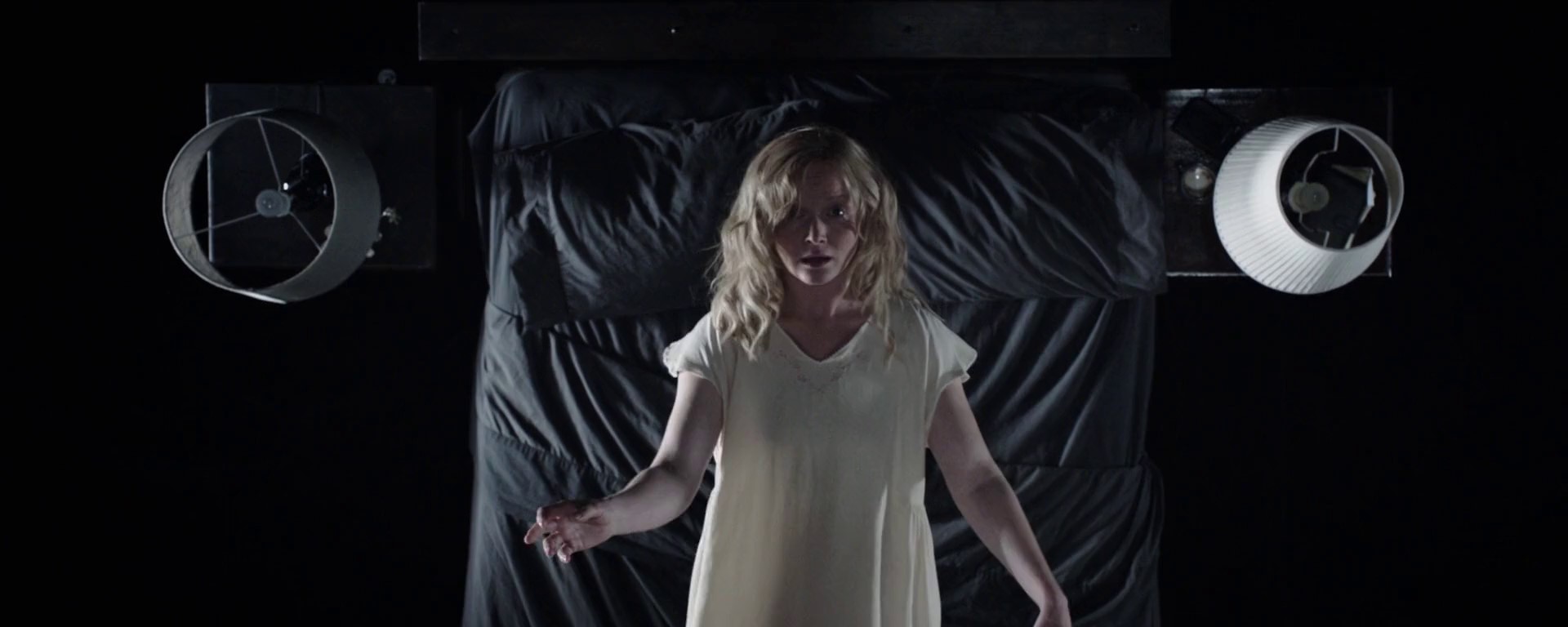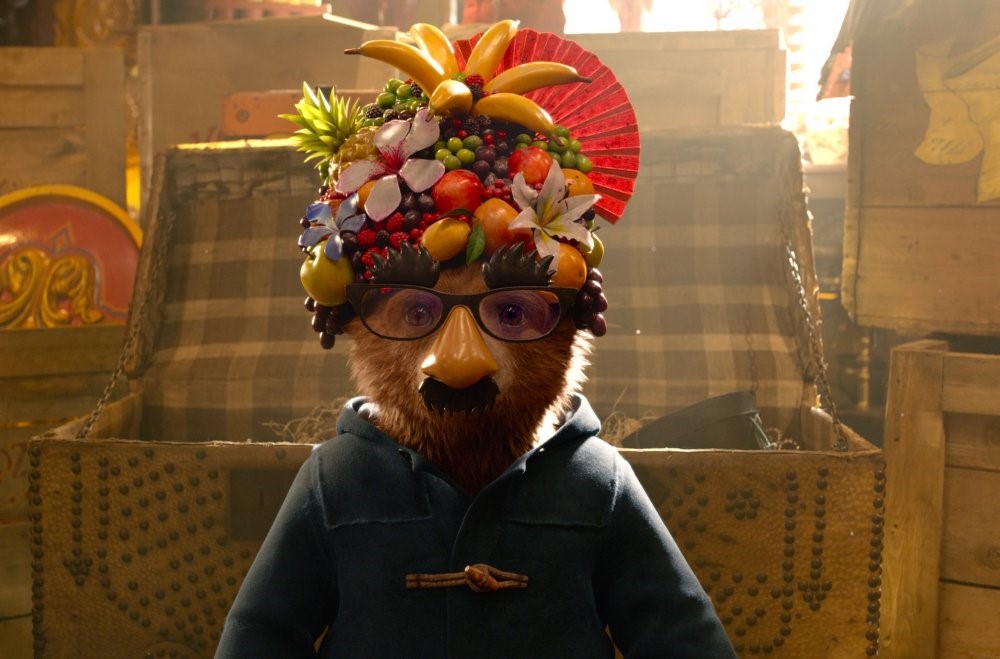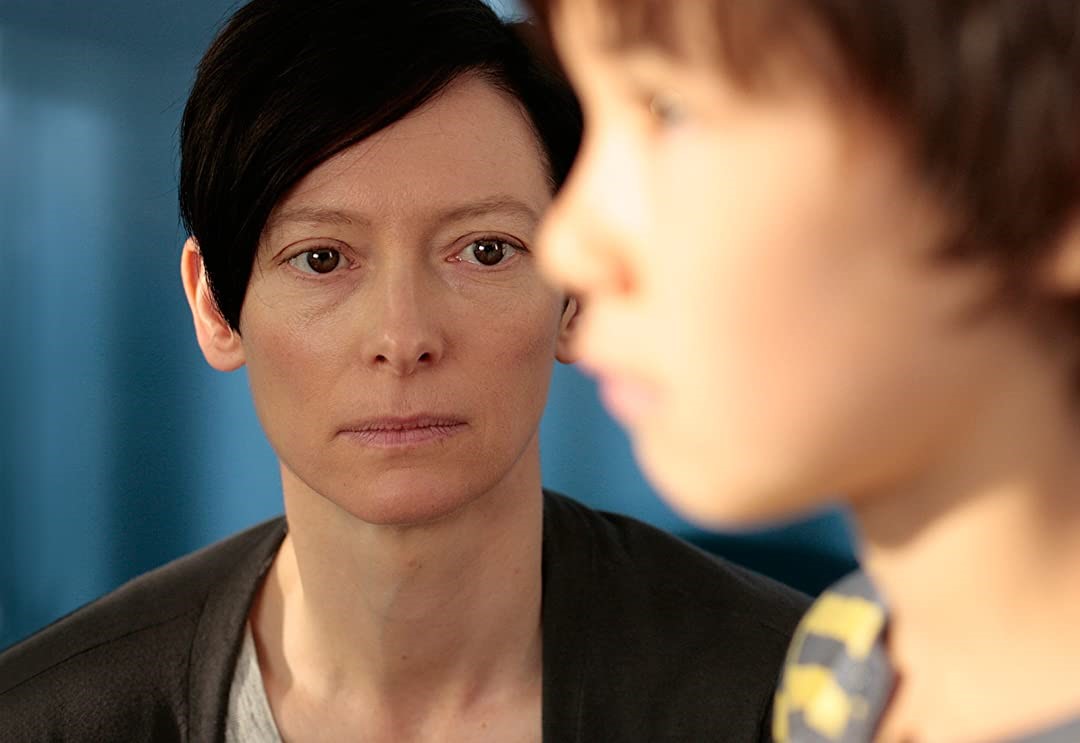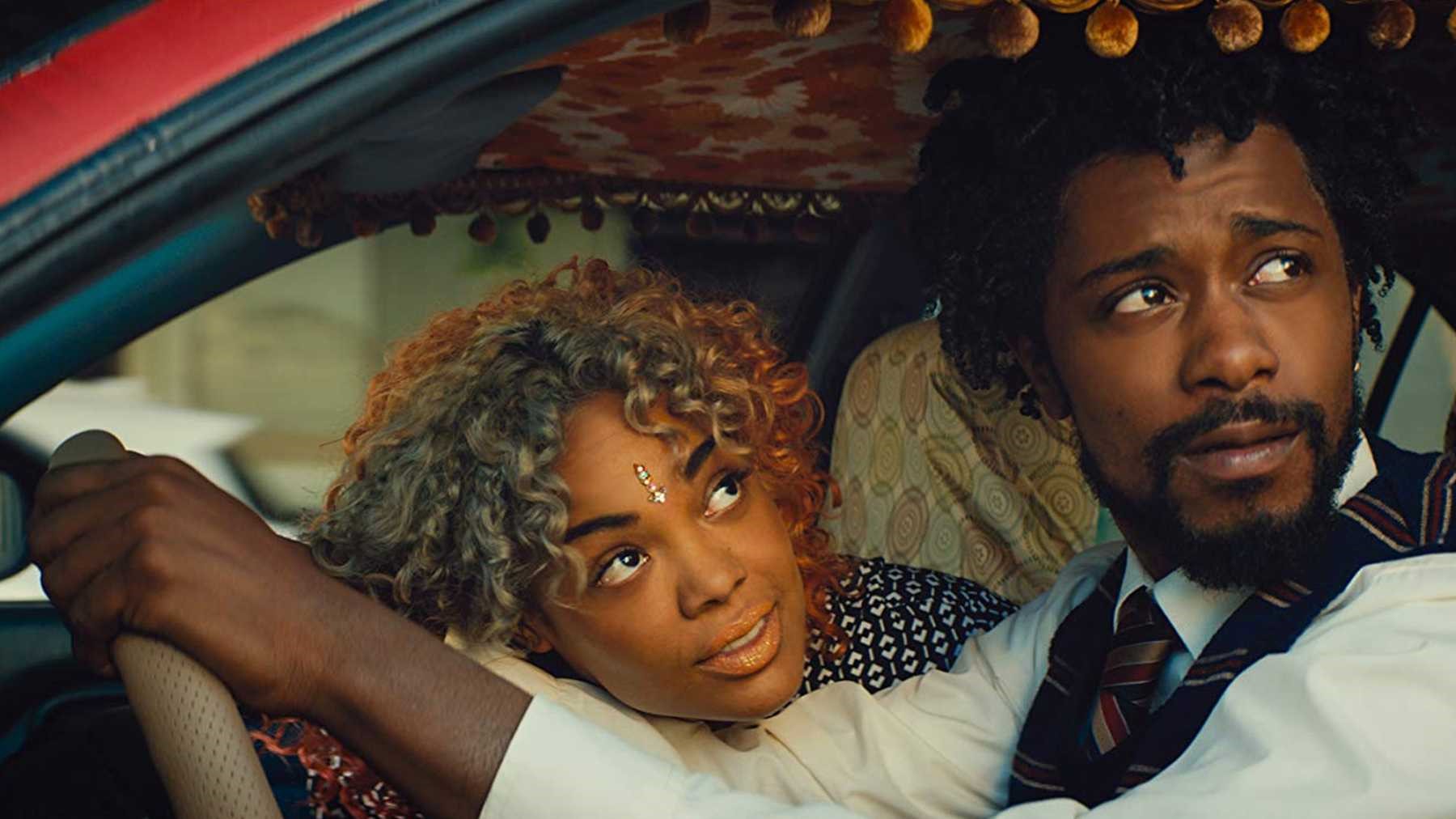
The Best Films of the 2020s… So Far

We are halfway through the 2020s (where did the time go?) and so it seems like an appropriate time to look back at the films that have come out this decade so far. In these 5 years, I have seen over 500 feature films, so making a best of list is going to be difficult. To make things a little easier, on myself, I’m going to expand my normal year end list size from 25 to 50, but that still has me leaving more than 90% of the films I’ve seen this decade off the list. I like including a few statistics with my picks, so included on my list are 2 Best Picture Winners, 1 Palme d’Or winners, 20 features directed by non-men, and 19 non-English films. While many of these blurbs come straight from my thoughts on the year end list in which they originally appeared, some have been edited as my thoughts evolved, and a few of them are completely new entrants as I caught up with the films after my initial publishing.

50. Decision to Leave (2022, Dir. Park Chan-wook)
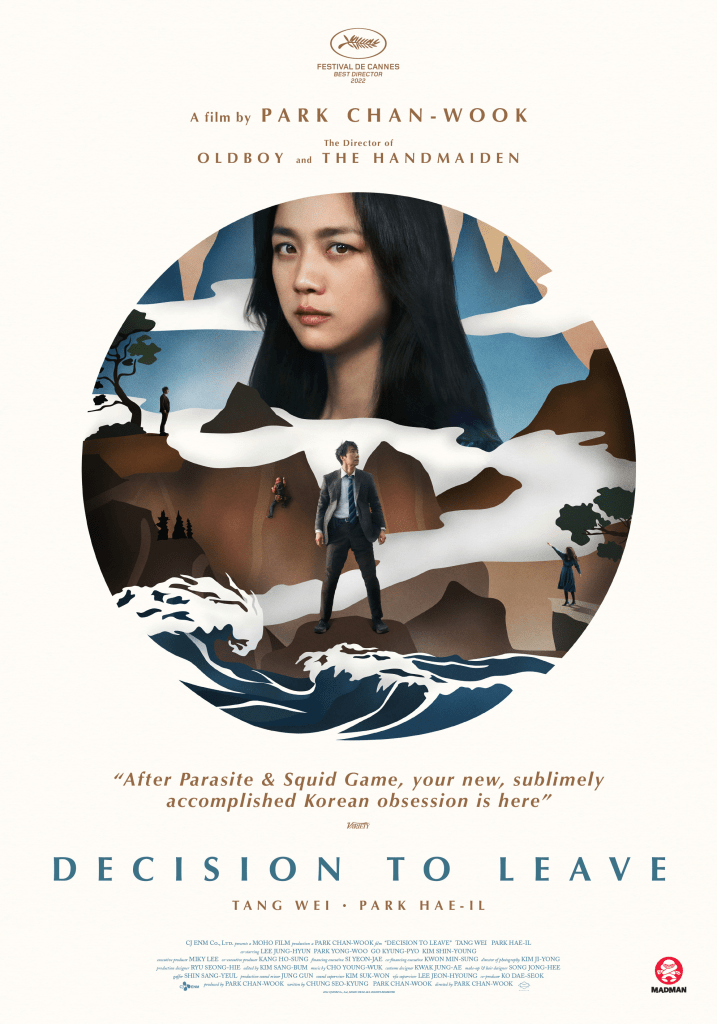
Park Chan-wook’s foray into neo-noir filmmaking proves that he is a master of all genres with a darker hint to them. Decision to Leave employs many of the genre’s staples: it stars a grizzled detective who falls in love with a femme fatal while attempting to solve a case she is related to. What the film utilizes that separates it from a sea of neo-noirs is a deft hand with melodrama. The melodrama never feels saccharine in Chan-wook’s hands, but they do elevate the attachment to characters and intrigue of the mystery.

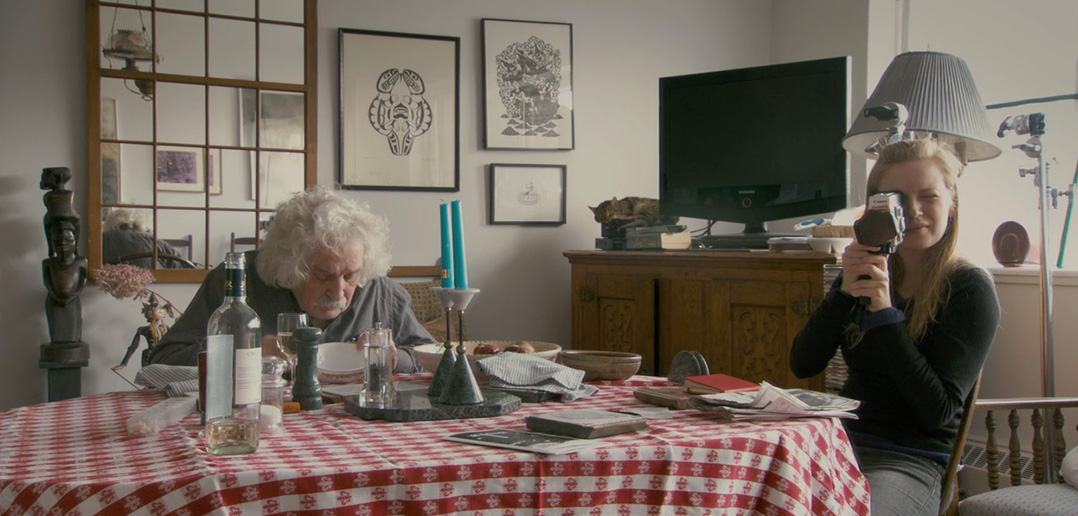
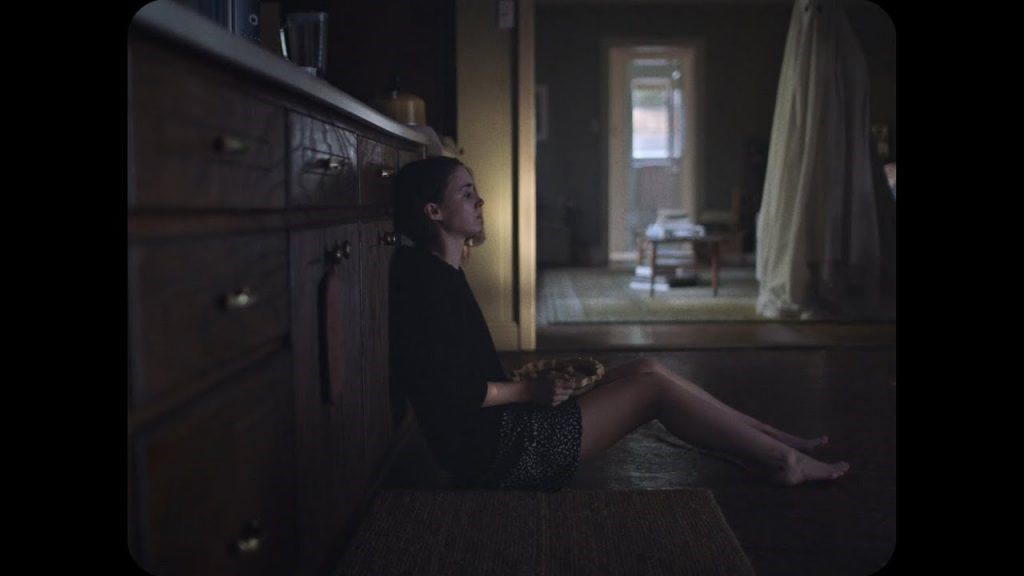
49. The Souvenir: Part II (2021, Dir. Joanna Hogg)

While the sequel to my favorite film of 2019 does not quite live up to its predecessor, The Souvenir Part II was still one of the best films of the decade. Taking place in the aftermath of the first film, Joanna Hogg’s semi-autobiographical feature continues with many of the same themes. Julie (Honor Swinton Byrne) struggles to cope with the circumstances that have become her life, but between the support of her mother (played by the actress’s real life mother Tilda Swinton) and the outlet of her passion of filmmaking she persists. The film is a testament to the power we have to recover when guided by those things and people we love.

48. The Quiet Girl (2022, Dir. Colm Bairéad)

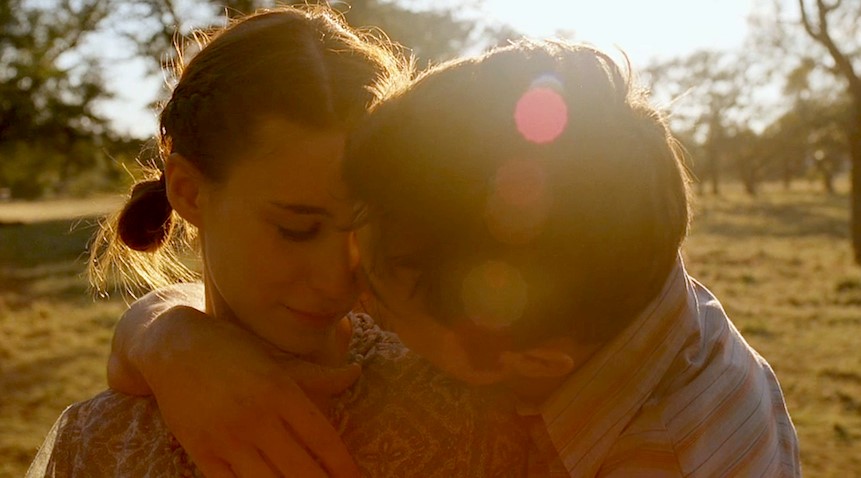
The Quiet Girl follows Cáit (Catherine Clinch) one of many siblings living in an overstuffed and impoverished household. Neglected by her family, she struggles in school and altogether lives a poor life. It’s only upon going to spend the summer with distant relatives that she is shown what love is and she begins to flourish. Watching Cáit slowly accept love into her life and emerge from her shell is the highlight of the film. The Quiet Girl manages to capture warmth and familial love in an extremely special way.

47. We’re All Going to the World’s Fair (2022, Dir. Jane Schoenbrun)
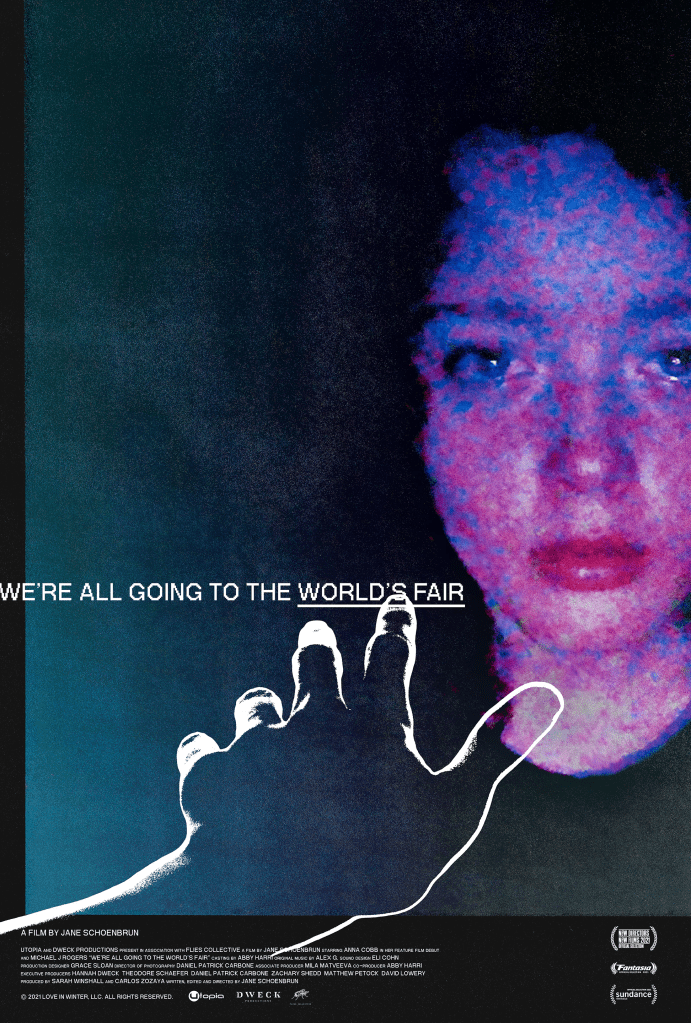
Before their breakout 2024 film I Saw the TV Glow (appearing later on this list), Jane Schoenbrun broke onto the indie filmmaking scene with this exploration of creepy pasta internet culture. Anna Cobb plays Casey, a young girl dives deep into the World’s Fair challenge and engages in the role playing aspects of it online with a mysterious user known as JLB (Michael J Rogers). The film is relatively narrativeless instead consisting largely of youtube clips running into one another, but still is tethered enough to the real world to extract some genuinely emotive performances, especially from the young Cobb. We’re All Going to the World’s Fair is a brilliant depiction of what it’s like to be alone in the current world.

46. Infinity Pool (2023, Dir. Brandon Cronenberg)
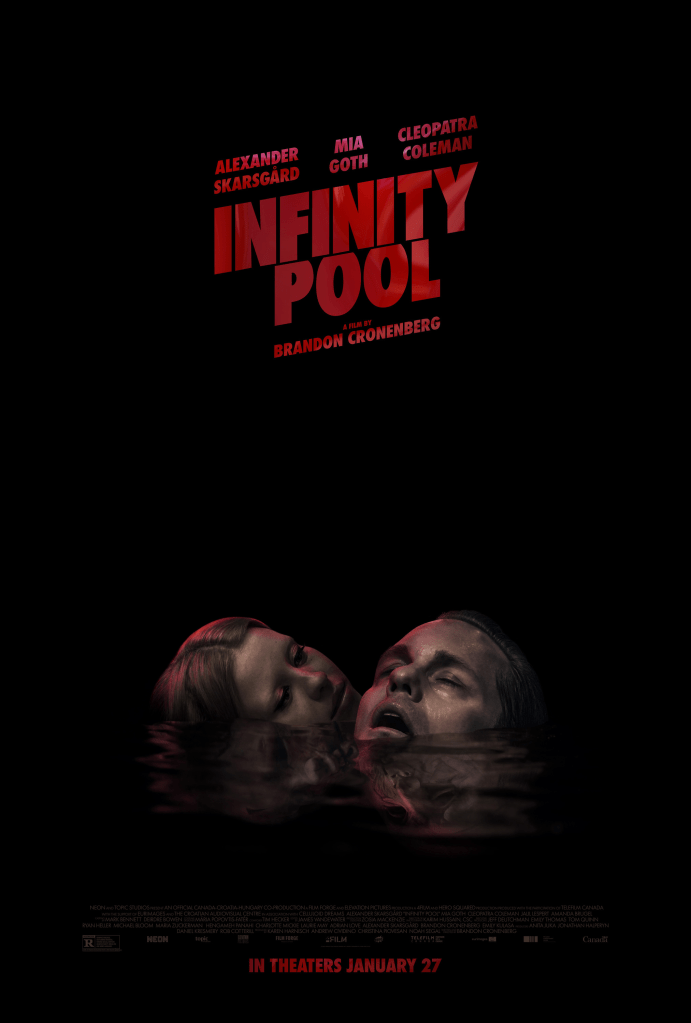
The best horror film of 2023 continues to prove that Brandon Cronenberg is more than just a nepo baby, he is an excellent film maker with his own style. Infinity Pool lingered with me, the creepy imagery, the complex themes, and especially the supporting performance from Mia Goth. The film is dark and twisted in a way that lingers in the mind for weeks after viewing. Alexander Skarsgård is excellent as the slimy failed author James, and as mentioned, Mia Goth as Gabi is impeccably deranged. The film explores what it means to be human in the most twisted ways imaginable.

45. Everything Everywhere All at Once (2022, Dir. The Daniels)
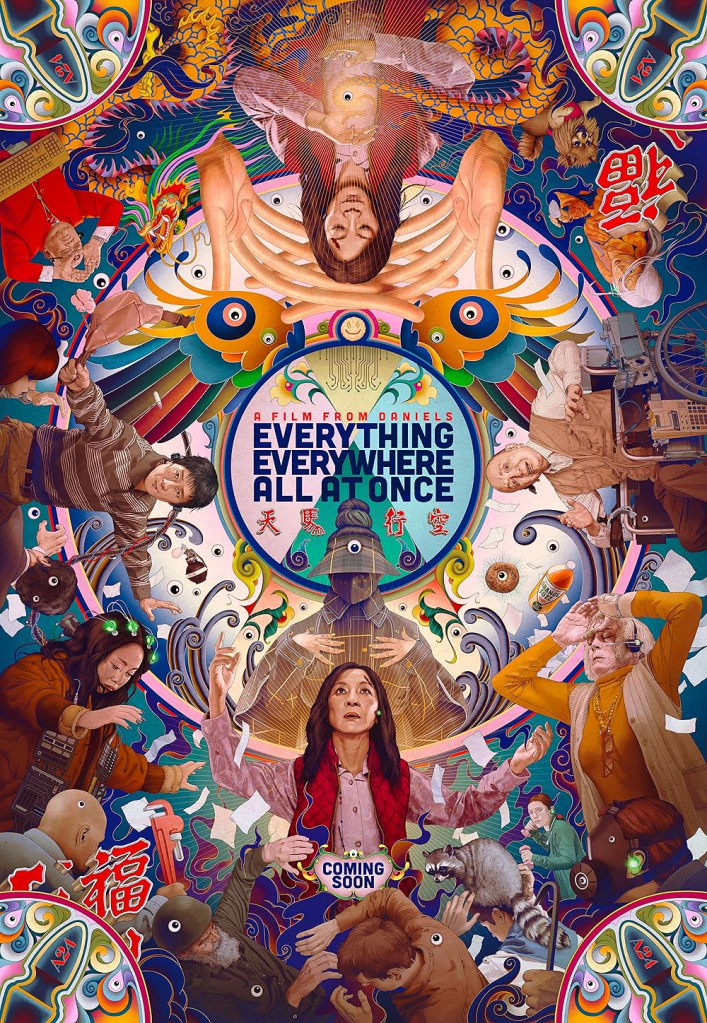
In their combined follow up to Swiss Army Man (2016) (Daniel Scheinert did have 2019’s The Death of Dick Long as a solo film in between), Daniels delivered a film just as if not more heightened than their feature debut, yet somehow more relatable to the mainstream, so much so that it won the top award at the 2023 Oscars. Everything Everywhere All at Once hinges on the performance of its lead Michelle Yeoh to take audiences on a journey to the edge of the world and to worlds beyond that. Yeoh delivers on those lofty goals and creates a perfect viewer conduit for the wild imaginations of Daniels.

44. Asteroid City (2023, Dir. Wes Anderson)
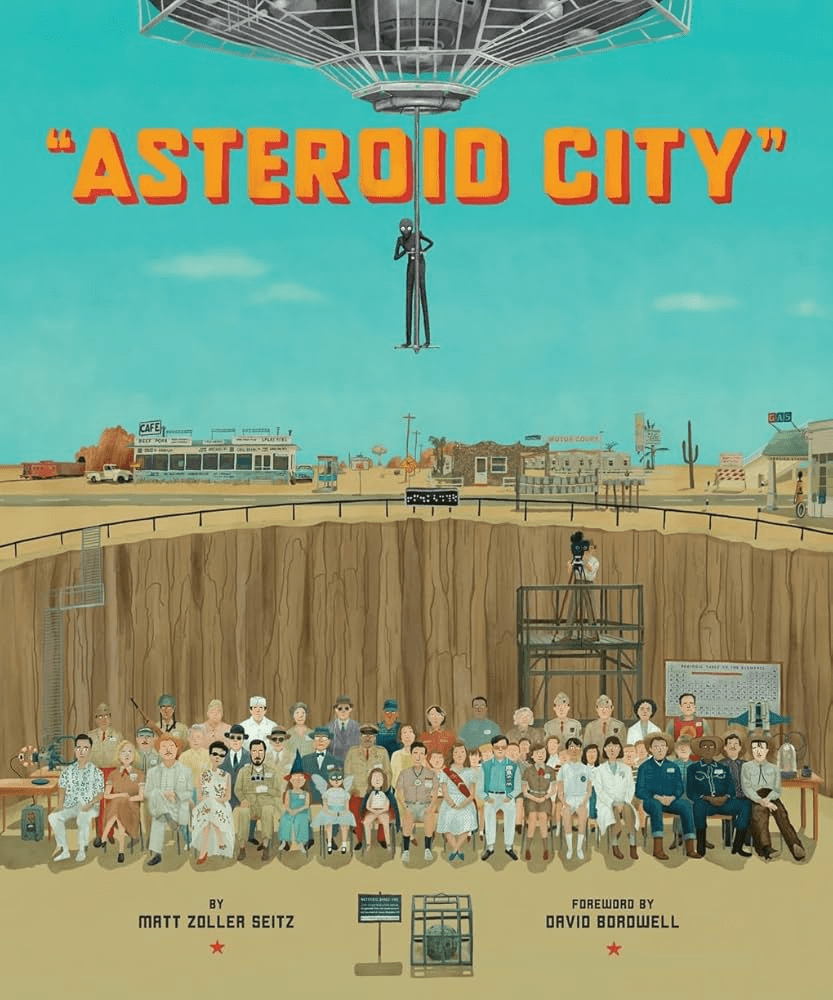
If you think Wes Anderson’s style is a little bit too much, then this is not the film for you. However, if you want to see Wes Anderson dive into his style headfirst and make the most Wes Anderson film ever, then you need to see Asteroid City. Consisting of multiple layers of storytelling, the film is a complex narrative that I’m still grappling with after only one watch. The innermost layer of the film, the one in color, is filled to the brim with interesting acting decisions and Anderson’s trademark production design. Yet it is the combination with the outer layers that elevate Asteroid City into one of Anderson’s best.

43. Broker (2022, Dir. Hirokazu Koreeda)

Koreeda has been making films since the early 90s, but it’s only really since his 2018 film Shoplifters that the Japanese auteur has become a household name in the US. Broker is the better of his two 2020s films (though I did enjoy 2023’s Monster). The film builds off of Shoplifters’ theme of love between unconventional families, as well as getting by on the edges of society. Mix in a little bit of thrills as two police officers follow the chosen family in hopes of catching them in the act of selling a baby and Broker has a perfect mix of excitement and sincerity.

42. Killers of the Flower Moon (2023, Dir. Martin Scorsese)
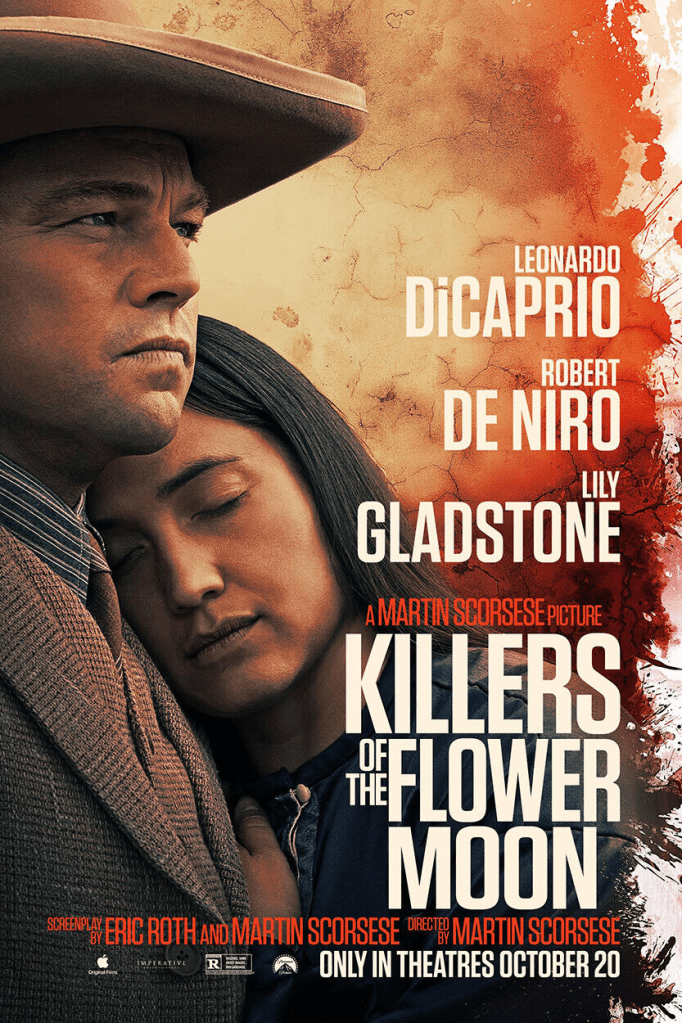
It is sacrilege to say this as a cinephile, but Scorsese has never really been my cup of tea. I respect him as a film maker, and I’ve never disliked his movies, they just have not resonated with me the way they do for most. That said Killers of the Flower Moon spoke to me in a way that most of his more recent films have not. While much of the film does fall in the bad men doing bad things that many of his films fall into, the inclusion of Lily Gladstone as Mollie Burkhart won me over. By centering on the victim, he made a film that resonated much more with me. Scorsese’s undeniable prowess with directing combined with a sympathetic co-lead make this one of his best films. I only wish that Gladstone appeared on screen more.

41. West Side Story (2021, Dir. Steven Spielberg)

The only reason to remake West Side Story was to correct the racist casting choices made by the 1961 original, and yet despite the superfluousness of the film’s existence, Steven Spielberg delivered a masterpiece that (I’ll say it) surpasses the original. The 2021remake’s best feature is the cinematography. Janusz Kaminski’s camerawork acts as an additional dancer in all of the music numbers as it glides through the scenes in a masterful way. While Ansel Elgort might not be the most charismatic Tony to ever play the part, the cast around him is excellent and imbue the film with so much life that the film stays relevant despite the history of its predecessor.

40. Shirley (2020, Dir. Josephine Decker)

I said the same thing the previous year with respect to her performance in Her Smell (Alex Ross Perry), but Elisabeth Moss is a genuine movie star and really needs to be recognized for more than just her television work. In her most recent film, she plays the acclaimed horror writer, the titular Shirley Jackson who is at an apparent low point in her life. Co-star Odessa Young plays Rose, Shirley’s temporary caretaker and is also outstanding in the film. The two play off each other exploring the power dynamics between the haves and have nots. Even when Shirley is bedridden and Rose should be in complete control, Moss’s acting clearly identifies that this is never the case. No matter how mentally unstable Shirley is, she is always manipulating the situation until she has complete control over Rose’s mind.

39. Girl Picture (2022, Dir. Alli Haapasalo)

I don’t have a great explanation for why this Finnish lesbian romance is so high on my list, but upon leaving the theater after watching it I was all smiles. The film’s focus on female friendship and a young lesbian romance was refreshing in a heteronormative movie landscape. Mimmi‘s (Aamu Milonoff) volatile nature as she gets in fights at school, messes around at work, and falls in and out and back in love make her the standout performance, but all three young leads are remarkable in their honesty.

38. How to Blow Up a Pipeline (2023, Dir. Danile Goldhaber)
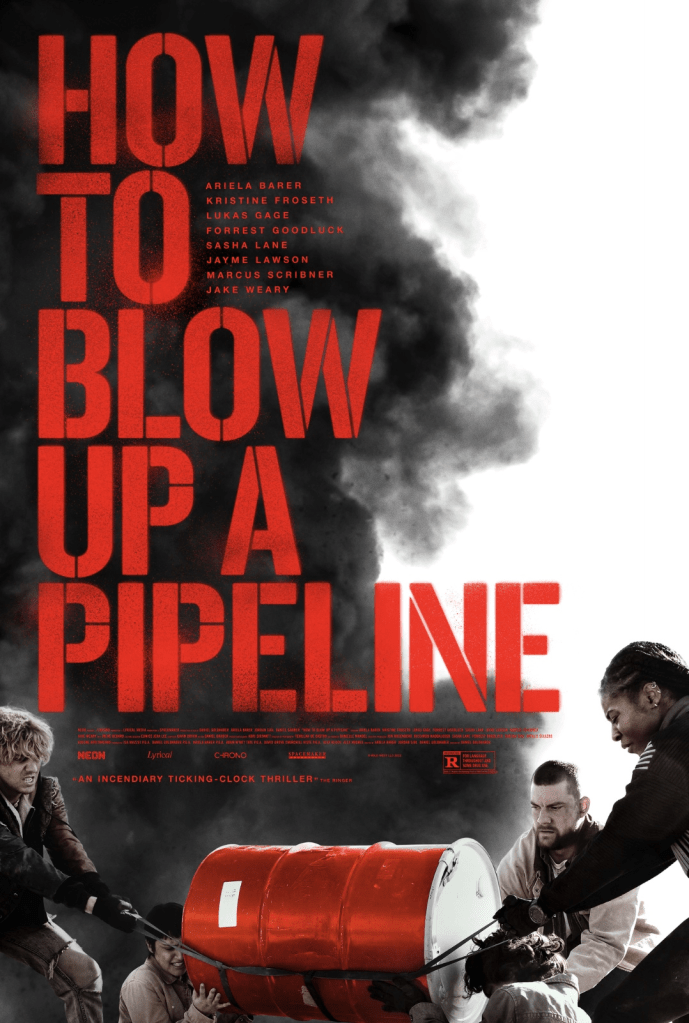
We’ve reached the point in our climate dystopia where our films can paint ecoterrorists as both the protagonists of a film and completely in the right. How to Blow Up a Pipeline is an incredibly tense thriller about a band of people whom all for different reasons believe that the destruction of an oil pipeline in Texas will serve their causes. Goldhaber cuts back and forth between the ecoterrorists’ past that motivated them to join this cause with the building of bombs and act of blowing up the pipeline. The film is remarkable in its ability to build tension and speak to a necessary issue in today’s world.

37. The Assistant (2020, Dir. Kitty Green)

The Assistant was the last film that I saw in theaters before the lockdown, and it was also the first great film I saw that year. Kitty Green managed to create an impressively tense drama for those with the patience to watch it. Rocking the impressive 92% to 25% critic to audience score on Rotten tomatoes, The Assistant is a perfect encapsulation of where my tastes differ from the average movie going public. I’m not looking for spectacle (not that there is anything wrong with looking for it in your entertainment); instead, I’m looking for subtle nuances that provoke a more genuine emotional response from me. Actor Julia Garner as Jane portrays the helplessness of a young woman attempting to navigate a workplace predisposed to cover for her boss’s indiscretions. Every moment of the film is poignant in its ability to express awfulness without explicitly showing anything.

36. Parallel Mothers (2021, Dir. Pedro Almodóvar)

The 2021 Almodóvar film leans heavily into his melodramatic roots to deliver a film that could be a season long plotline for soap opera but was also effectively emotional. Almodóvar continues to be a master of his craft as every second of the film has his fingerprints on them. Actresses Penélope Cruz and Milena Smit are wonderful as Janis and Ana two women who become entangled after giving birth on the same day. Their interplay helps to temper the absurdity of the screen play and deliver something emotionally devastating and believable.

35. Anatomy of a Fall (2023, Dir. Justine Triet)

Anatomy of a Fall (2023) - IMDb

The Palme winning Anatomy of a Fall cemented itself this year as one of the greatest courtroom dramas in cinema history. Sandra Hüller is impeccable as a wife who is under suspicion of killing her husband. She skirts the line in her performance such that the audience can never be certain if she is innocent or guilty. Much of that uncertainty is also due to Triet’s remarkable direction. The use of audio recordings of a fight between Hüller’s Sandra and her husband Samuel (Samuel Theis) is a linchpin of the film. It both represents a possible motive for Sandra and questions if normal marital fights can be used to incriminate. Triet delivers a complex picture of marriage and the court system.

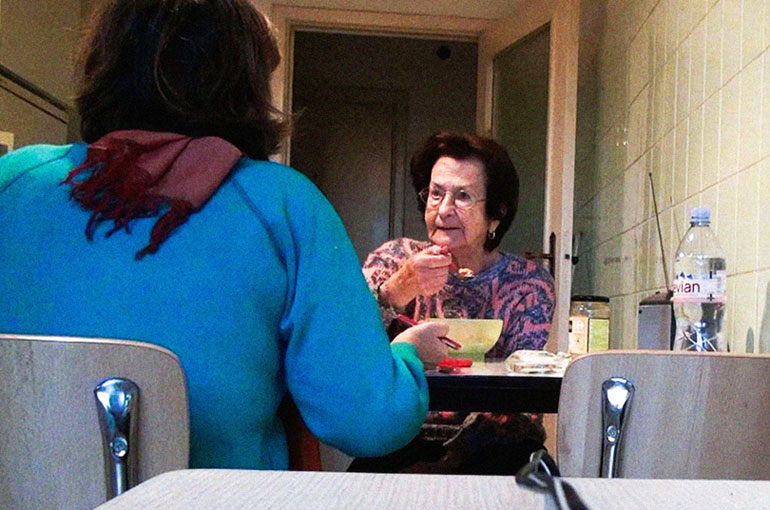
34. Vortex (2022, Dir. Gaspar Noé)

If provocateur Gaspar Noé releases a film it will indubitably make my year end list, and Vortex is no different, even though this one has a much more somber tone than his standard fair. The film utilizes a unique dual screen setup to capture the day-to-day goings on of a couple dealing with the women’s onset of Alzheimer’s disease. Notably, Italian auteur Dario Argento plays one of the leads in a stunning declaration that he can act just as well as make excellent films. Like many of Noé’s films Vortex is a brutal watching, this time just for more emotional reasons.

33. A Thousand and One (2023, Dir. A.V. Rockwell)

Sundance Grand Jury: Narrative winner A Thousand and One snuck up on me for how good it was. Similar to 2016’s Moonlight (Dir. Barry Jenkins), A Thousand and One explores the Black experience of a young man through various points in his life. Rockwell’s film, however, uses these time skips to show the evolving relationship between a boy and his mother played wonderfully by Teyana Taylor. Her performance is one of the best of the year it came out, as she manages to capture Inez’s change over the decade while still making each era feel like the same person, just with more years of experience. I’d also like to call out Gary Gunn’s score for the film which was my favorite of that year.

32. Gunda (2021, Dir. Viktor Kosakovskiy)

Ranking films can be difficult when exploring all aspects of cinema, and Gunda is a perfect encapsulation of why. The narrativeless, dialogueless, black and white, experimental documentary is about the life of animals on a Norwegian farm, specifically the pig Gunda. While completely different from every other film on this list (Andrea Arnold’s Cow made a year end list but not this one), the filmmaking is undeniable and it deserves to be recognized. By setting the camera at eye level to the young piglets (mere inches above the ground) the film captures the essence of the animals and brings life into them without unnecessary storytelling and personification.

31. One Fine Morning (2022, Dir. Mia Hansen-Løve)
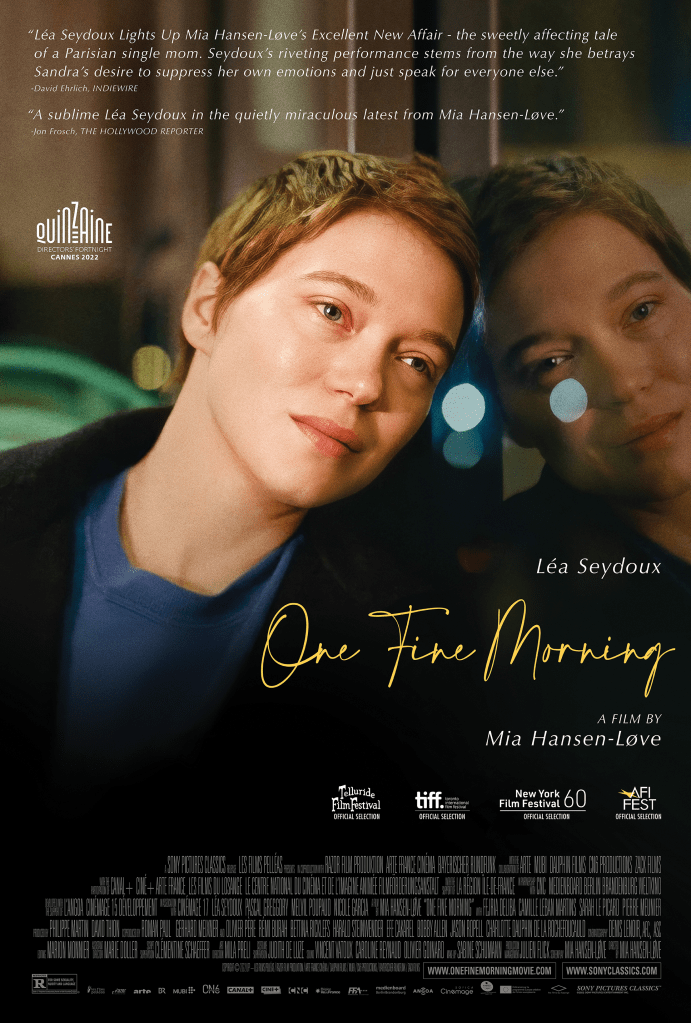
While I had been familiar with her since her Cannes winning performance in Blue is the Warmest Color, Léa Seydoux cemented herself as one of the best actors working today in this decade, and her work with Mia Hansen-Løve, a favorite director of mine, is her best of the decade thus far. Like most of Hansen-Løve’s films, One Fine Morning is a realistic depiction of women and the intermingling of their love lives with the additional complications in their lives. In this film, Sandra (Seydoux) must balance an ailing father with a fling with an old friend all while being a single mother. Simple yet poignant the film delivers what I love in present day French cinema, and Hansen-Løve is a large part of why that scene is as powerful as it is.

30. Another Round (2020, Dir. Thomas Vinterberg)
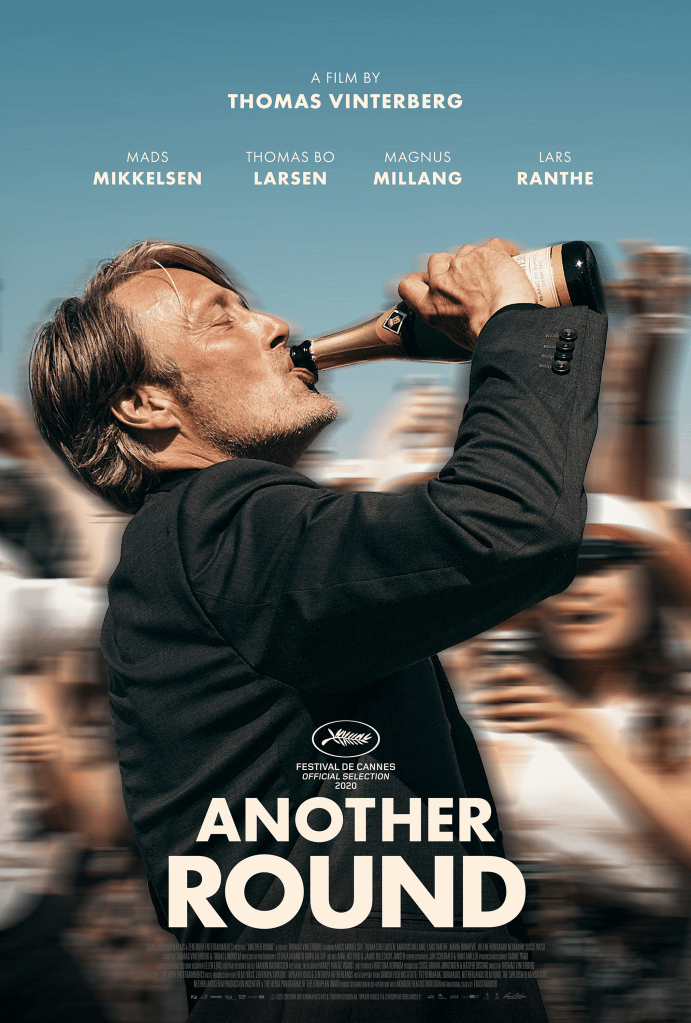
Mads Mikkelsen drunkenly dancing at the end of this film is the most fun 3 minutes I had in 2020 movies and succinctly encapsulates the themes of Another Round. Mikkelsen’s Martin and his friends have been playing a dangerous game where they attempted to live life at constant state of inebriation. As one would expect, this has some negative consequences for the group, but it also leads them to some of the highest highs they’ve had in their middle life. Mikkelsen’s jubilant dancing at the end reflects the urge to return to the bottle and chase those highs once more. Vinterberg refuses to deny the enjoyment his characters receive through their self-destructive habit.

29. Nomadland (2020, Dir. Chloé Zhao)

The best picture winner for the year of the pandemic may not have aged as well in that time as I would have thought (it was my number 1 film of the year when I released my year end list in January 2021, but now lags behind a few contemporaries), yet there is no denying that the film still is magnificent. After the success of Nomadland Zhao was gobbled up by the studio system and made one of the most unique (though largely panned) Marvel films, but that just goes to show how distinctive a voice she has behind the camera. Frances McDormand and Nomadland were the perfect vehicle for Zhao’s sensibilities, and the decision to use otherwise non-actors was more than a publicity casting as it highlighted the naturalistic tendencies that Zhao heavily utilizes.

28. Cyrano (2021, Dir. Joe Wright)
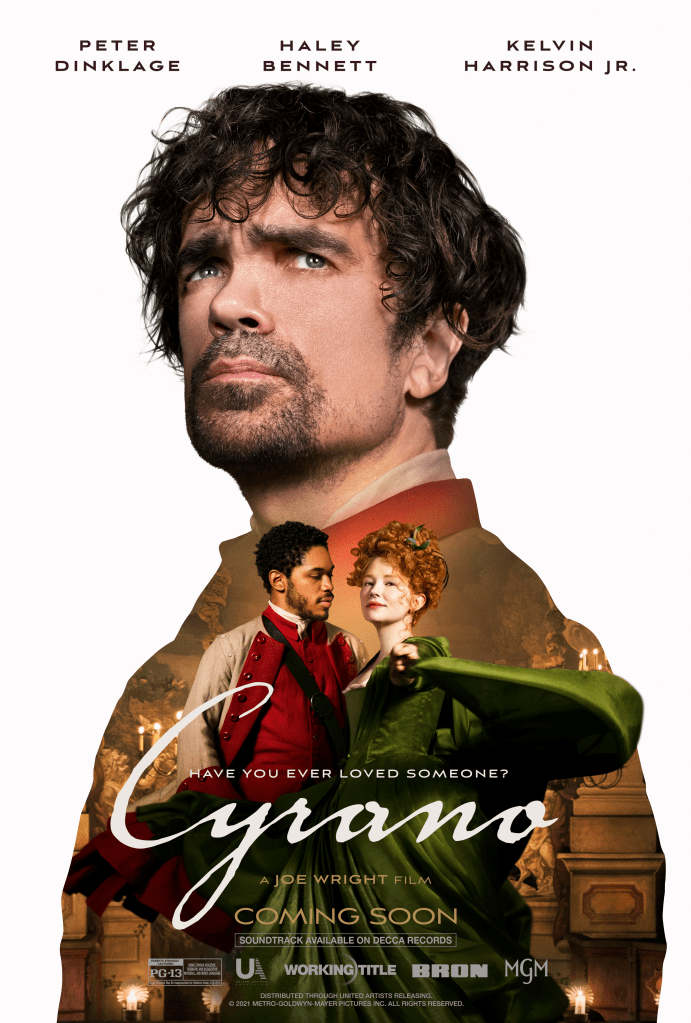
The film that grew in my estimation the most so far this decade, was Joe Wright’s musical adaptation of Cyrano de Bergerac. While Peter Dinklage may not be the most acclaim worthy singer to headline a musical in the 2020s, his performance in central to why Cyrano is in my opinion this decade’s best musical. The story is tried and true as it’s been adapted to screen numerous times, but this version captures the magic like few others do. Cyrano’s passion for Roxanne (Haley Bennett) and want for her to be happy makes for a great bit of camaraderie between him and Christian (Kelvin Harrison Jr.), and Joe Wright’s trademark visual flare enhances the classic tale just enough to make the film sing.

27. Return to Seoul (2022, Dir. Davy Chou)

While I may have aged out of my twenties (by more than I care to admit), the depiction of a twentysomething person wandering through life in search of meaning still resonates with my soul, and Return to Seoul was one of the best entrants in that genre. Park Ji-min as the French Korean Freddie perfectly captures that feeling as she explores South Korea, a place where despite being from she has no connection. The distance she exhibits when reconnecting with her biological father and resistance to creating a relationship with him rings true as priorities change from generation to generation, and Freddie’s interests lie more in drinking and enjoying her youth than falling into the confines of familial ties.

26. Women Talking (2022, Dir. Sarah Polley)
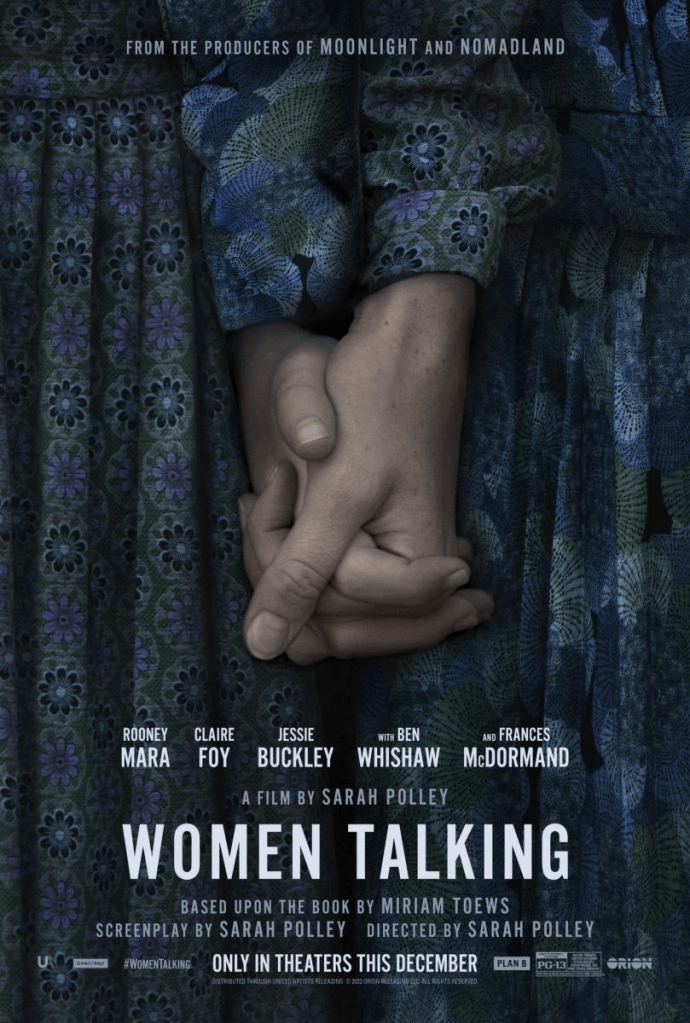
While many criticized the film for being too play-like (the camera seldom leaves a single barn), Sarah Polley captured something special in her long-awaited follow-up to the 2012 documentary Stories We Tell. Starring a real who’s who of great female actresses, Women Talking uses a Mennonite community to tell a story of rampant patriarchal abuse in present day without the film feeling preachy. This near present day setting acts as a constant reminder that as far as we’ve come, the trappings still exist all around us. Each of the adult women are given large meaty parts to bring the audience into the lives these women lead, and they all succeed in the most literally titled film on this list.

25. The Zone of Interest (2023, Dir. Jonathan Glazer)
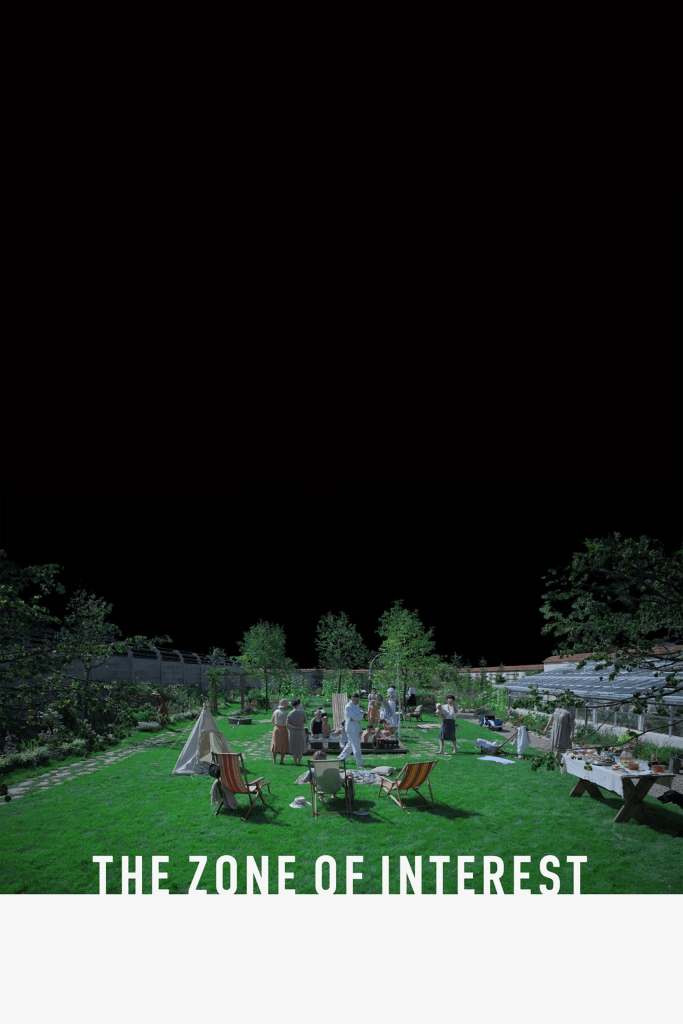
The second of Sandra Hüller’s Oscar worth performances that year, Jonathan Glazer’s follow up to the haunting 2014 Under the Skin is no less shaking. Taking place in an estate sharing a wall with Auschwitz, The Zone of Interest manages to capture the horrors of the Holocaust without showing a single frame of the violence inflicted upon its victims. Instead, everything is conveyed through sound design and the acting of the guilty family. The sound design is particularly remarkable, and it winning the best sound Oscar for its year was the best thing the Academy did all decade. While the sound design may be the most apparent standout of the film, the entire thing is meticulously put together in a way to leave the viewer in devastated silence.

24. The Blue Caftan (2023, Dir. Maryam Touzani)
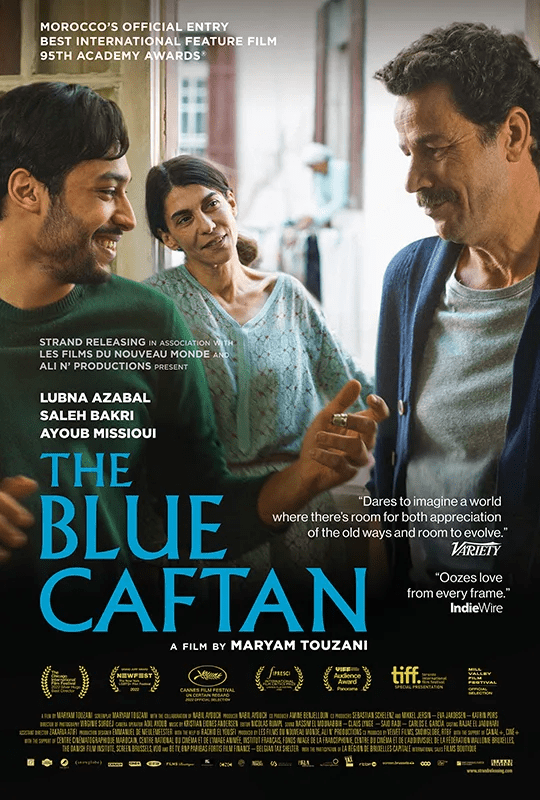
What at its heart is a love triangle film between a married couple and the worker they hire to work at their apparel shop, The Blue Caftan is an exceptionally warm watch that can’t help but fill the viewer with love. While Youssef (Ayoub Missioui) would be seen as in interloping home wrecker in most films, here he and his relationship with Halim (Saleh Bakri) is understood by Halim’s wife Mina (Lubna Azabal) and the three of them end up in a familial relationship where each clearly cares about the rest. A complex romance, The Blue Caftan was an amazing watch that stuck with me even as a mid-SIFF watch.

23. The Eternal Daughter (2022, Dir. Joanna Hogg)
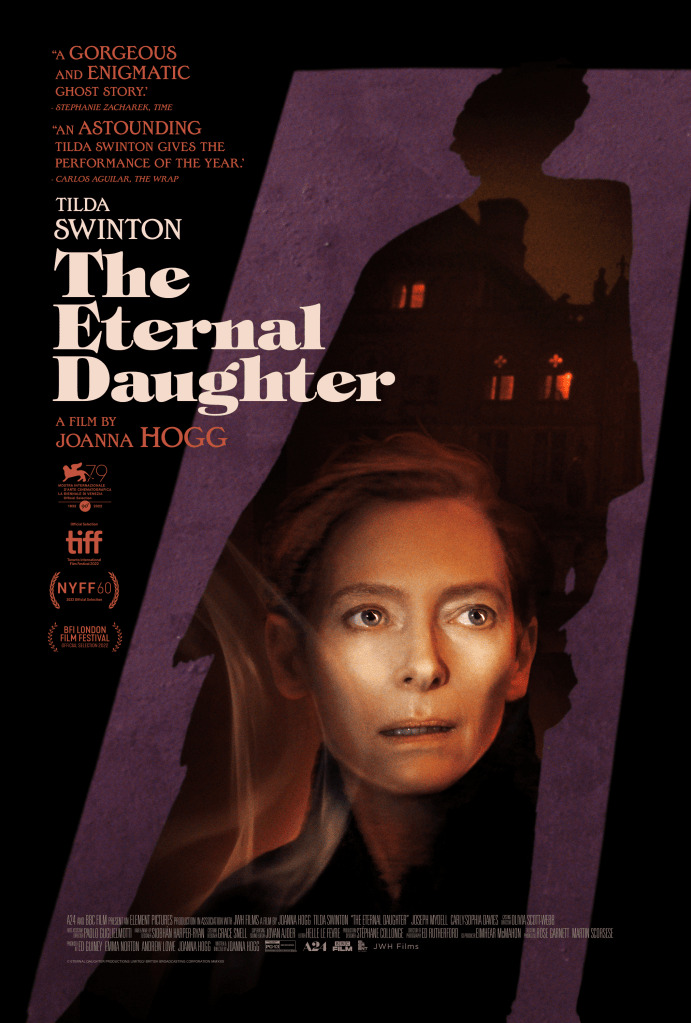
The third feature in director Joanna Hogg’s Souvenir series adopts a more mysterious tone than its grounded predecessors. It also trades a mother daughter casting choice of Tilda Swinton and Honor Swinton Byrne for dual roles for Tilda as both mother and daughter. While the film is full of Hogg’s trademark slow conversations with meaning carefully hidden behind meticulously chosen dialogue, the aforementioned changes lead to a single static shot that’s the most emotional moments of the year (at least that doesn’t come from the next film).

22. Sing Sing (2024, Dir. Greg Kwedar)

For all the accolades I will sing for the distribution studio A24, Sing Sing was one of the largest failures in their tenure. Not because the movie is bad, obviously as it has made my top 10 of the year, but because they completely botched the distribution of the film. It never even came close to opening wide which likely cost it quite a few Oscar nominations. That said, even a baffeling distribution model shouldn’t be enough to deny Colman Domingo his second consecutive Oscar nomination as the enigmatic prisoner John Divine Whitfield. The film headlined by Domingo imparts the importance of art programs in correctional facilities to the wider public and is an essential film in humanizing the incarcerated population.

21. The Breaking Ice (2024, Dir. Anthony Chen)
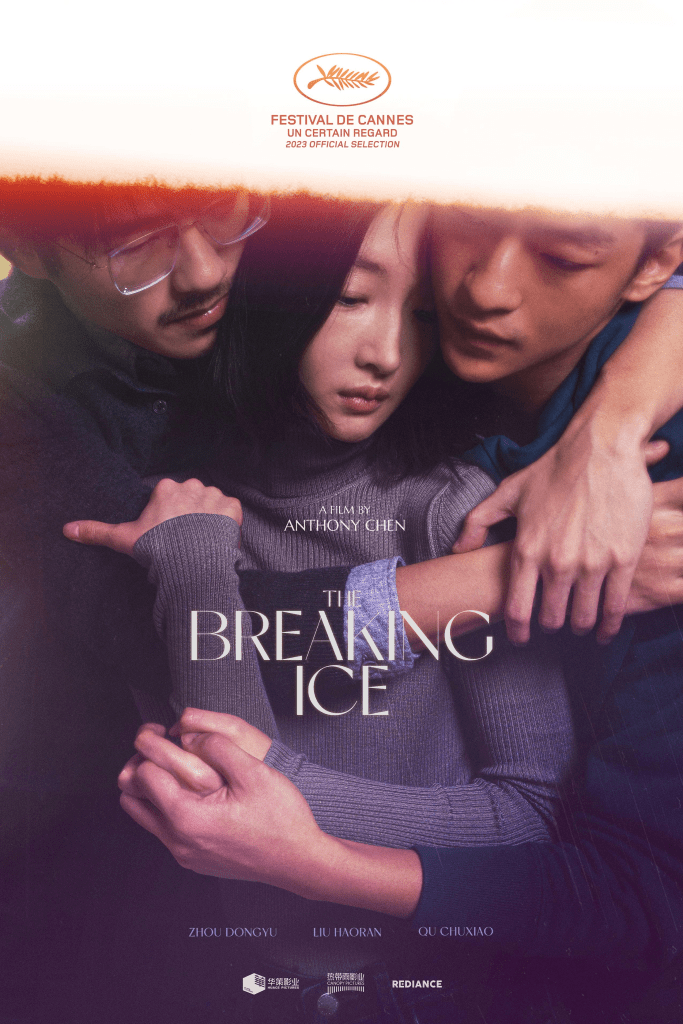
One of the least seen films on this list, The Breaking Ice touched me in a way that I was ill-prepared for. Li Haofeng (Haoran Liu) is a twenty something man lost in the world. He is constantly receiving calls from his therapist’s office concerned that he hasn’t shown up to his session and seems unsure of what his life is for. While out of town for the wedding of a college friend, he ends up in the company of a tour guide Nana (Dongyu Zhou) and her friend Han Xiao (Chuxiao Qu). The three of them create an immediate friendship that hovers in the liminal space between platonic and romantic and brought my depressed self a lot of hope in the cold winter.

20. The Worst Person in the World (2021, Dir. Joachim Trier)
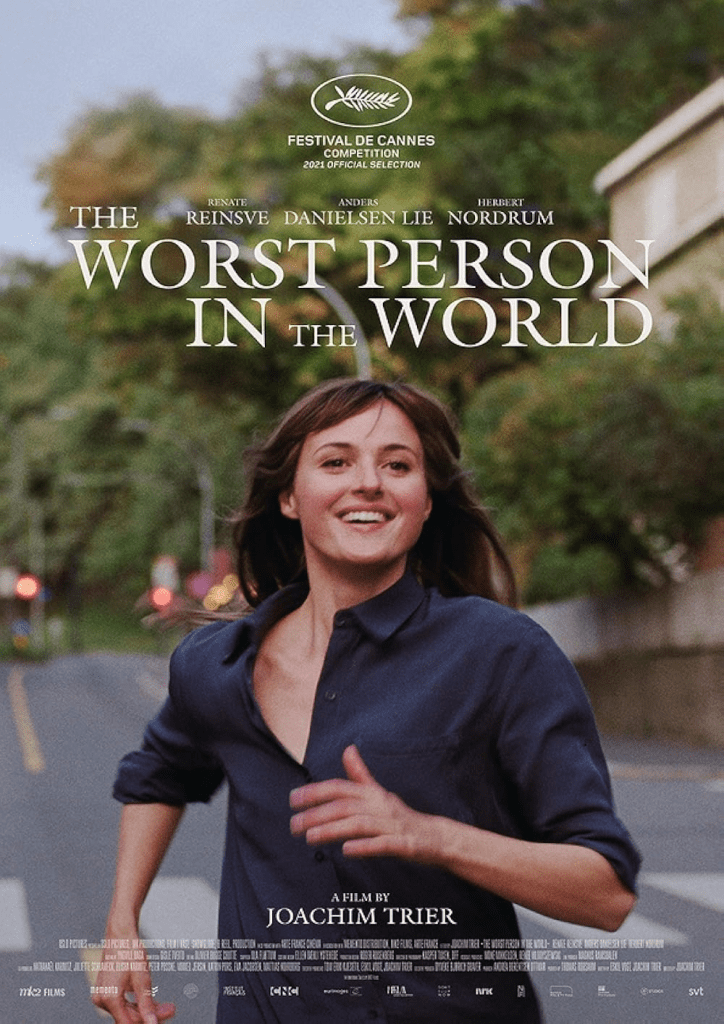
The 2022 Oscars marked a paradigm shift for international features with two of the films (The Worst Person in the World and another film which will be arriving later on this list) breaking out of the specific category and making an appearance in multiple categories. Like the aforementioned Return to Seoul, The Worst Person in the World is another entry into the young adult lost in the world genre that I love so much. Renate Reinsve plays Julie as this film’s lost protagonist. What makes this genre special is how new the feeling seems to be as the millennials were the first generation to have it worse than their parents and Trier captures that cosmic confusion in his film.

19. Spencer (2021, Dir. Pablo Larraín)

I have said it many times before, but I will say it again: “Kristen Stewart is the best actress of her generation”. Her portrayal of Princess Diana is poignant, as she captures the agony and unrest that Diana was undergoing while contemplating divorcing Prince Charles. While Larraín’s direction is magnificent, and the costuming and production design enhance the film, Stewart’s performance is the reason to watch Spencer. Much like with Jackie (2016) and Natalie Portman, Larraín does just enough to let his lead actress convey the breadth of emotions during a trying time.

18. Bergman Island (2021, Dir. Mia Hansen-Løve)
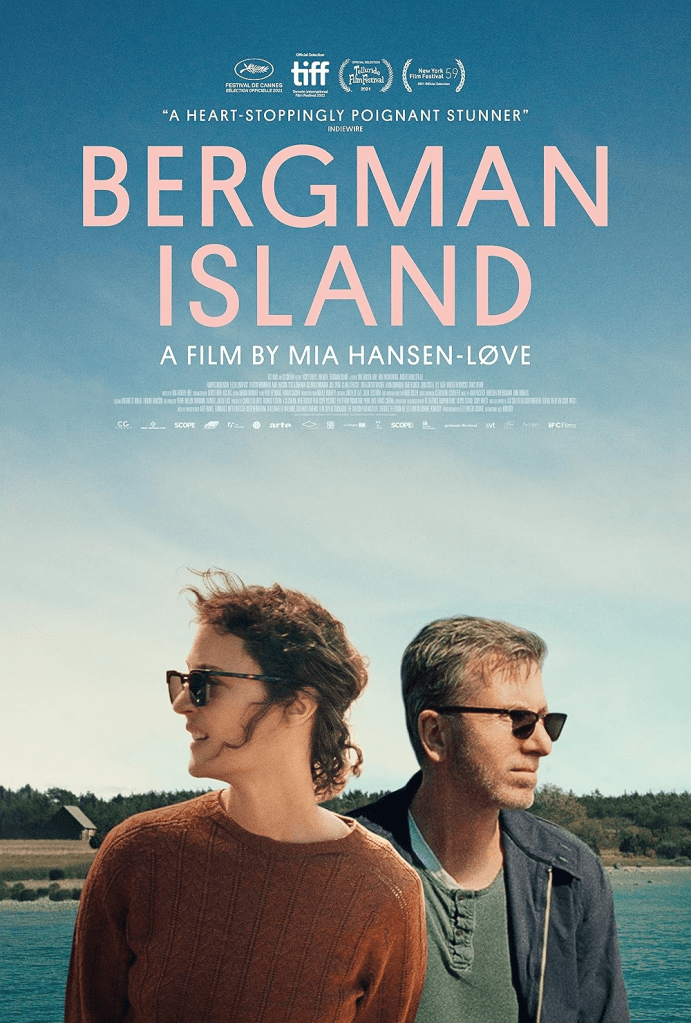
In this outing, director Mia Hansen-Løve delivers another superb picture featuring her strength of capturing interpersonal relationships. Like in all her previous pictures, she creates characters with an emotional depth that is front and center to the story. Bergman Island chooses to explore this complexity by utilizing the titular stunt location as well as a movie-within-a-movie trope.  Both feed into her story seamlessly, build upon the wonderful character depth. The film is subtle and warm in its depiction of love and the complexities of relationships and honest in its focus on the creative process.

17. First Cow (2020, Dir. Kelly Reichardt)

First Cow is actually one of my least favorite Kelly Reichardt films, but even a middling Reichardt film is easily one of the best films of the decade. Cookie played wonderfully by John Magaro is one of the most sympathetic characters to ever be brought to screen. He’s just a young man with domestic sensibilities trapped on the frontier. Magaro captures the kindhearted Cookie by portraying him as extremely soft-spoken and caring. Even when he and his friend King-Lu (Orion Lee) start stealing milk to bake cakes for profit, it’s clear that King-Lu is doing so for the freedom the capital will bring the pair while Cookie just loves cooking for his fellow man. He wants nothing more than to be in the service industry. Even if the two men have slightly different goals, Reichardt manages to recapture the spark from one of her first films Old Joy (2006) by delivering a tranquil tale of male friendship devoid of machismo posturing.

16. Nickel Boys (2024, Dir. RaMell Ross)

Shot almost entirely in first person, RaMell Ross’s devastating examination of the criminalization of Black boys, is a masterwork. Chronicling the friendship of two Black boys, Elwood (Ethan Herisse) and Turner (Brandon Wilson), who meet in Nickel Academy, a reform school for criminal youth with a sordid secret Nickel Boys pushes the boundaries of the medium to induce sympathy for its two subjects. By putting oneself directly in the eyes of the dual protagonists, one is able to empathize with the unjust lot in life they received. Early on the film plays loose with narrative structure playing only short clips over long periods in time, but once Elwood enters Nickel and meets Turner, the film takes a somewhat more narratively structured approach and is stronger for it.  

15. Do Not Expect Too Much from the End of the World (2024, Dir. Radu Jude)
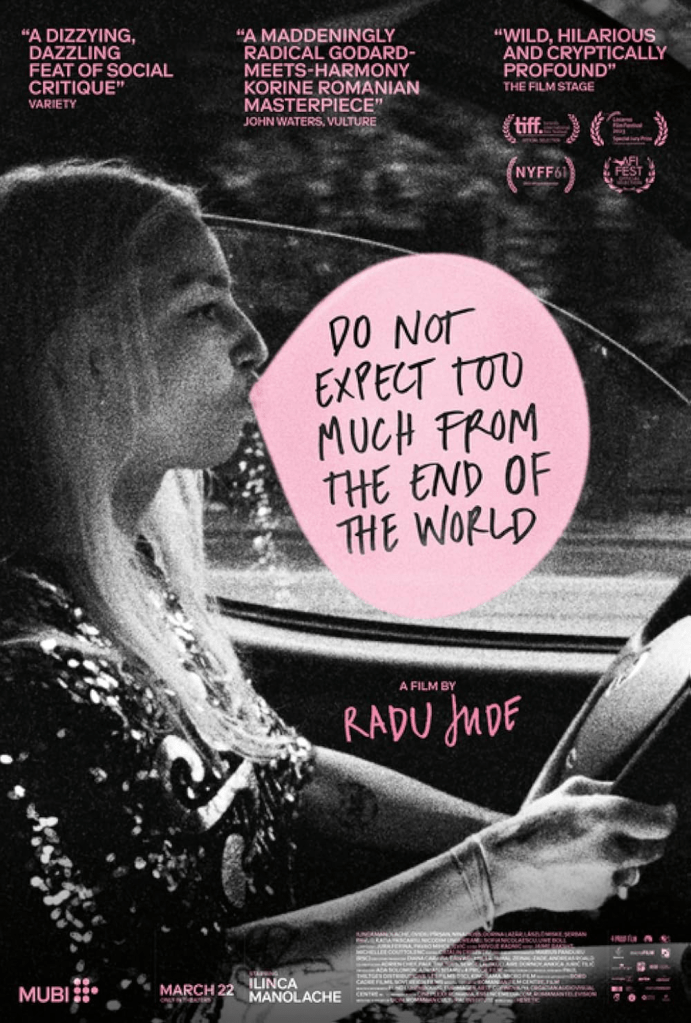
At nearly three hours long, this Romanian film will most assuredly not be for everyone, especially as Angela’s (Ilinca Manolache) alter-ego Bobita is tailor made to be a turn off, but the brashness of the film and its lead are essential to the feel of the film. Jude’s film can be seen as a hit piece against capitalistic tendencies and the corporations that have complete control over a working-class person’s ability to survive in the world. Overworked and underpaid, Angela is put face to face with the people whose lives her bosses directly negatively impacted, but in need of her paycheck she escapes into short videos under her assumed male chauvinist identity as a reprieve from the world crumbling around her.

14. Shiva Baby (2021, Dir. Emma Seligman)

The first feature of director Emma Seligman was part of a pattern of great first films by non-male directors this decade. The comedy balances being genuinely funny with being one of the tensest watches of the year. Highlighted by a disconcerting score by Ariel Marx, Shiva Baby captures to suffocating feeling that family functions can have, especially when one has a secret to keep. While the tension can flirt with uncomfortable levels at times, the absurdity of Danielle’s (Rachel Sennott) situation and a reliable joke line from her father adds just the right amount of humor and levity to the stressful circumstances.

13. Licorice Pizza (2021, Dir. Paul Thomas Anderson)

The closest to a perfect film that 2021 had to offer, the newest work by auteur Paul Thomas Anderson is an unconventional love story between two people who really should not be in love. The episodic style of the film serves the romance between Gary (Cooper Hoffman) and Alana (Alana Haim) well. It allows it to develop gradually. In addition to being a sweet story of first love, Licorice Pizza is an extremely funny film. Most of Anderson’s films have a level of humor to them, but it is in the forefront here more than any of his other films.

12. All We Imagine as Light (2024, Dir. Payal Kapadia)

Something needs to be done about the best international film category at the Oscars because countries refuse to put forward their best films (especially India between this and RRR in 2022) leaving them unable to be nominated thus denying them of the recognition that they deserve. All We Imagine as Light is a wonderful picture following three women living on their own in Mumbai. Directed by a woman, Payal Kapadia, the film captures the intimacy between female friendship and its universality even if not more so existent in a country where women’s rights to independence, especially in making their romantic decisions, is less common.

11. The Taste of Things (2023, Dir. Anh Hung Tran)
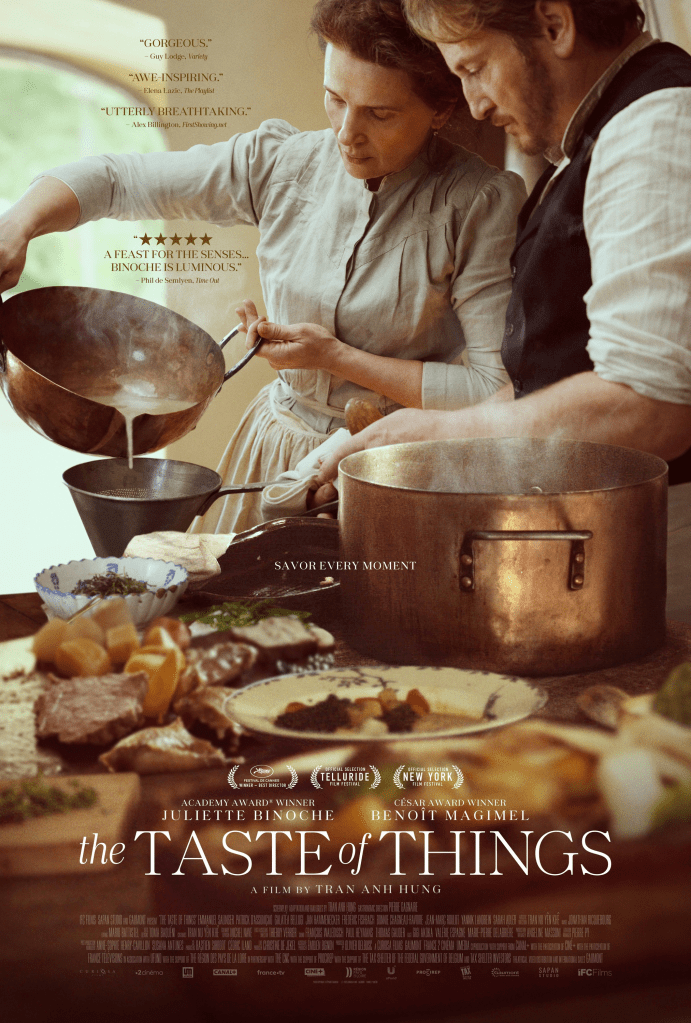
While talking about the problems of the best international film category at the Oscars, many people point to The Taste of Things as another offender as it likely prevented Anatomy of a Fall from winning the Oscar, and yet I’m here to tell you that France was right to submit The Taste of Things as its submission that year, it is the better film. Part love story and part food porn, Juliette Binoche is once again perfect in this film as an estate cook who works for her lover the chef Dodin Bouffant (Benoît Magimel), yet despite her subservient position and the norms of the era maintains an unprecedented level of independence. Likely the most romantic film I’ve seen this decade, director Anh Hung Tran created something masterful that deserves to be more than a fun fact related to Oscar submissions.

10. Memoria (2021, Dir. Apichatpong Weerasethakul)

The Jury Prize winner at the first Cannes back after the pandemic, Apichatpong Weerasethakul’s Memoria is both another in a long line of similar films by him and the first one to really resonate with me. Maybe it’s the casting of Tilda Swinton who makes yet another appearance on this list, but Memoria captured me more than his other films despite sharing the plodding nature of his other films. The film was originally set to not be released for home viewing as Weerasethakul wanted the film to only be seen on the big screen, and while I do wish I had been able to there I’m just glad I had any chance to see it. The film set a momentous tone for the first slot in the top 10 of the decade thus far.

9. Drive My Car (2021, Dir. Ryûsuke Hamaguchi)

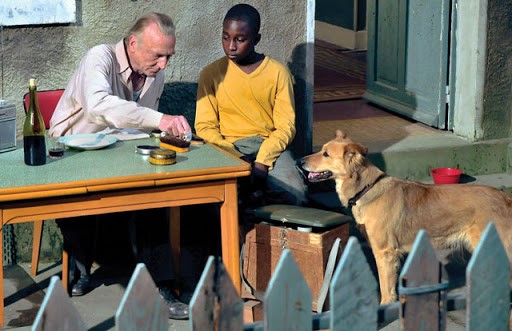
The three hour, Japanese, slow burn narrative may be a hard sell to many, but the film is an example of the lasting impact that cinema can have on a person. After the lengthy prologue (the opening credits appear at the forty-minute mark), the film settles into its pattern for the remainder of the film. Yûsuke Kafuku (Hidetoshi Nishijima) attends practice for the play he is directing and then rides in the car contemplating life while Misaki (Tôko Miura) drives him. This may not seem like much especially considering the length of the film, but the repetitive nature of these moments allows the audience to share in Yûsuke’s reflections and develop a strong bond with each character.

8. Small Axe: Lovers Rock (2020, Dir. Steve McQueen)
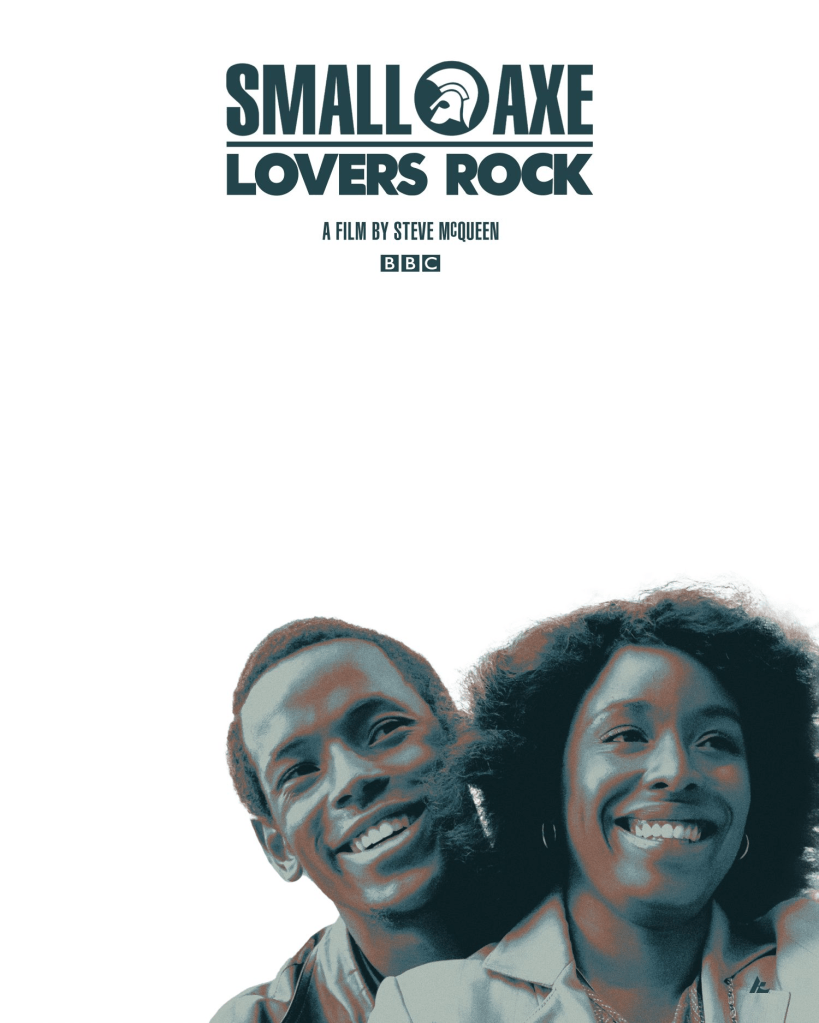
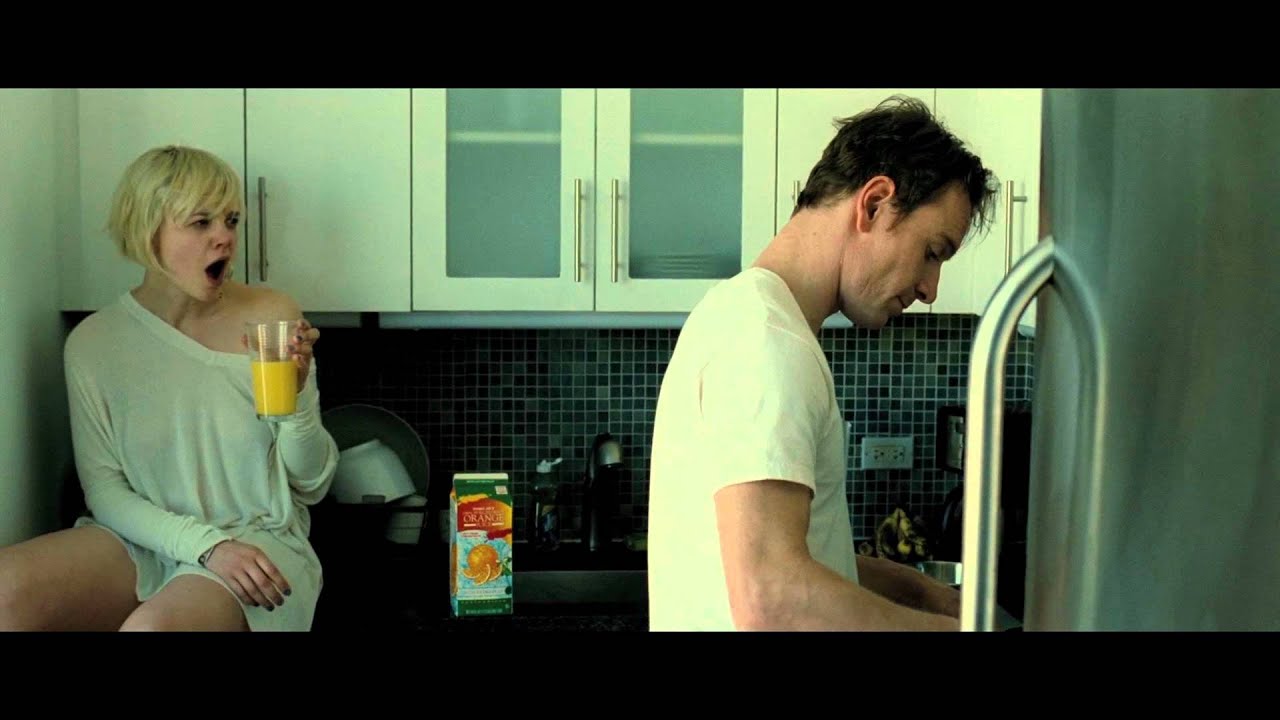
Likely the greatest piece of art to come out of 2020 was Steve McQueen’s Small Axe mini-series of features, and while Mangrove was a great courtroom drama, Lovers Rock is the great Steve McQueen film of the set. When I think about McQueen’s body of work, I instinctively think of long scenes. Examples being the 17-minute scene of Bobby Sands (Michael Fassbender) talking to the priest (Rory Mullen) in Hunger (2008) and of Chiwetel Ejiofor tiptoeing to avoid asphyxiation in 12 Years a Slave (2013). Rather than those two though, Lovers Rock long scene instead harkens back to a scene from my personal favorite McQueen film Shame (2012) where Carey Mulligan extends the 3-minute Frank Sinatra Classic to nearly 5. This extended cut of the song is almost painful in it’s beauty, and the same can be said with the Janet Kay’s ‘Silly Games’ scene in Lovers Rock. The 3 ½-minute song is looped and extended to 10 full minutes which is likely not something that would have ever happened in the reggae party depicted. It’s in that fantasy space, however, that the film transports us into the room. We feel the sublime joy of the party goers as they find a momentary escape from the prejudiced world on the other side of the sweltering walls housing the party.

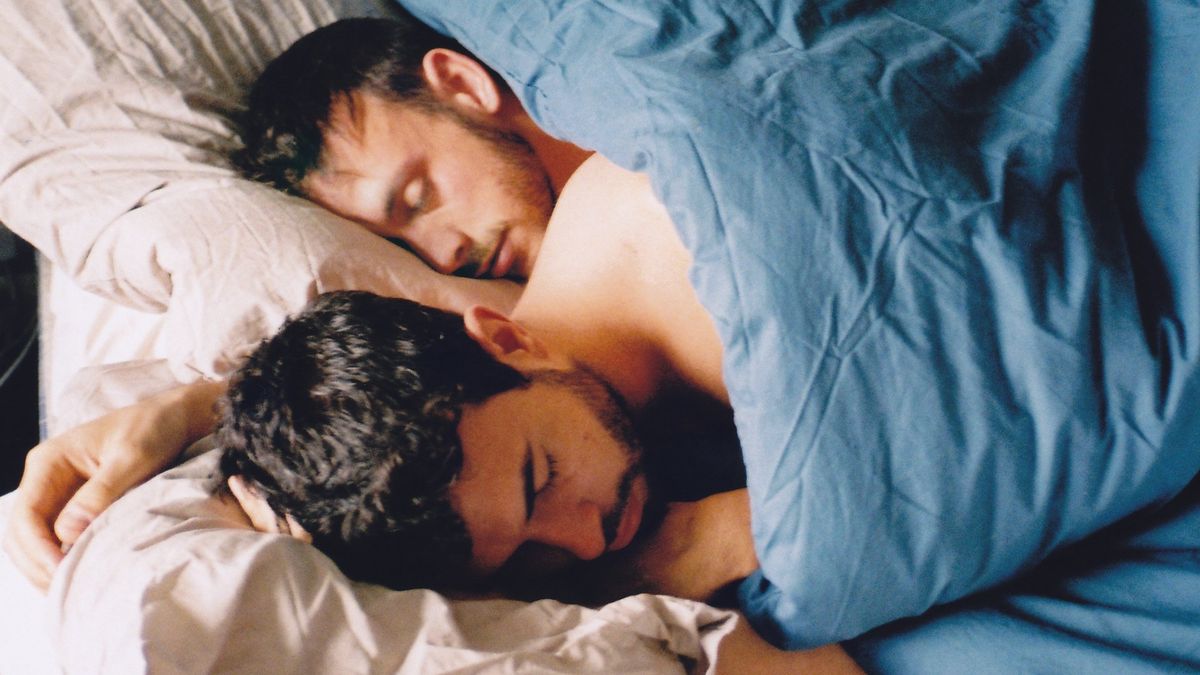
7. All of Us Strangers (2023, Dir. Andrew Haigh)
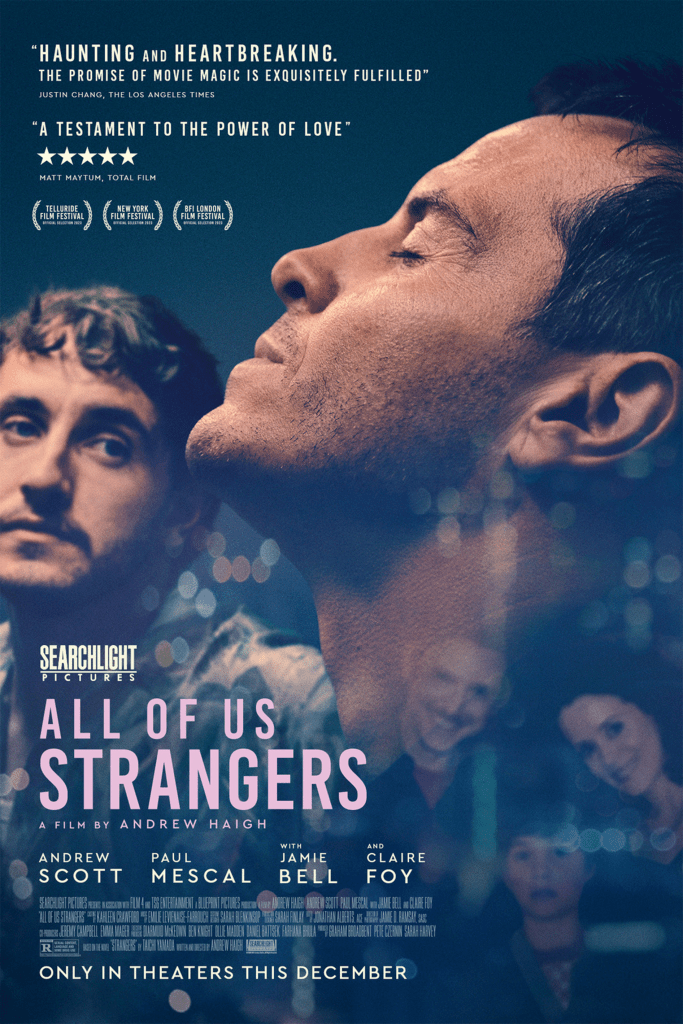
One of the last films I saw in my 2023 film catch up, All of Us Strangers came awfully close to being my number one. The film is an exploration of a man’s struggles with his queerness due in large part to never being able to tell his parents who he was. Haigh lets Adam (Andrew Scott) process that longing by creating a world where his parents still live in their childhood home having never aged since they passed when he was 12. These scenes are intercut with his burgeoning relationship with Harry (Paul Mescal) which grows as Adam is able to process his identity with his late parents. The film hit me especially hard as a queer person who is struggling with processing her past, but even without that personal connection the film would rank high on this list.

6. Past Lives (2023, Dir. Celine Song)

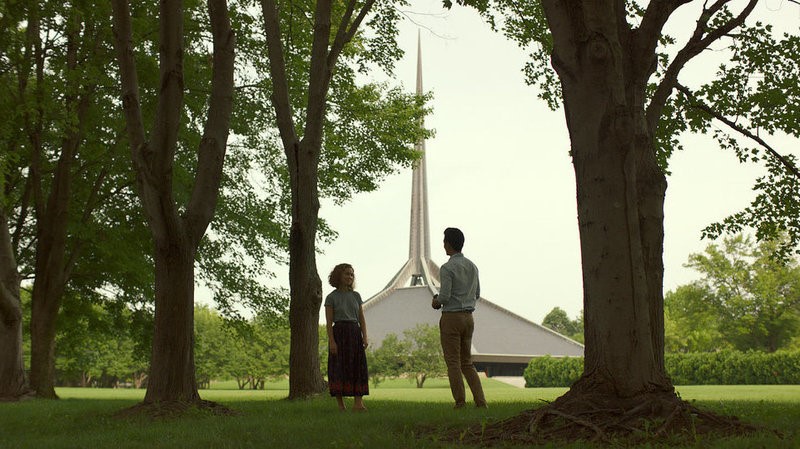
I managed to catch Celine Song’s directorial debut at the opening night gala for SIFF (The Seattle International Film Festival) and while she could not directly talk about her captivating screenplay – it was the midst of the writer’s strike – one couldn’t help but see the brilliance in her that lead to such a perfect screenplay and perfect movie as she addressed the pack room of viewers stunned in silence. Past Lives is both a romance and not at the same time. It captures the longing that exists when considering the potential loves that we never had, and how even when we are happy in our current lives those memories persist. Greta Lee is revelatory as a woman who is happy in her current life, married to a man she loves, but is taken by the remembrance of a boy she used to know. The movie feels like the inverse of Linklater’s Before films and deserves to be seen with the same reverence.

5. The Brutalist (2024, Dir. Brady Corbet)
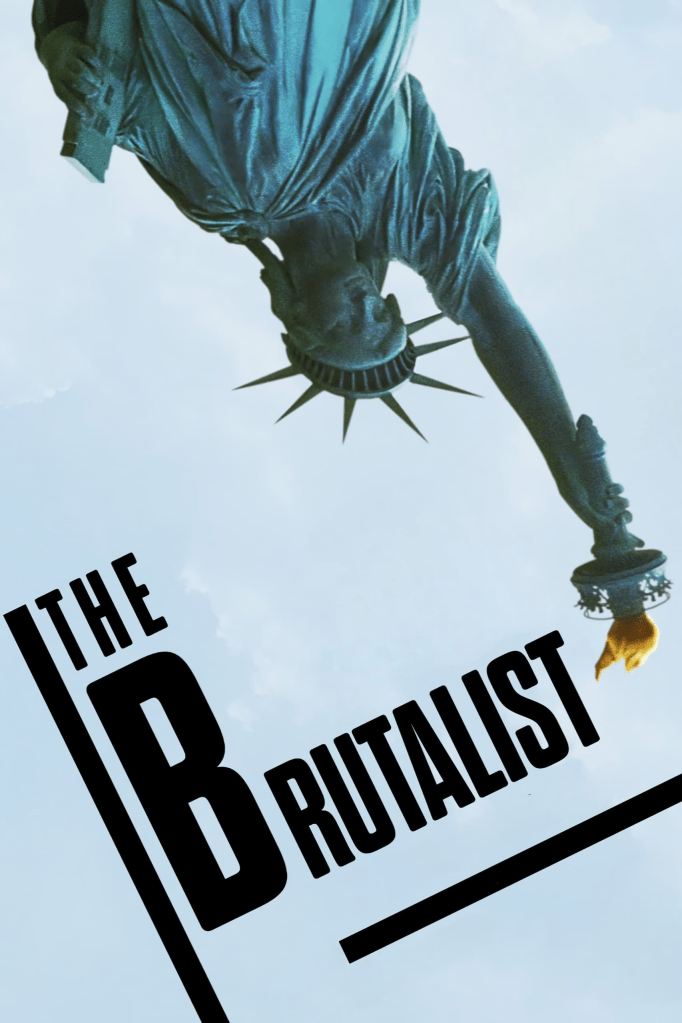
Sometimes upon first viewing of a film, I don’t think anything special of it, yet even without a subsequent viewing it lodges itself in my mind and refuses to budge greatly increasing in my opinion throughout the years. This is what happened with director Brady Corbet’s previous film, Vox Lux. That film still haunts me six plus years after its release. The Brutalist I feel will have a likewise long lifespan in my mind, though this one hit with me immediately. This three-and-a-half-hour epic, complete with overture and intermission, explores the impact trauma has on oneself and the processing of said trauma through art. Beautifully shot and scored, The Brutalist feels akin to a dream, with fictional architect László Tóth’s building being impossible to comprehend in its scope and layout.

4. Never Rarely Sometime Always (2020, Dir. Eliza Hittman)4
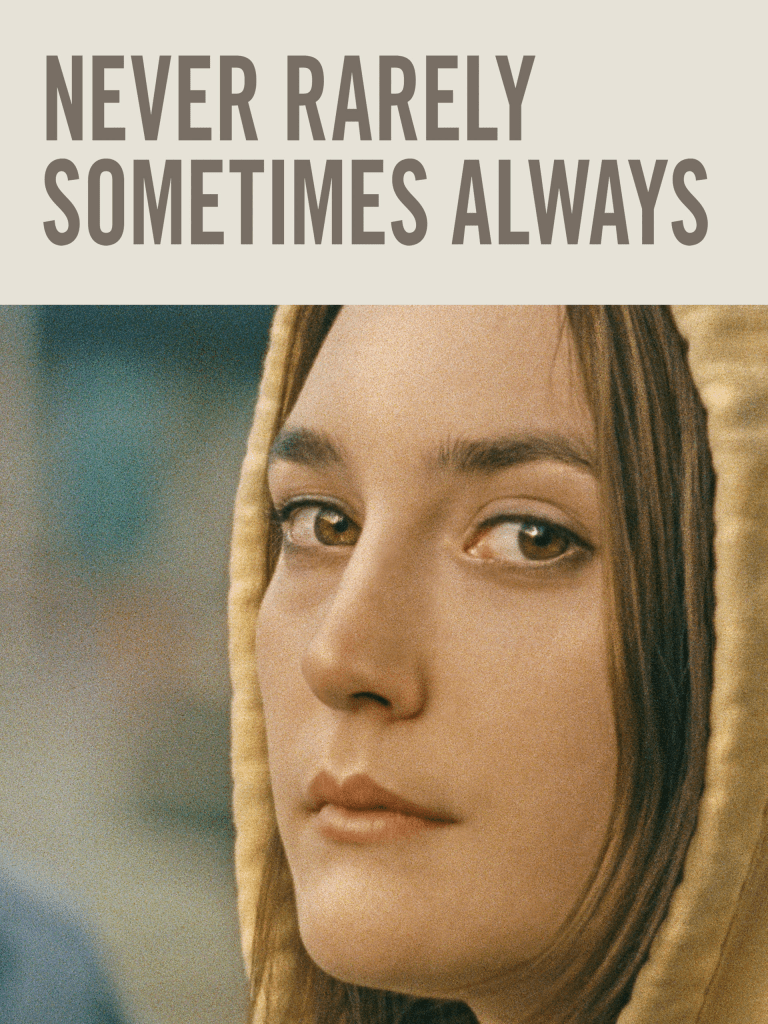
A trick to making it near the top of one of my year end list is to make me sob uncontrollably, yet not feel exploitative when doing so. Never Rarely Sometimes Always accomplished that multiple times in its runtime. The most obvious instance of this happening is during the scene from which the film takes its name. Autumn (Sidney Flanigan) is sitting in a planned parenthood office to get an abortion. We know that she is pregnant, but we don’t know much in the way of the details about how it happened. When the nurse asks the standard questionnaire for which Autumn is to answer with one of the words in the film’s title, we learn that the circumstances of the teenager’s sex life are more insidious than careless. As the questions become more personal and cut deeper Flanigan’s performance turns tragic. Instead of answering all she can do is cry, all the viewer can do is cry, all I can do simply remembering this scene is cry.

3. Tár (2022, Dir. Todd Field)
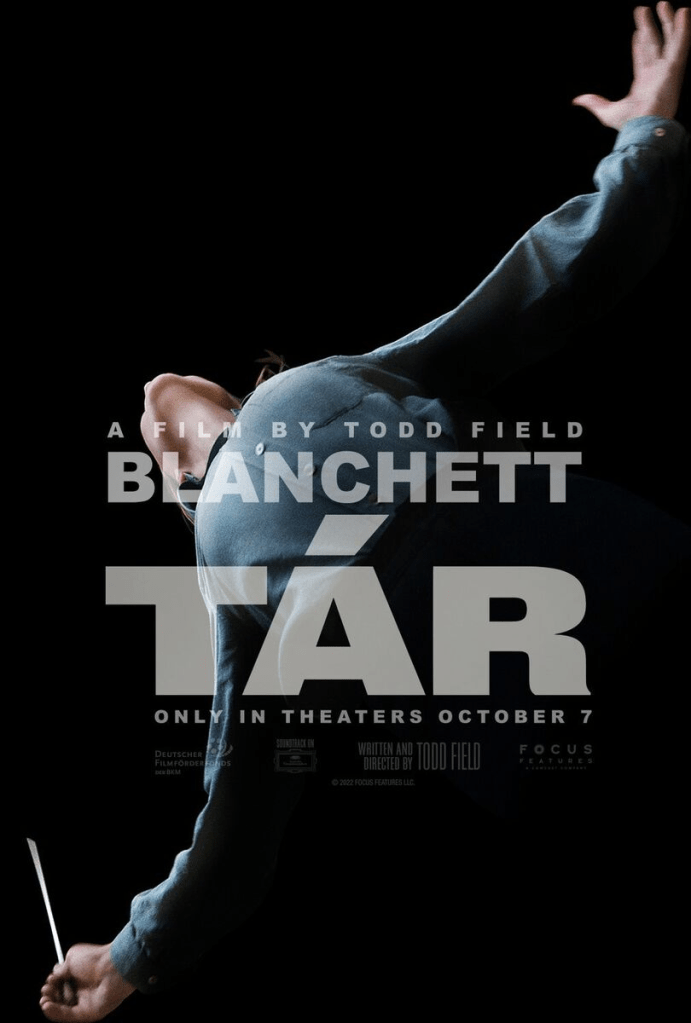
I’m an auteurist at heart, I believe most films are a product of their director first and foremost, but TÁR is one of those few exceptions. TÁR is 100% Cate Blanchett’s film. The film focuses on one of our greatest working actors for the entire three-hour duration of the film while she slowly begins to reckon with the decisions she’s made over the course of her career. Blanchett’s perfectly captures the fictional composer who exudes charisma while preparing for a new performance and pursuing affairs.

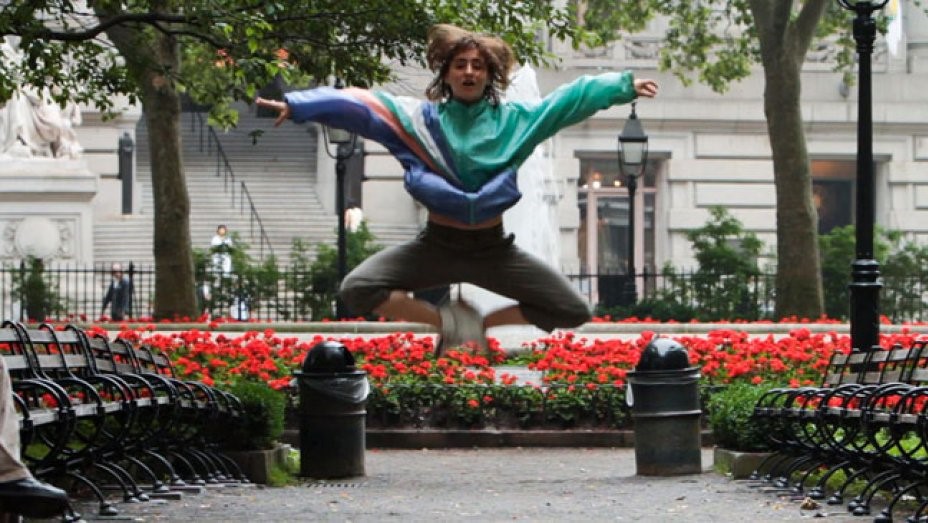
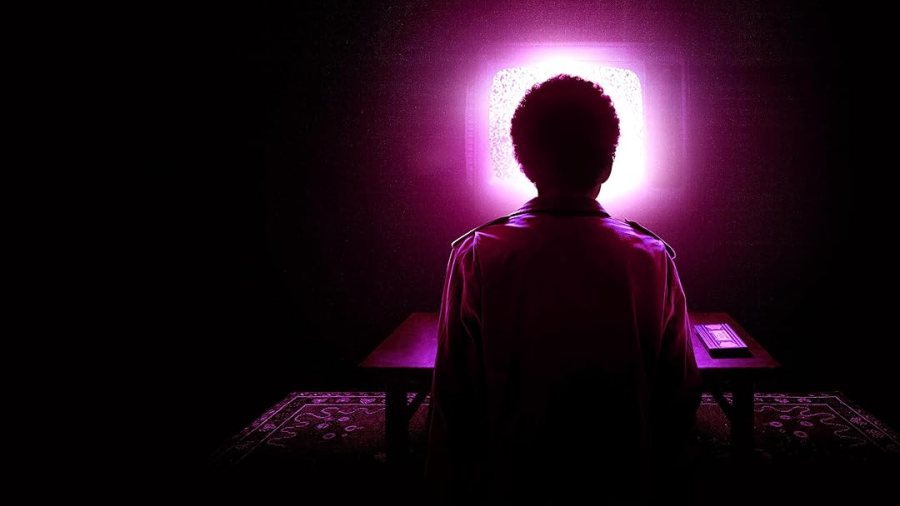
2. I Saw the TV Glow (2024, Dir. Jane Schoenbrun)

In their newest release, Jane Schoenbrun takes the power of nostalgia and uses it as a jumping off point to make one of the most poignant allegories for the trans experience ever committed to celluloid (yes I double checked, it was shot on film). Owen (played by Ian Foreman while young and Justice Smith after) and Maddy (Brigette Lundy-Paine) are both outsiders who bond over a teenage TV show called the Pink Opaque. Their experiences with the show take on a surreal quality and end up existing as a hazy memory but are essential to their being. While Owen’s journey takes a dark turn due to personal inaction, the film’s enduring image is the message “there is still time” written in sidewalk chalk on the street in suburbia. This sentiment leaves the viewer with the hope that it’s never too late to live one’s truth.

1. Aftersun (2022, Dir. Charlotte Wells)

Number one with a bullet, the directorial debut of Charlotte Wells is a meandering memory captured largely on standard def camcorder. What makes Aftersun so special is the underlying emotionality of the film. What may look like just home movies of a father/daughter trip to a Turkish resort takes on a much deeper meaning because of the implications of the present. It’s likely that this is the last time the two main characters ever saw each other and witnessing their personal mostly, but not completely, hidden feelings feels like prying into things which should never be shared. Calum (Paul Mescal) is doing everything in his power to create a wonderful memory for Sophie (newcomer Frankie Corio), but his personal dramas have a way of seeping out in a way that affects Sophie for years to come. Aftersun is the best cinema had to offer in its year, and is the best film of the decade thus far.

The Best Films of the Decade: Part 7

I really hit a wall, and I am sorry that this series stalled out. The state of the world compounded with my depression to strip of my ability to focus on film for a few months, but it is still my passion am going to do my best to continue writing.

Part 1. Honorable Mentions 101-150 (in alphabetical order)
Part 2. 100 – 91
Part 3. 90 – 81
Part 4. 80 – 71
Part 5. 70 – 61
Part 6. 60 – 51
Part 7. 50 – 41 (below)
Part 8. 40 – 31 (coming soon)
Part 9. 30 – 21 (coming soon)
Part 10. 20 – 11 (coming soon)
Part 11. 10 – 1 (coming soon)

  1. The Fits (dir. Anna Rose Holmer, 2016)

To this day, The Fits is the only narrative from director Anna Rose Holmer, and that is a complete shame. Her debut film uses magical realism to exemplify the uncertainty inherent in graduating from childhood to adolescence. The film takes the viewpoint of its lead character Toni (Royalty Hightower), a young tomboy who spends her time at brother’s side in training in a boxing gym. Intrigued by the group of girls in a dance troupe practicing in the same gym, she begins to discover herself. A wonderful hypnotic film highlighted by a strong debut performance; The Fits leaves me wanting more from the two women at its center.

The Fits — Review | The Reviews

  1. Shame (dir. Steve McQueen, 2011)

Shame is a movie that I can only talk about in the first person. When I first saw the film by myself, I was in a packed theater during the St. Louis International Film Festival. In those circumstances, McQueen’s precision in building tension was overwhelming and resulted in a panic attack. Months later the film hit wide release and I watched it again in a mostly empty theater and a few friends, and the melodrama and oppressive mood again weighed on me, but this time left me flabbergasted in awe. Michael Fassbender acclimates well to McQueen’s intensity demands, but as good as Fassbender is in the film, it was Carey Mulligan’s devastating performance as Sissy that left such an impression on me that I literally named myself after her. Shame is not the best film on the list, but it is the one the undoubtedly had the largest impact on my life.

SHAME Featurette: The Story - YouTube

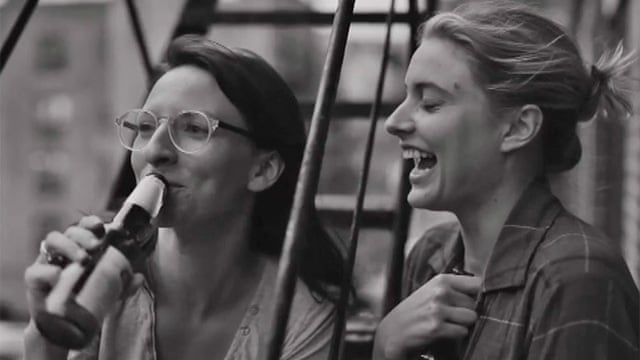
  1. Frances Ha (dir. Noah Baumbach, 2013)

The best of the Baumbach writer/director Gerwig writer/star films, Frances Ha is the perfect quarter-life crisis film. The film’s black and white aesthetic hearkens back to the classic films of the French New Wave which Baumbach sought to emulate. But while the style and story beats may reflect the carefree whimsy of France in the 1960s, it is Gerwig’s performance that transforms the film into a purely American film, and I say that in the best of ways. She manages to combine the young and carefree nature of the French New Wave with the purposeless meandering of the millennial generation who graduated college to find the world was not what was promised.

Frances Ha – review | Film | The Guardian

  1. Inside Llewyn Davis (dir. Joel and Ethan Coen, 2013)

A journey of a man and his cat, except the cat is not his and the journey is nothing but a string of a series of desperate attempts to find meaning in life. Oscar Isaac gives the performance of his career so far as the titular Llewyn, a folk singer trying to continue as a solo act after his partner’s suicide. Because of the lack of sales of the new album, Llewyn couch surfs and jumps at any opportunity to continue in the craft that he loves. The film touches on the loss of passion, and the loss of purpose when it disappears. Isaac spends much of the film displaying different levels of discontent, but said discontent is all because Llewyn knows the passion he once had.

Inside Llewyn Davis - Official Trailer [HD] - YouTube

  1. Her Smell (dir. Alex Ross Perry, 2019)

Elisabeth Moss does not get the credit as a film actress she deserves. Between Mad Men, The Handmaid’s Tale, and Top of the Lake, it is easy to dismiss her a TV actress, but in between those shows she has taken incredibly complex roles in multiple critically acclaimed films. Alex Ross Perry correctly identified Moss as an actress capable of headlining his two plus hour film Her Smell. Moss stars as punk singer Becky Something who is struggling to maintain her fame because of her own self-destructive behavior. The film centers exclusively on her through five scenes in her flailing career while she first loses control and then struggles to regain it. Perry bemoaned his inability to put any money behind an Oscar campaign for Moss and her inevitable snub was egregious as the success of this film is exclusively because of her.

Her Smell - Tyneside Cinema

  1. Clouds of Sils Maria (dir. Olivier Assayas, 2015)

Fun fact, did you know that Juliette Binoche took her role in Godzilla (dir. Gareth Edwards, 2014) to prepare Clouds of Sils Maria. She did it to better understand the character of Jo-Ann Ellis (Chloë Grace Moretz) a young actress know for a young adult science fiction series who after years in camp films sets out to perform in a meaty dramatic role in the play that Binoche’s character became famous for. The film plays on themes of identity and the connection between character and actor. This theme is further enhanced by the meta casting of Kristen Stewart (the standout of the film and best actress of her generation don’t @ me) who’s career essentially mirrors Moretz’s character. Stewart and Binoche are a perfect acting pair and push each other wonderfully as co-leads.

iClouds of Sils Maria | The Current | The Criterion Collection

  1. The Wind Rises (dir. Hayao Miyazaki, 2013)

Whether or not Hayao Miyazaki ever returns to the big screen, The Wind Rises was clearly crafted as a swan song for the acclaimed director. Miyazaki’s love of flying machines its forefront in this film, even more so than his 1992 film Porco Rosso, as it tells the story of real life engineer Jirô Horikoshi who was most famous for reluctantly designing the planes that Japanese fighters used in World War II. While the story is more grounded in reality than any other Miyazaki film, his flair for the fantastical is still distinctly felt through a memorable earthquake scene and plentiful gravity defying dream sequences. What makes the film a perfect swan song is how much Horikoshi’s passion mirrors that of the acclaimed Japanese auteur; with this reading it is difficult to Miyazaki as not treating The Wind Rises as his retirement announcement.

The Wind Rises - Official Trailer - YouTube

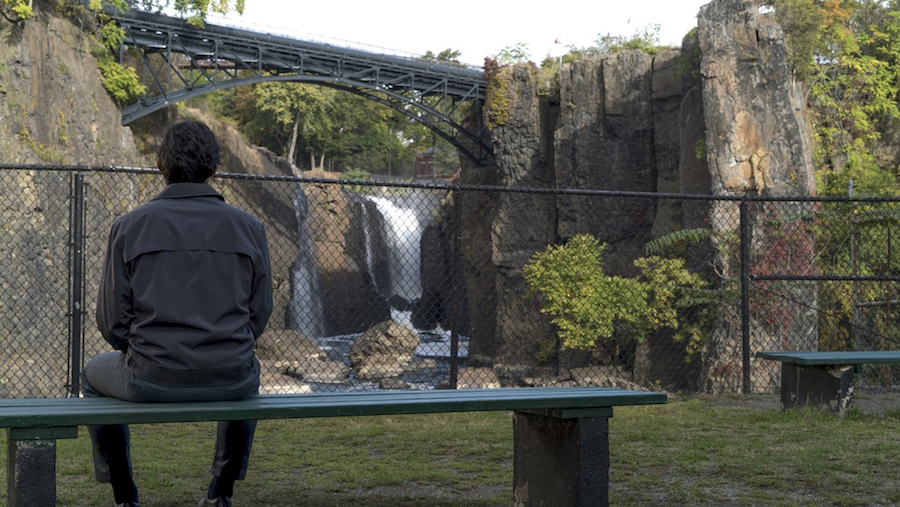
  1. Paterson (dir. Jim Jarmusch, 2016)

Fresh off his starring role in the highest grossing film of all time (domestic), Adam Driver left the world of lightsabers to return to his independent roots in this quiet poetic slice of life.  Jim Jarmusch channeled his inner Charlie Kaufman in directing by adding moments of absurd surrealism to the otherwise aggressively grounded character study. Driver plays the titular Paterson a bus driver and poet in the living in a city that shares his name.  Paterson’s poetry underscores the entire film, frequently stopping to allow driver to recite pomes in full.  Jarmusch uses this medium of art to reflect on his own craft both bring the creators personal fulfillment while being impermanent and fragile.

The Last Thing I See: 'Paterson' (2016) Movie Review

  1. Phantom Thread (dir. Paul Thomas Anderson, 2017)

A dressmaker is an odd final role decision for an actor oft included in the lists of the greatest of all time, whose acclaim comes from playing larger than life oil tycoons and presidents, but that’s what Daniel Day Lewis declared when he announced Phantom Thread as his final film. While Reynolds Woodcocks profession may not be one that frequently results in epic stories, Day-Lewis’s precision was once again complimented by his There Will Be Blood (2007) director Paul Thomas Anderson’s grandiose vision. Yet, despite the cinema powerhouses of the two men at the center of the film, it is Vicky Krieps performance of Alma that lays at the center of what makes the beautiful period piece work. Her ability to counter Lewis’s manipulative character with her own charisma speaks volumes towards her future.

Made to measure: Daniel Day-Lewis bows out in Phantom Thread - The Irish  News

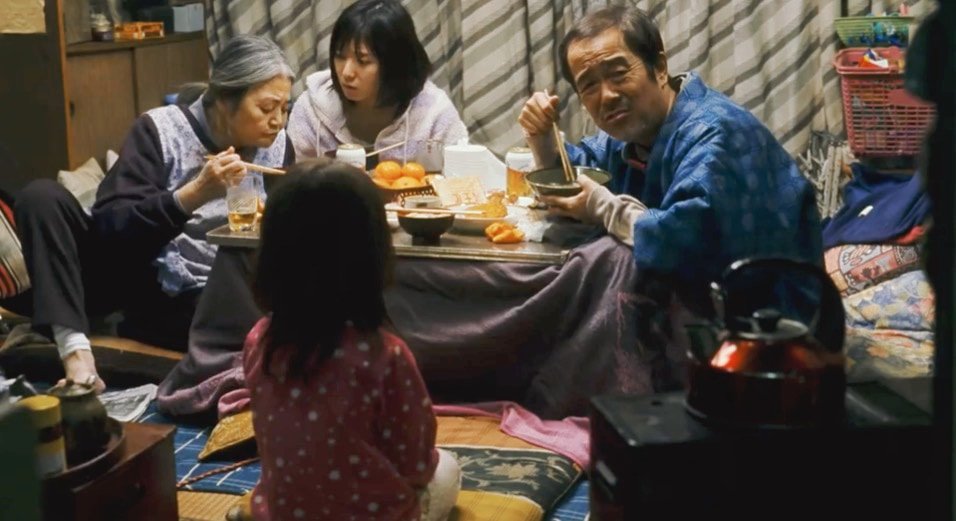
  1. Shoplifters (dir. Hirokazu Kore-eda, 2018)

2018’s Palme d’Or winner, Shoplifters is a masterful drama about family.  Reminiscent of Satoshi Kon’s Tokyo Godfathers (2003), a collection of mostly unrelated vagabonds adopts a young girl they find outside, and after finding that she is being abused by her genetic family adopt her into their makeshift family. Their tragic story draws attention to the tribulations thrust upon the impoverished and contrasts the legality of their actions with their necessity.  Despite being hustlers and crooks, the love and adoration shared between the members is heartwarming, and you long for them to stay together despite the struggles.

Is blood enough?” Koreeda Hirokazu on makeshift families and Shoplifters |  Sight & Sound | BFI

The Best Films of the Decade: Part 6

Sorry that the frequency of these lists has slowed substantially, the quarantine is definitely having an affect on my ability to be productive. I still promise to get this list out, I may just need to mix some other creative ventures in between to keep me fresh.

Part 1. Honorable Mentions 101-150 (in alphabetical order)
Part 2. 100 – 91
Part 3. 90 – 81
Part 4. 80 – 71
Part 5. 70 – 61
Part 6. 60 – 51 (below)
Part 7. 50 – 41
Part 8. 40 – 31 (coming soon)
Part 9. 30 – 21 (coming soon)
Part 10. 20 – 11 (coming soon)
Part 11. 10 – 1 (coming soon)

  1. Weekend (dir. Andrew Haigh, 2011)

Andrew Haigh’s exploration of the interconnectivity of sex, intimacy, and love is the driving force behind one of the best queer films of the decade. The film begins with Russell (Tom Cullen) heading to a gay club in search of meaningless sex and he finds Glen (Chris New). While the two of them end up meaning much more to each other than they could have imagined, Weekend doesn’t rely on the romance movie cliché of love at first sight. Instead the meaning of sex slowly evolves in a more organic manner.

060 Weekend

  1. Stories We Tell (dir. Sarah Polley, 2012)

An entirely unique documentary, Sarah Polley’s Stories We Tell starts with a conventional premise, exploring the power of family storytelling, but while interviewing her own family, Polley stumbles onto a long-held secret. This revelation elevates what would have already been a personal exploration into a mesmerizing identity crisis. The talking head documentary type may have largely fallen out of vogue in most critic stories, but Stories We Tell proves that with a strong enough premise even old ways of telling a story can feel new.

059 Stories We Tell

  1. Sunset Song (dir. Terence Davies, 2016)

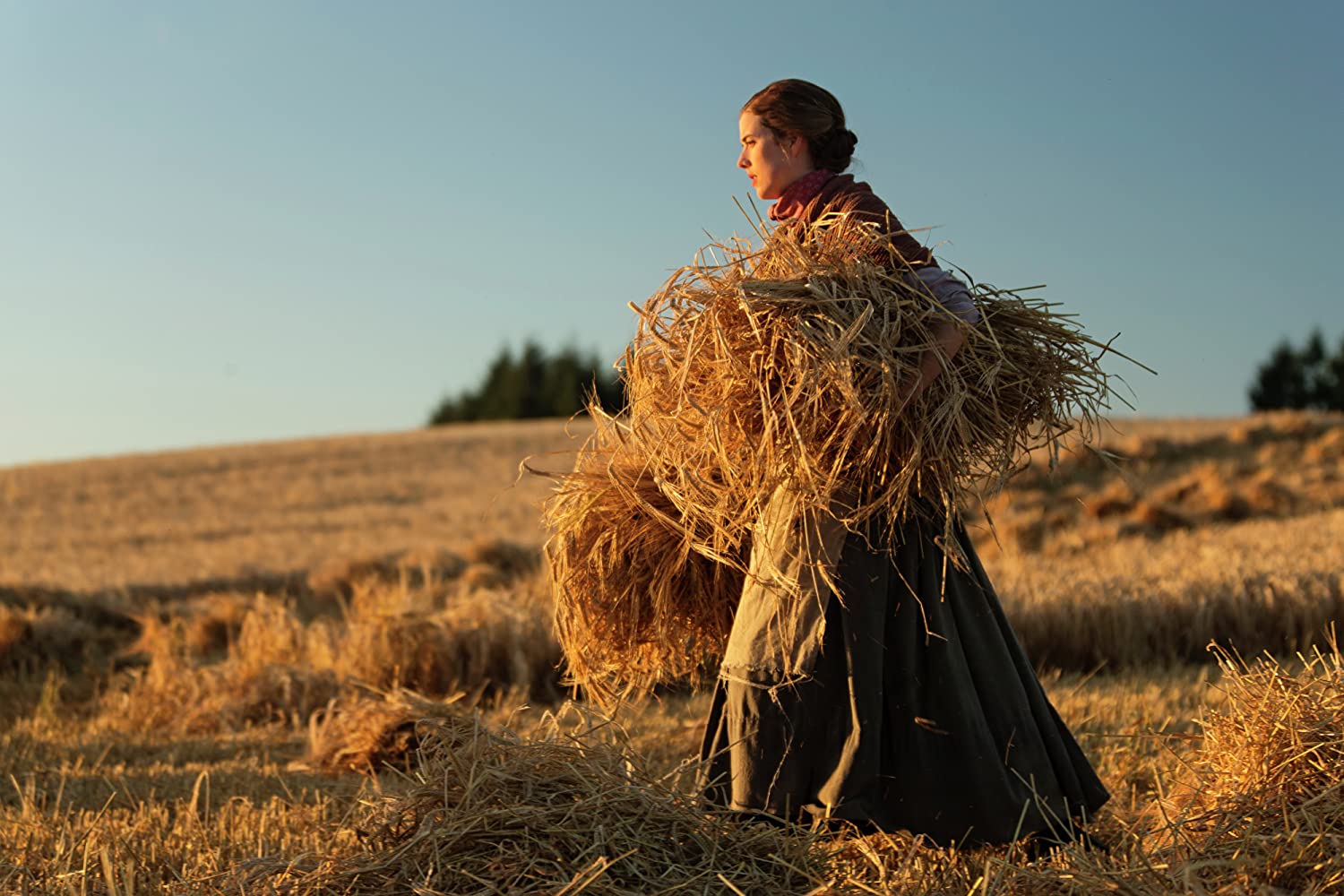
A favorite discovery of mine this decade was English director Terence Davies. All three films he directed in the decade, The Deep Blue Sea in 2012 and A Quiet Passion in 2017 being his other two, were strong contenders for the list. Sunset Song was my personal favorite of the three because I think it captures what he does best. Davies is able to capture womanhood in a way very few male writers and directors can. The film is a gorgeously shot period piece about the strength of a young woman from time where she was not allowed to possess any. Agyness Deyn’s portrayal of Chris is heartbreaking as he suffers the cruel men in her life. With no real power, all she can do is soldier on and live the best life that she is able.

058 Sunset Song

  1. The Tree of Life (dir. Terrence Mallick, 2011)

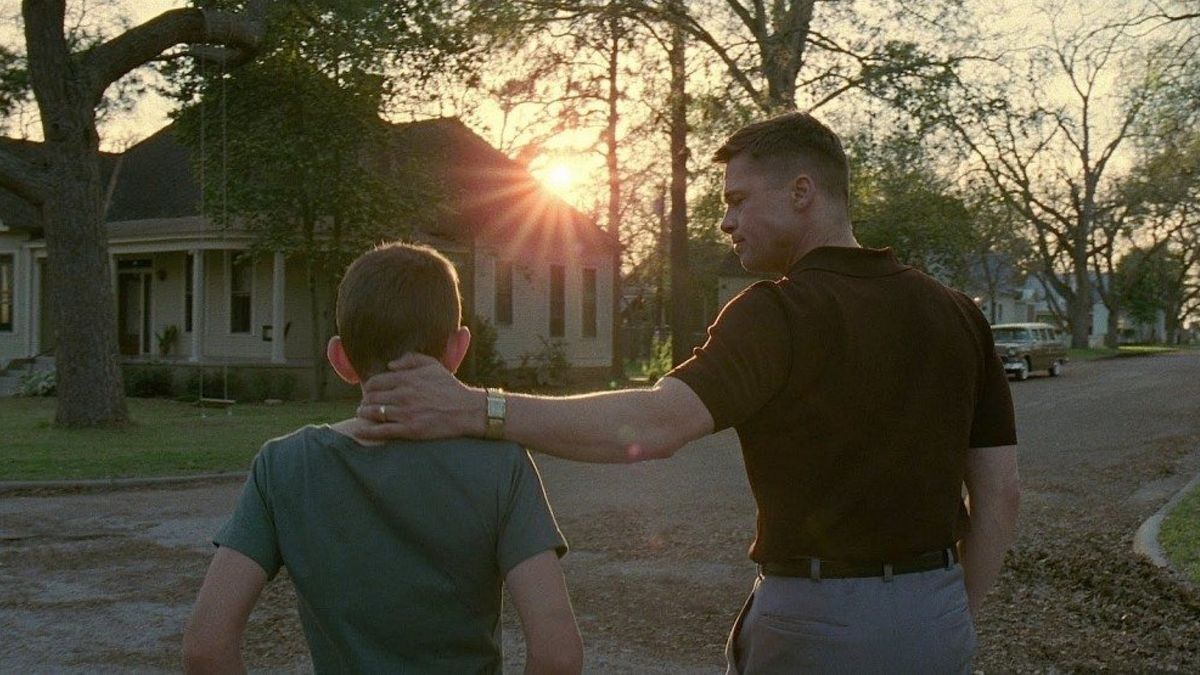
Ever since his 1973 classic Badlands, Mallick’s films became increasingly ethereal, more concerned with mood than plot. After The Tree of Life won the Palme d’Or this mood forward style became a dominant trend in the US art house scene resulting in many subpar copycats (including a few by Mallick himself). And while the impact The Tree of Life had on cinema may not be exclusively positive, there is no denying that it is a masterfully crafted film. Mallick’s shoot everything and find the film in the cutting room approach mixed perfectly with the decades best cinematographer Emmanuel Lubezki capturing beautiful imagery for Mallick’s poetry and Alexandre Desplat’s score to mesh with.

057 The Tree of Life

  1. Certain Women (dir. Wim Wenders, 2011)

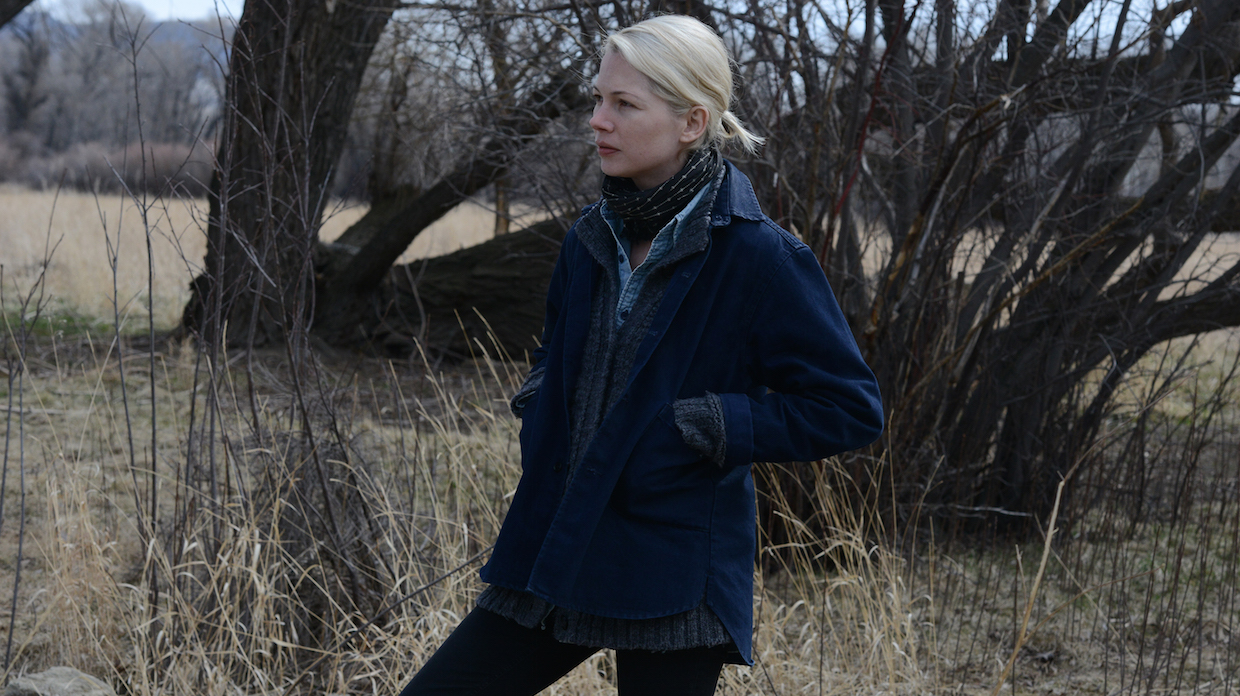
Kelly Reichardt very well may be my favorite active director, and the quarantine causing me to miss her new film First Cow was personally frustrating. While some may consider her films to be slow, the time that she gives her characters to breathe create the depth that makes them endearing.  Even in the vignette styled Certain Women, each character feels fully formed. All four actresses Laura Dern, Michelle Williams, Kristen Stewart, and Lily Gladstone capture women in completely different places but who still share a universality in being women.

056 Certain Women

  1. Eighth Grade (dir. Bo Burnham, 2018)

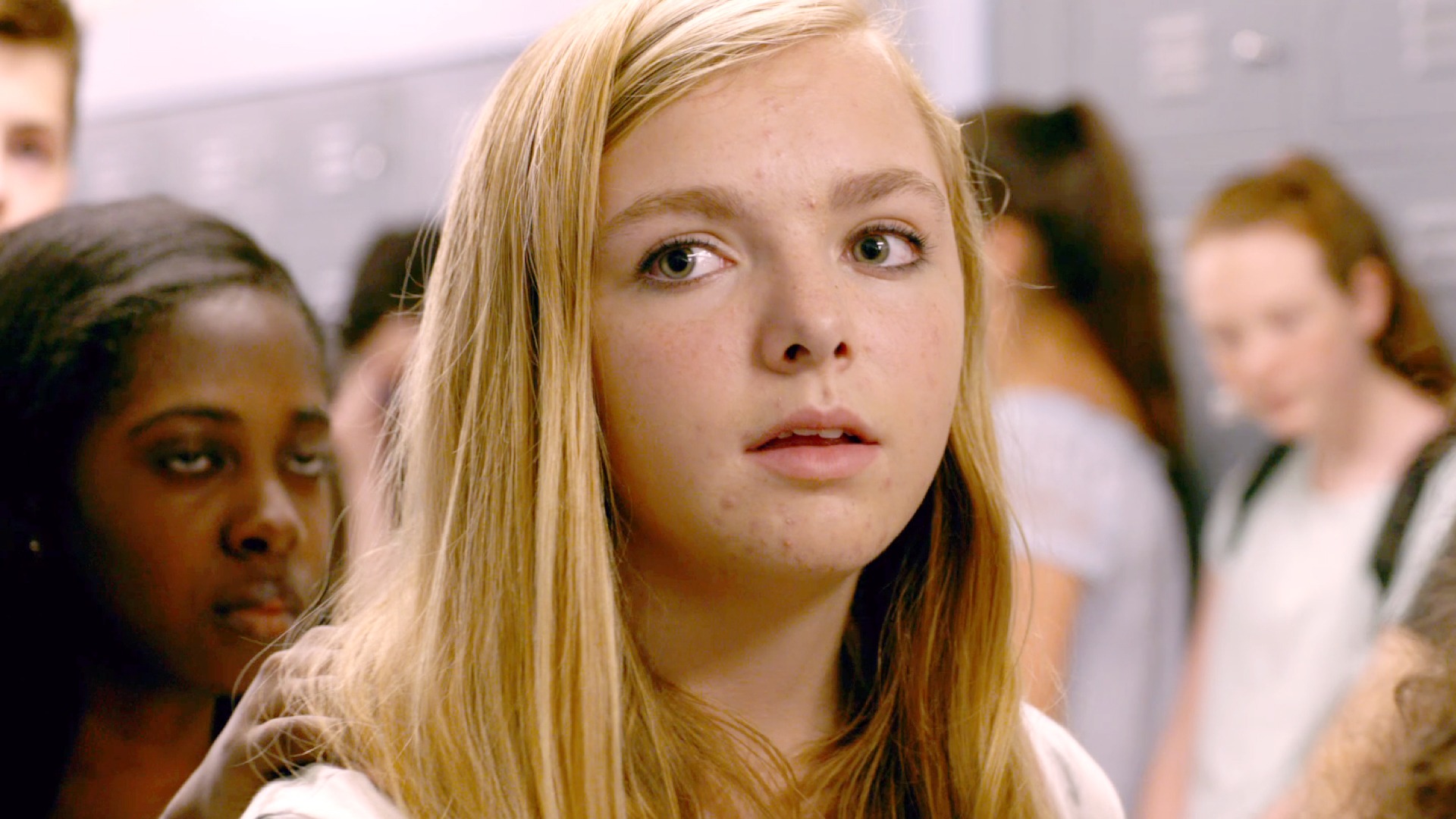
Bo Burnham’s initial entry into the cinematic realm succeeds because of his experience in the different medium of YouTube, not despite it.  Having been with YouTube since its beginning, Burnham has an innate connection to the youngest generation.  This connection allows him to portray the kids in Eighth Grade as unique individuals not just a collection of stereotypes allotted to “kids these days”.  This understanding is best exemplified in the relationship between the father and daughter pair (played by Josh Hamilton and Elsie Fisher respectively).  Elsie’s character acts irrational as most eighth graders do, but her father doesn’t bemoan her for that; instead he accepts that puberty does weird things to people and does his best to understand.

055 Eighth Grade

  1. The Farewell (dir. Lulu Wang, 2019)

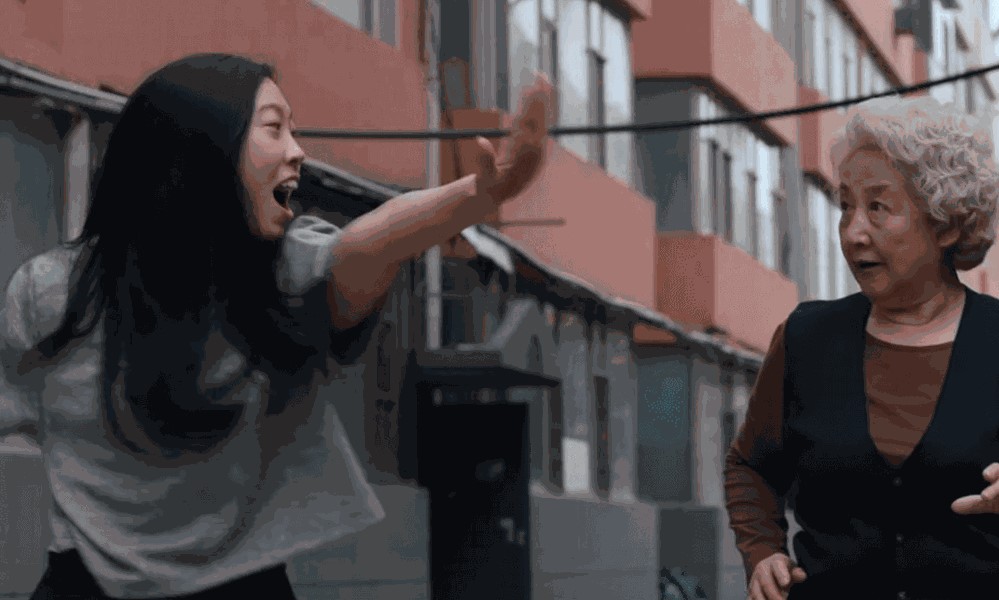
Casting Awkwafina as lead in a dramatic film where a young woman struggles to say goodbye to her dying grandmother was certainly a gamble, but it proved to be one that paid off. Awkwafina proves she is more than just a comedian in Lulu Wang’s touching film, but still uses her comedic flare to impart some much-needed levity into the otherwise depressing premise. Lulu Wang grounds the emotion inherent in the premise just enough to keep it’s meaning while preventing the film from moving into the realm of melodrama.

054 The Farewell

  1. Victoria (dir. Sebastian Schipper, 2015)

Victoria is a two-hour 18-minute crime thriller shot in real time with zero cuts. And by zero cuts, I mean actually zero cuts. No hidden cuts like in 2019’s 1917 (dir. Sam Mendes), but legitimately a single uncut take. The story of the film is interesting if unremarkable, but this is an instance in which the gimmick elevates the film. Shooting in real time accomplishes two things enhances the effectiveness of the range of emotions the characters feel. The time gap between exhilaration, exuberance, and terror being so minimal compounds the rollercoaster feel of the film.

053 Victoria

  1. Things to Come (dir. Mia Hansen-Løve, 2016)

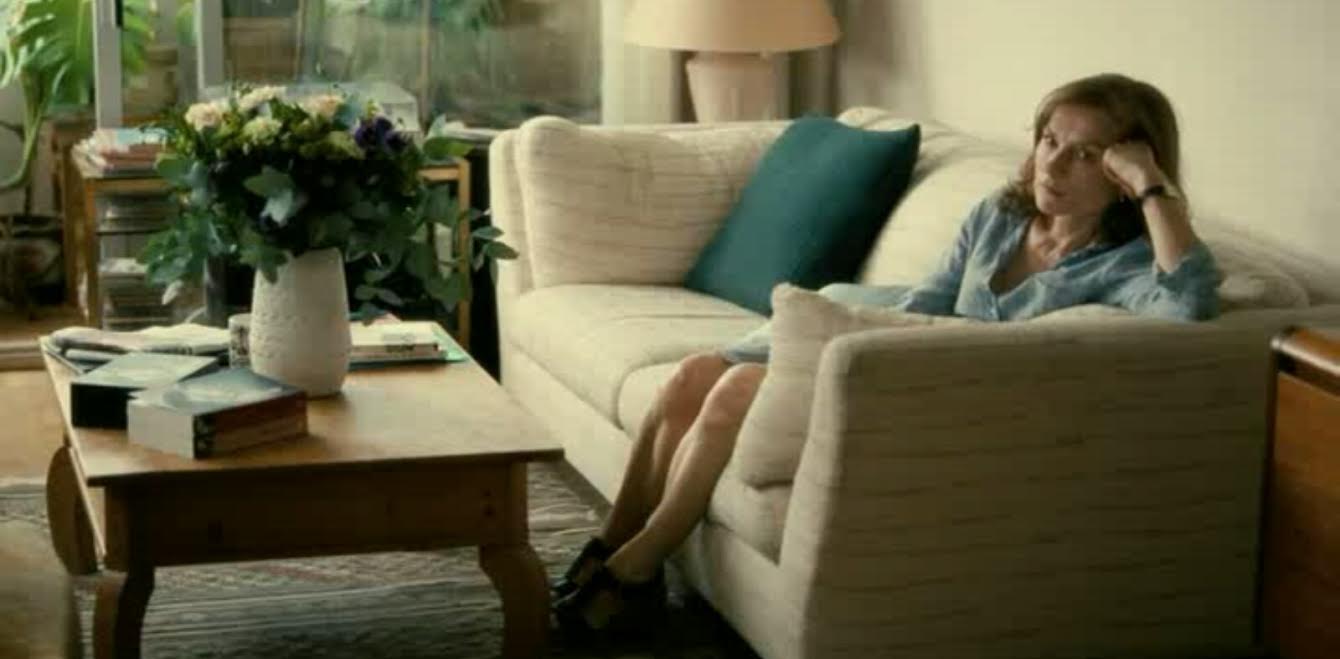
Despite the Hollywood adage that there are no acting parts for women over 30, Isabelle Huppert has been able to get consistent work in the decade excelling in the scarce few roles for middle-aged women. In Things to Come, she delivers her best performance with the help of French auteur Mia Hansen-Løve. In the film she depicts Nathalie, a woman who sees her life fall apart in front of her eyes. Taxed with consecutive tragedies, she subsists through them. A mid-life crisis that’s circumstance driven instead of born of ennui, she is still able to derive new fulfillment in the freedoms thrust upon her.

052 Things to Come

  1. Uncut Gems (dir. Benny and Josh Safdie, 2019)

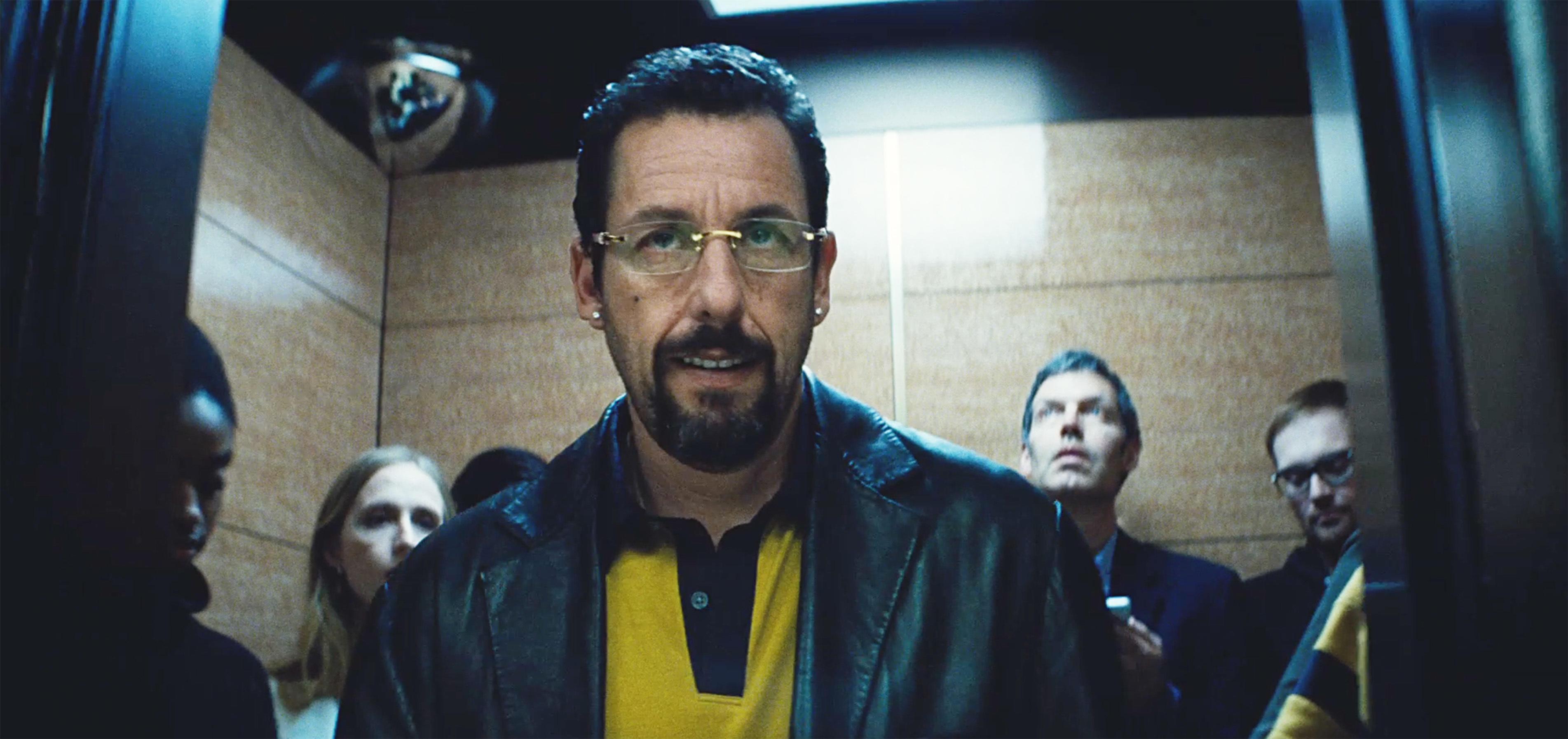
This movie is a lot. The Safdie Brothers have a habit of filling their films to with constant stimuli. Uncut Gems builds upon this style by enlisting the manic acting of Adam Sandler manic acting who once again proves that when in the hands of a capable director he can be an excellent actor.  The other trademark of a Safdie film is showing a seedy aspect of New York. Uncut Gems accomplishes this despite its main characters coming from wealth by making Sandler a compulsive gambler and owner of a shady diamond shop. Everything about this film just clicks in the speed and intensity of the Safdie Brothers’ direction.

051 Uncut Gems

The Best Films of the Decade: Part 5

I realize that I’m a few months late in posting this list, but I put it off trying to catch up on some films and then I felt it was too late. Three weeks into quarantine, and I’ve finally found the time and motivation to put together my list.

Part 1. Honorable Mentions 101-150 (in alphabetical order)
Part 2. 100 – 91
Part 3. 90 – 81
Part 4. 80 – 71
Part 5. 70 – 61 (below)
Part 6. 60 – 51
Part 7. 50 – 41
Part 8. 40 – 31 (coming soon)
Part 9. 30 – 21 (coming soon)
Part 10. 20 – 11 (coming soon)
Part 11. 10 – 1 (coming soon)

  1. Toni Erdmann (dir. Maren Ade, 2016)

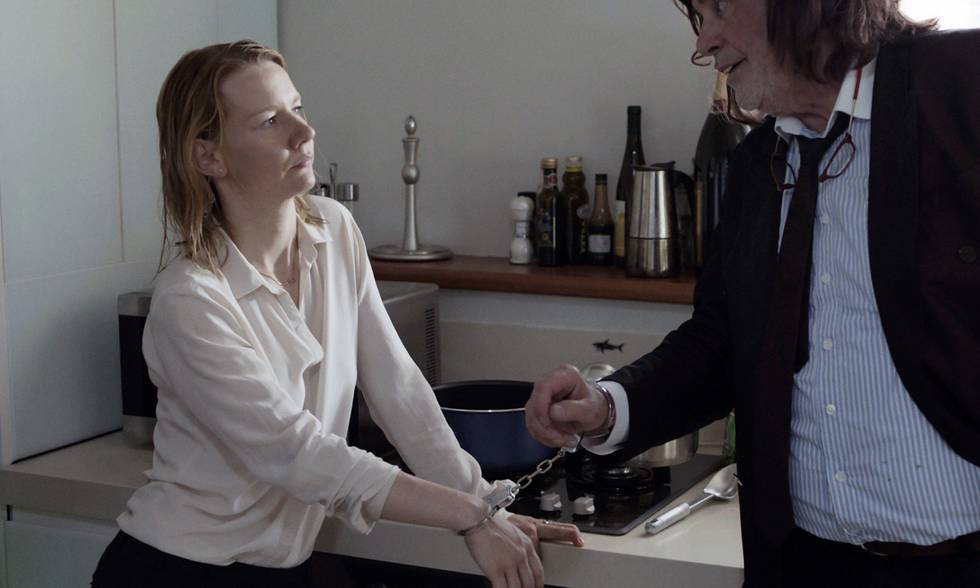
In her Cannes Palm snub Toni Erdmann, director Maren Ade explores the complexities of a father daughter relationship long after the child has grown. Sandra Hüller plays Ines the daughter who has her life seemingly together. However, when her prankster father Winfried, Peter Simonischek, shows up, her polished exterior begins to crack. A story about the lengths a father will go to reconnect with his daughter, and the wall she built for emotional security.

070 Toni Erdmann

  1. First Man (dir. Damien Chazelle, 2018)

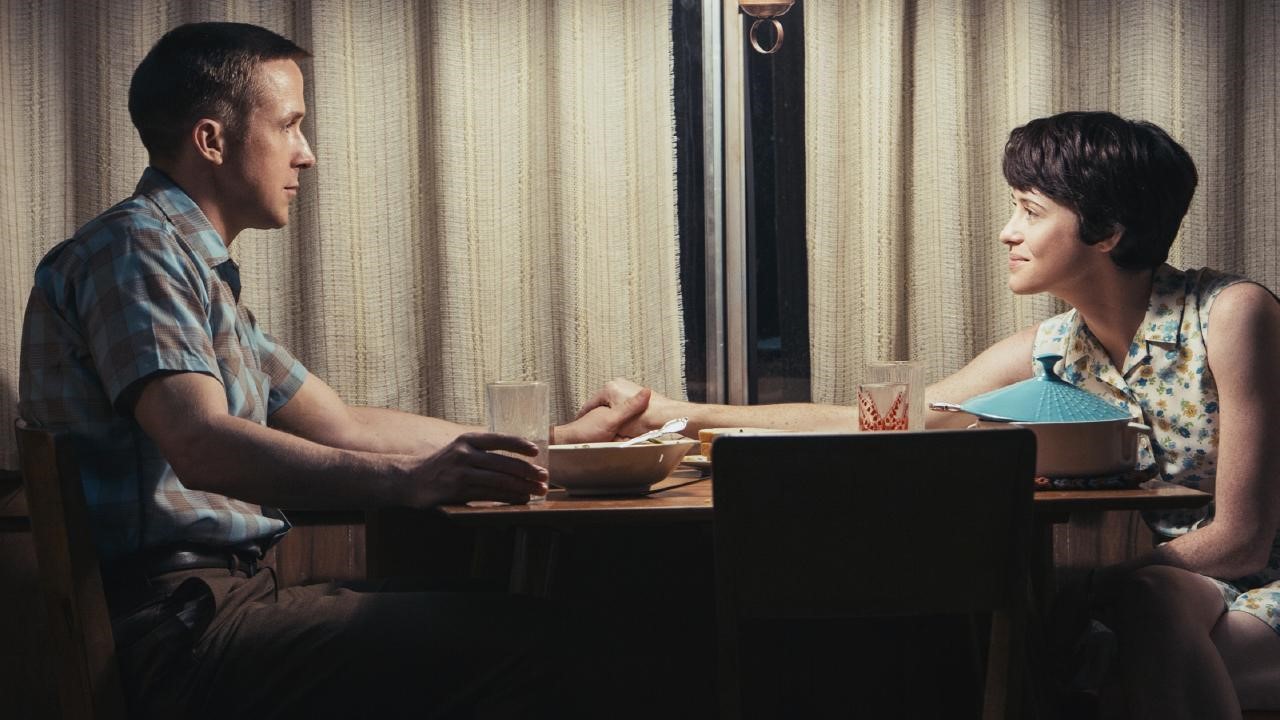
The subdued audience reactions to Chazelle’s latest film was entirely due to audience expectations not a reflection on quality. While many patrons purchased a ticket for what they assumed would be an Apollo 13 (dir. Ron Howard, 1995), but instead they were confronted with a painfully personal story about a man who uses the moon as just another place to run to. I wrote a longer piece on the film when it came out and re-post it here.

069 First Man

  1. The Other Side of the Wind (dir. Orson Welles, 2018)

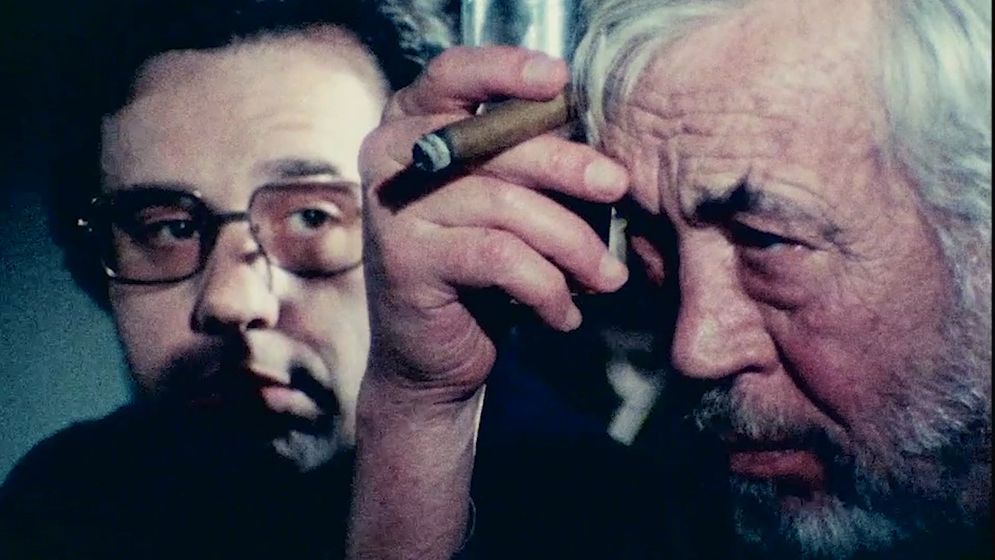
Despite not being alive in this decade (nor the prior two), 35 years after his death, Orson Welles manages to find his way into my best films of the decade list.  Beginning production in the 1970s, it had every reason to feel extremely dated as it attempted to satirize the state of film at the time.  And yet, Welles’s commentary while not necessarily applicable to cinema today, feels like what a 2018 commentary on 1970s film would be.  His condemnation of the machismo mentality of many of the major studio directors especially feels modern.  Conversely, the film within a film that mimics the French New Wave lends itself well to the Art House scene in cinema today.  Through all the layered coding, the film also works as an allegory for the end of Orson Welles’s career with John Huston serving as stand in for Welles himself.  This multi-layered filmmaking results in The Other Side of the Wind being exceedingly intricate yet rewatchable.

068 The Other Side of the Wind

  1. Tangerine (dir. Sean Baker, 2015)

In this trans woman’s opinion, Tangerine is the greatest film about trans women ever created. Sean Baker accomplishes this first and foremost by casting trans women Kitana Kiki Rodriguez and Mya Taylor to play the lead roles of Sin-Dee and Alexandra. Secondly while Sin-Dee and Alexandra’s transness is ever-present in the film, the film is not about them being trans. Instead Tangerine is primarily a heartfelt buddy comedy between the two leads. From a visual standpoint the vibrant colors of Hollywood strip malls pop beautifully despite being shot on an iphone. The artificial, neon glaze is a perfect complement to a wonderful film.

067 Tangerine

  1. Pina (dir. Wim Wenders, 2011)

German auteur Wim Wenders spent much of the decade exploring how the medium of film could be combined with other artistic mediums. His 2015 documentary The Salt of the Earth (codirected with Juliano Ribeiro Salgado) exploring the work of photographer Sebastião Salgado nearly made this list, but it was his first film of the decade, Pina, that resonates as a perfect blend of mediums. A tribute to the late German dance choreographer Pina Busch, the film named for her highlights her work by presenting many of her most famous pieces cutting between performances by different skill levels of dancers.

066 Pina

  1. A Separation (dir. Asghar Farhadi, 2011)

From the opening scene of Asghar Farhadi’s masterpiece, a western audience is predisposed to be against Payman Maadi’s character Nader. Iranian’s patriarchal system denies his with Simin (Leila Hatami) any say in their future or the future of the child. Because of this, when Nader gets physical with his housekeeper Razieh (Sareh Bayat), it’s easy to wish the worst of him. Yet that’s not what Simin, the audience surrogate, wants. The film explores the complexities of emotions and the difficulties that a strict patriarchal set of laws adds to them.

065 A Separation

  1. Blue Valentine (dir. Derek Cianfrance, 2010)

Speaking of films about the difficulties of relationships with unsympathetic male protagonists, it’s hard to imagine watching Derek Cianfrance’s Blue Valentine and not come away loving Cindy (Michelle Williams) and being frustrated with Dean (Ryan Gosling). And yet, Cindy’s love for Dean doesn’t seem at all unrealistic. By mixing time periods, Cianfrance makes sure the film never goes too long without a sweet moment from Dean. These are the moments that Cindy must retreat to when her husband is inconsiderate or abusive. While the performances by both leads are stellar, this is one of many films appearing on this list that make the argument for Michelle Williams being the best actor of the decade.

064 Blue Valentine

  1. The Great Beauty (dir. Paolo Sorrentino, 2013)

The Great Beauty is director Paolo Sorrentino’s homage to my favorite film of all time, Federico Fellini’s all time classic La Dolce Vita (1960). Like Fellini’s film, The Great Beauty centers around a man, Jep (Toni Servillo), entrenched in the garish Italian night life who finds that living the life that many men dream about, brings him no contentment. He floats between parties, each one more lavish than the last, and despite being a lauded guest feels perpetually alone. By capturing that complex emotional state, Sorrentino brushes with greatness.

063 The Great Beauty

  1. Take Shelter (dir. Jeff Nichols, 2011)

Michael Shannon made most of his mark this decade as a great character actor and supporting man, but his leading performance in 2011’s Take Shelter proves that he could just as easily have been an A-list leading man. In the film, he plays Curtis, a young man who upon having a vision of the apocalypse begins doing everything to prepare for it and keep his family safe. This intense preparedness begins costing him as the world labels him insane. As Curtis, Shannon captures the emotion of a man willing to sacrifice everything to save his family, even if his family doesn’t believe him.

062 Take Shelter

  1. No Home Movie (dir. Chantal Akerman, 2016)

The first film on the list that causes me to tear up just by thinking about it, No Home Movie is the final film that visionary director Chantal Akerman made. Despite its name, the film is comprised of footage primarily shot in Akerman’s mother’s Brussels apartment near the end of her life. They spend the runtime chatting about their past together. Even when Chantal is away from her mother on work, she films the Skype sessions between them, capturing the loving and important relationship the two of them have. Unfortunately, this love and importance is made even more apparent by what happened after the film. After shooting completed, Natalia Akerman passed away. After completing the film, but 2 days before it was set to premier, Chantal Akerman succumbed to the grief of losing her mother and took her own life.

061 No Home Movie

The Best Films of the Decade: Part 4

I realize that I’m a few months late in posting this list, but I put it off trying to catch up on some films and then I felt it was too late. Three weeks into quarantine, and I’ve finally found the time and motivation to put together my list.

Part 1. Honorable Mentions 101-150 (in alphabetical order)
Part 2. 100 – 91
Part 3. 90 – 81
Part 4. 80 – 71 (below)
Part 5. 70 – 61
Part 6. 60 – 51
Part 7. 50 – 41
Part 8. 40 – 31 (coming soon)
Part 9. 30 – 21 (coming soon)
Part 10. 20 – 11 (coming soon)
Part 11. 10 – 1 (coming soon)

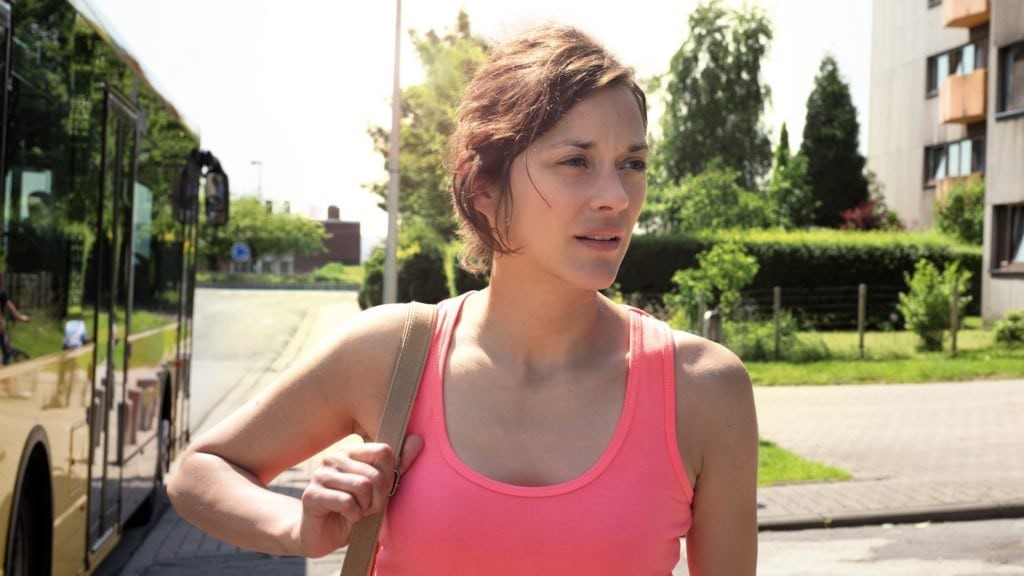
  1. Two Days, One Night (dir. Jean-Pierre and Luc Dardenne, 2014)

Marion Cotillard scored a rare acting Oscar nomination from a non-English film for her devastating performance in the Dardenne brother’s anti-capitalist film Two Days, One Night. Her character, Sandra, is threatened with losing her job unless her coworkers willingly give up their bonus. She spends the titular time period showing up to her coworkers’ home and pleading to their humanity to keep her family from the brink of poverty by asking them to give up their money. A lovely film from pair of magnificent auteurs.

080 Two Days One Night

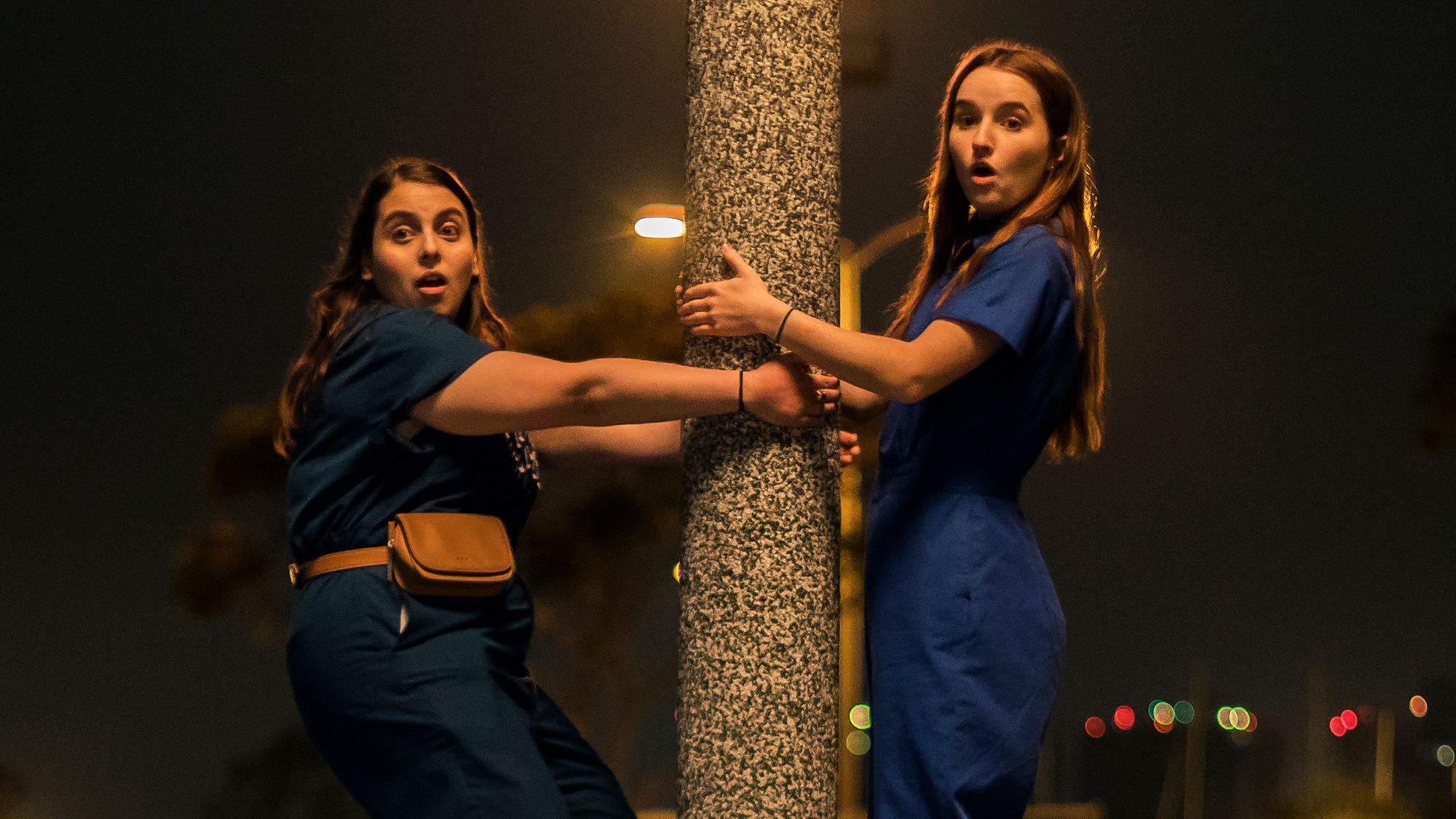
  1. Booksmart (dir. Olivia Wilde, 2019)

So much more than just Superbad (2007) but with young women, Booksmart is a brilliant depiction of regret at wasted opportunities and fear of change coming to a head at a major junction in one’s life. Amy (Kaitlyn Dever) and Molly (Beanie Feldstein) balance their comedy and tragedy well as leads, but Booksmart’s real strength lies in it’s supporting cast. Initially portraying all supporting roles as traditional teenage comedy tropes, the film spends time lingering on each one allowing them their own moments of humanity. This is exemplified no better than with Billie Lourd as the standout Gigi.

079 Booksmart

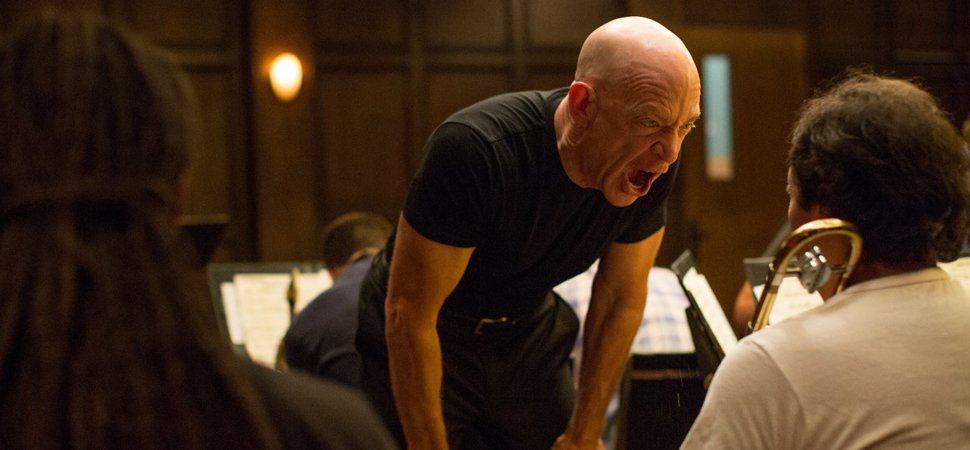
  1. Whiplash (dir. Damien Chazelle, 2014)

The movie that helped Damien Chazelle burst onto the public consciousness and won J.K. Simmons his Oscar, Whiplash is an important film in understanding America’s independent film scene in the 2010s. Chazelle’s films whether musicals or not, are heavily influenced by their music. Whiplash is not only about a jazz musician, but through the editing and direction the film itself takes on Jazz like quality. It crescendos in volume and pacing as the film’s plot intensifies. A perfect start to one of the decade’s breakout directors’ career.

078 Whiplash

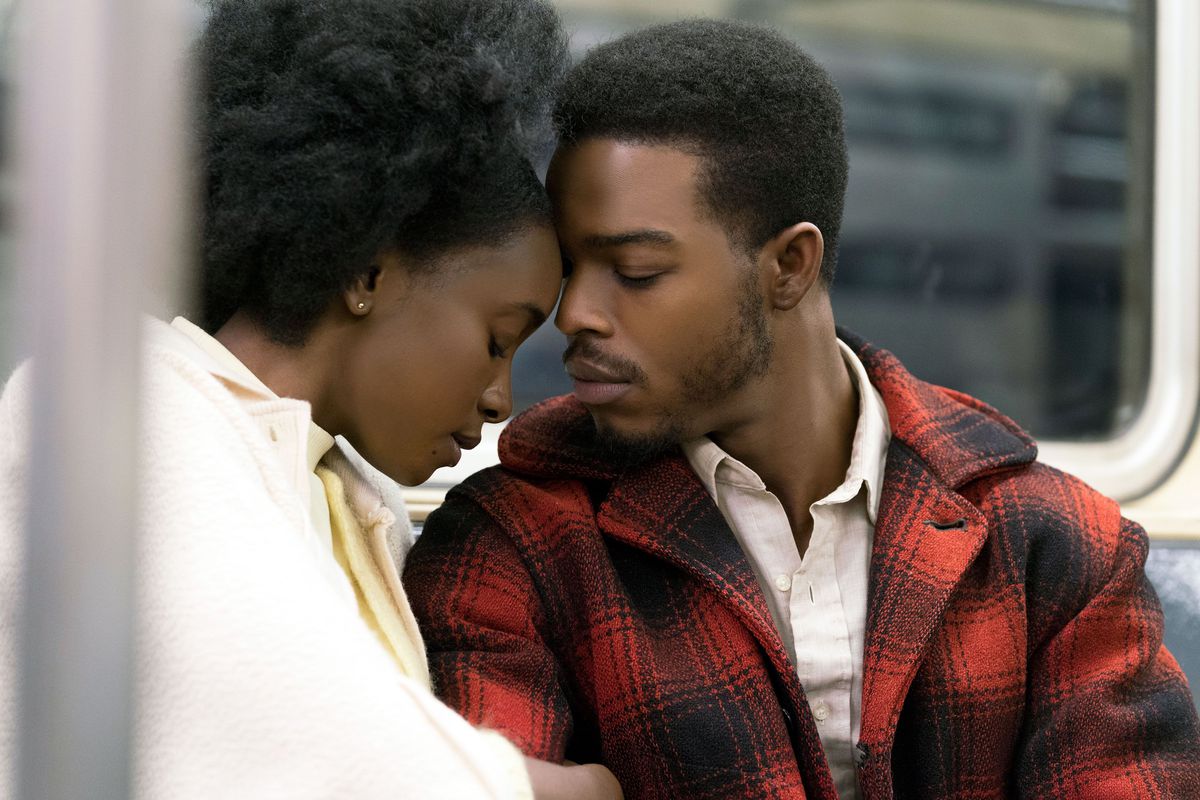
  1. If Beale Street Could Talk (dir. Barry Jenkins, 2018)

Barry Jenkins’s follow up to the Oscar winning Moonlight is another love story that specifically addresses social concerns of being black in America. Beginning the film in media res and using Kiki Layne’s voice over narration when switching between the past and present creates cohesion between the two halves of the film.  This non-linear storytelling allows for the climaxes of each half of the film to take place at the same time amplifying the power behind the story.  Jenkins proves his directing chops by turning this novel into a tightly paced drama, a skill that time and time again proves to be very rare.

077 If Beale Street Could Talk

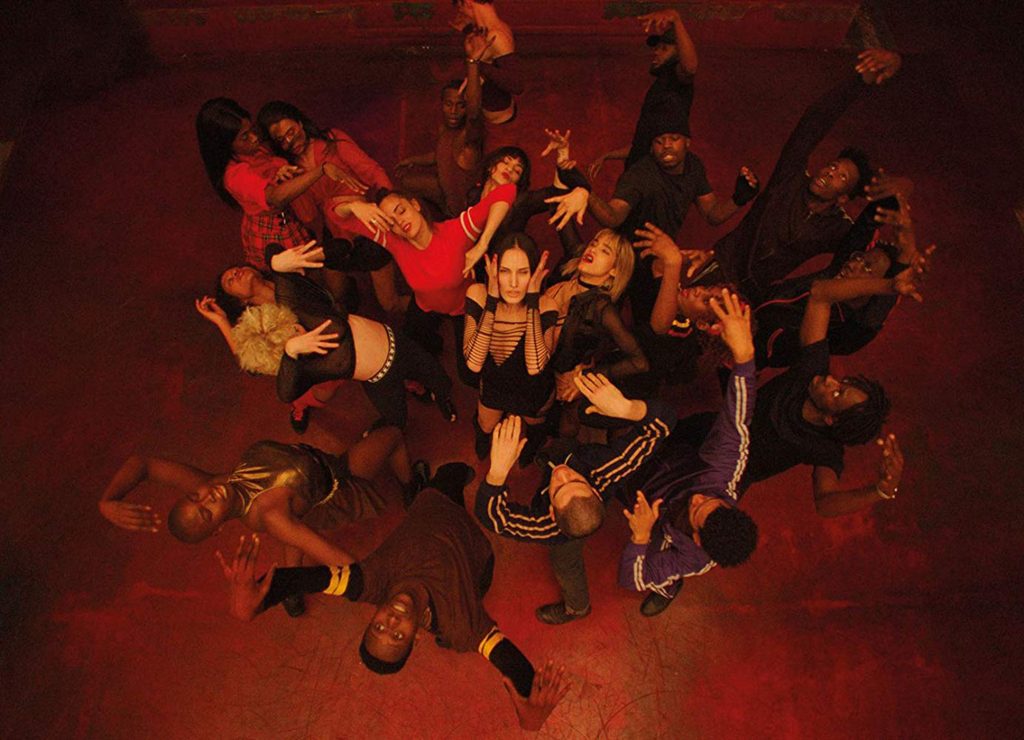
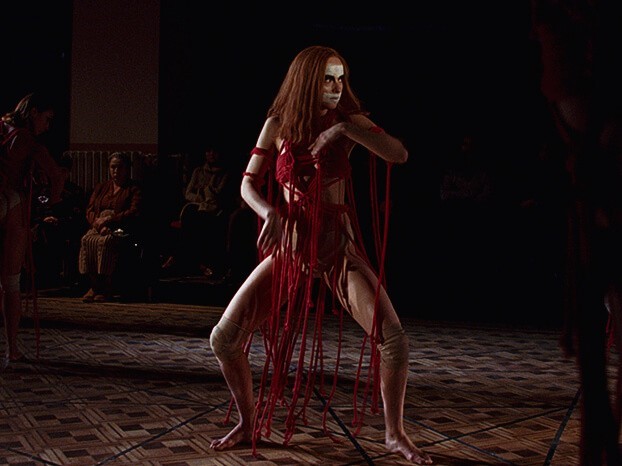
  1. Climax (dir. Gaspar Noé, 2019)

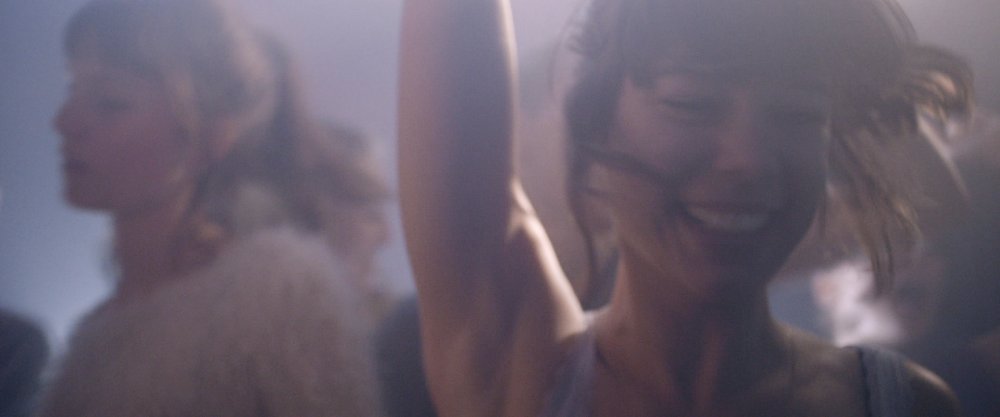
Argentinian provocateur Gaspar Noé’s 2019 film Climax needs to be viewed somewhere very dark and with the volume very loud. Noé’s films are known for having unconventional cinematic techniques implemented for the sake of making the viewer uncomfortable. With a basic storyline that members of a dance troop have their punch spiked with LSD at an after party, Climax implements a droning score and untethered camera to instill a dosed feeling in the audience as well as the characters. These techniques as well as the graphic imagery crescendo constantly throughout the film without a moments reprieve for the 100-minute runtime.

076 Climax

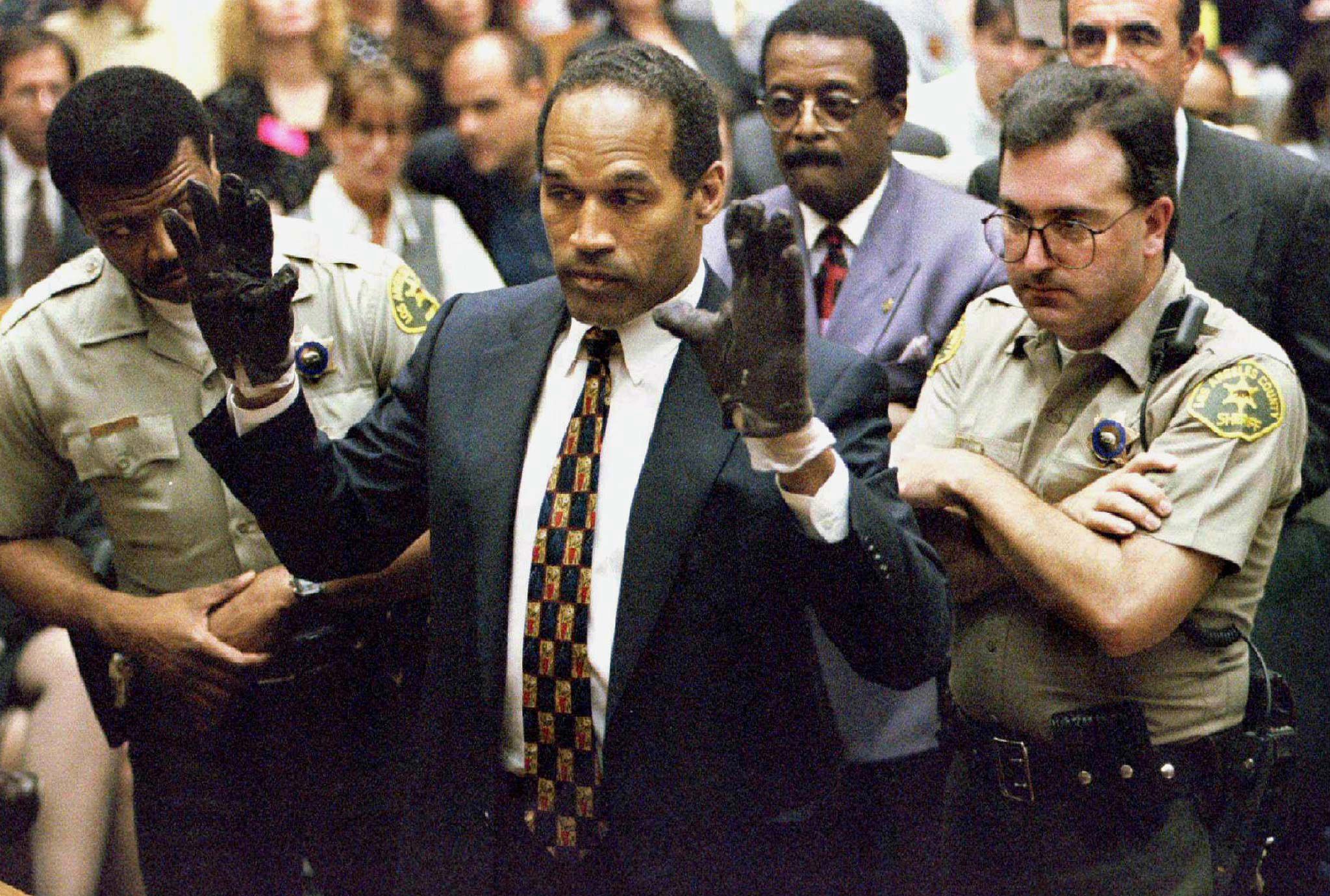
  1. O.J.: Made in America (dir. Ezra Edelman, 2016)

I’ll be honest, I’m may be falling for the most equals best fallacy with this one, but the seven-and-a-half-hour documentary miniseries about O.J. Simpson was a great watch for me one Saturday in 2016.  The film uses its length to add necessary context for understanding the social implications of the O.J. case. A full episode of the documentary focuses on the Rodney King riots, which while not directly related to O.J. was essentially for understanding why the black community took the O.J. acquittal as a win. The film uses the flexibility afforded to it by being a miniseries to tell a complete and engrossing picture.

075 OJ Made in America

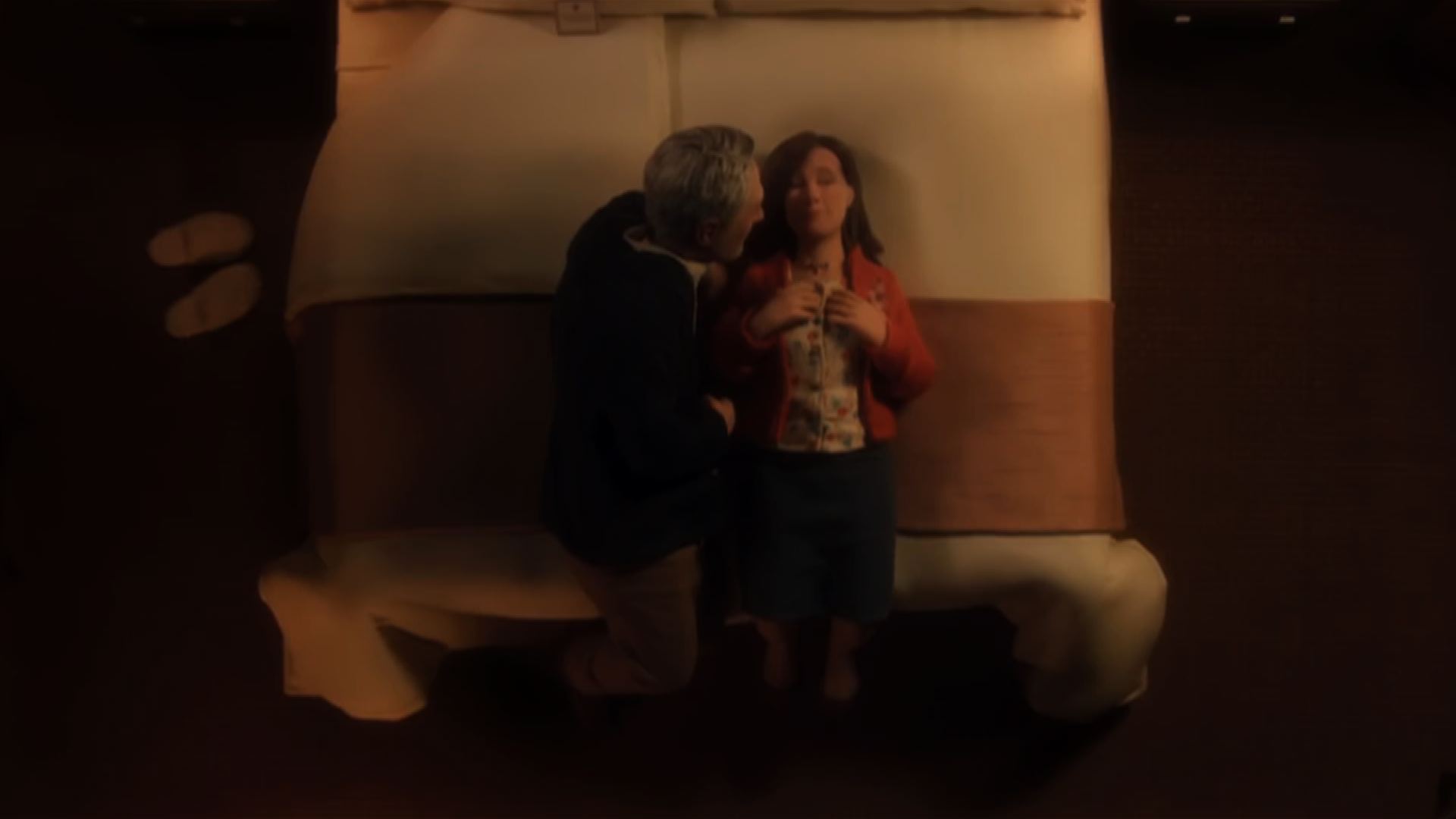
  1. Anomalisa (dir. Charlie Kaufman and Duke Johnson, 2015)

Charlie Kaufman’s name attached to a film is always a must view experience for me, and his previous directing excursion, 2008’s Synecdoche, New York, is one of my all-time favorites. his foray into stop motion cinema for 2015’s Anomalisa further grabbed my interest as a medium which should be well poised to mix with Kaufman’s signature surrealism.  Sure enough, the stylized medium was perfect for delivering his blend humor and melancholy in the surreal. Highlighted by Jennifer Jason Leigh’s memorable unaccompanied rendition of Cyndi Lauper’s “Girls Just Wanna Have Fun”, Anomalisa is a one of a kind viewing experience.

074 Anomalisa

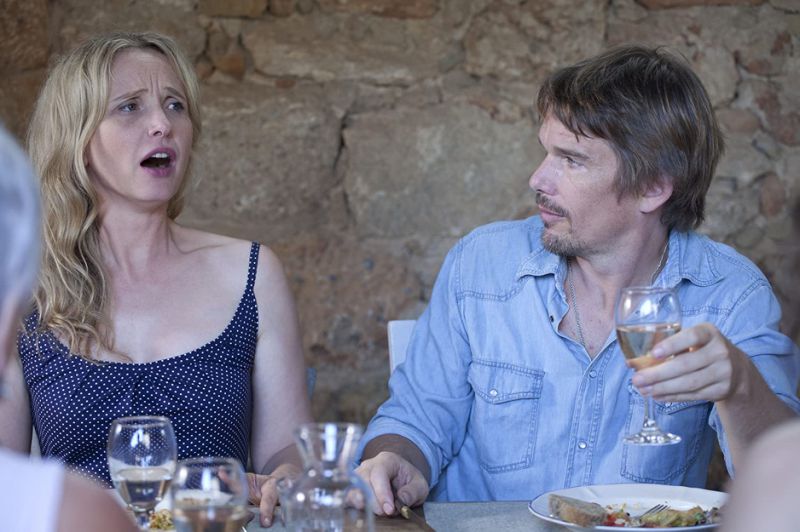
  1. Before Midnight (dir. Richard Linklater, 2013)

The third in Richard Linklater’s Before Trilogy, brings a touch of reality to the decade long love story between Jesse (Ethan Hawke) and Celine (Julie Delpy). Before Sunrise (1995) was a love at first sight fairy tale. Before Sunset (2004) was a statement to the power of love, that love would always find a way. Another 9 years later, and the couple finds that a relationship isn’t as simple as falling in love was. Delpy and Hawke are incredible as the characters they’ve been living with for much of their careers, and the realistic tone is a perfect next chapter in the trilogy.

073 Before Midnight

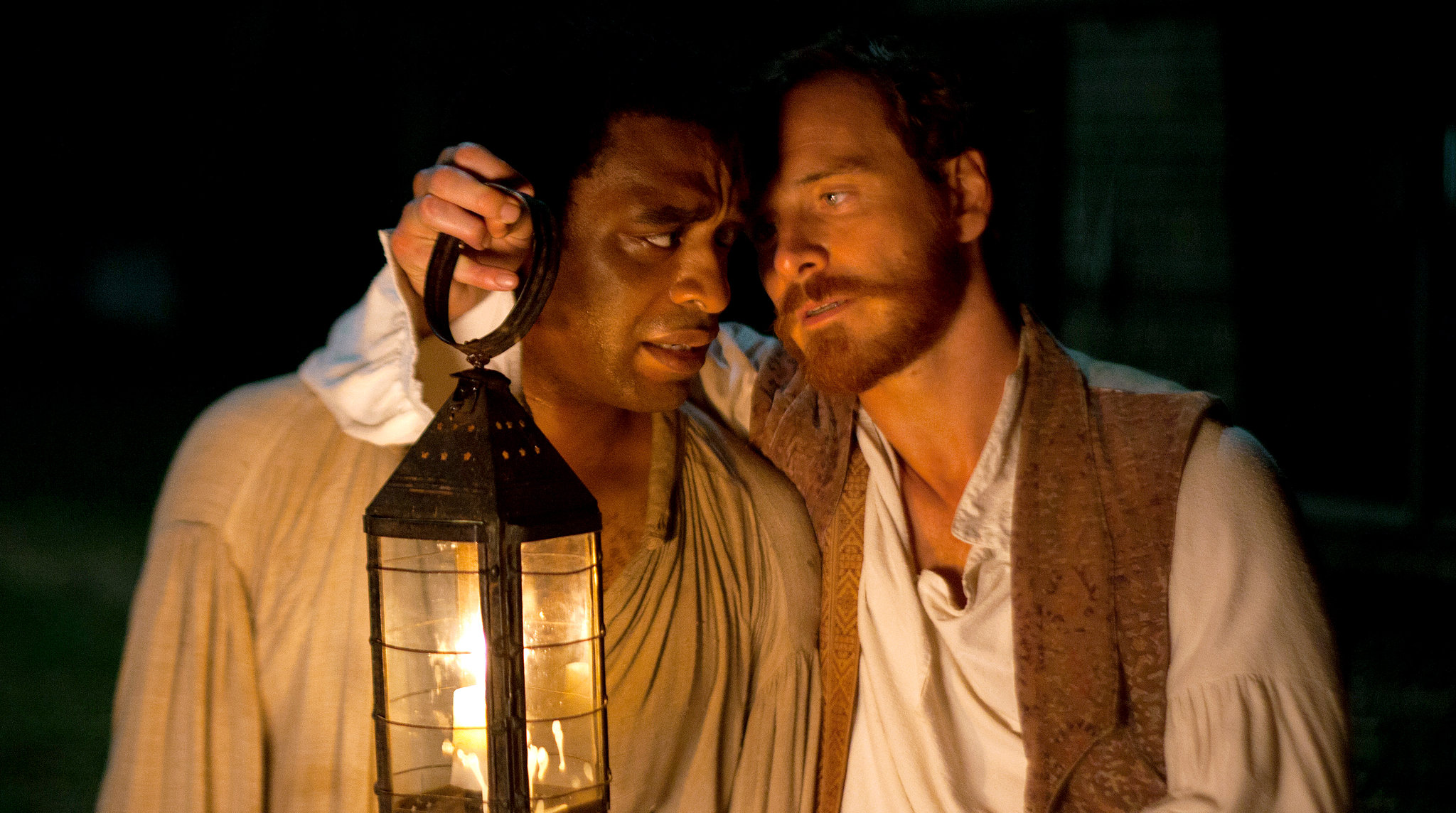
  1. 12 Years a Slave (dir. Steve McQueen, 2013)

British Auteur Steve McQueen does not make fun films. He works with dark topics and themes, and Solomon Northup (Chiwetel Ejiofor), a free man, being kidnapped and sold into slavery fits well into McQueen’s oeuvre. McQueen’s style of closeups and long takes both heighten the discomfort in viewing. His techniques rely on strong performances as they allow for less postproduction wizardry, and Ejiofor is a strong fit for the personal style. His face expresses the depths of his character’s emotions without needing to speak.

072 12 Years a Slave

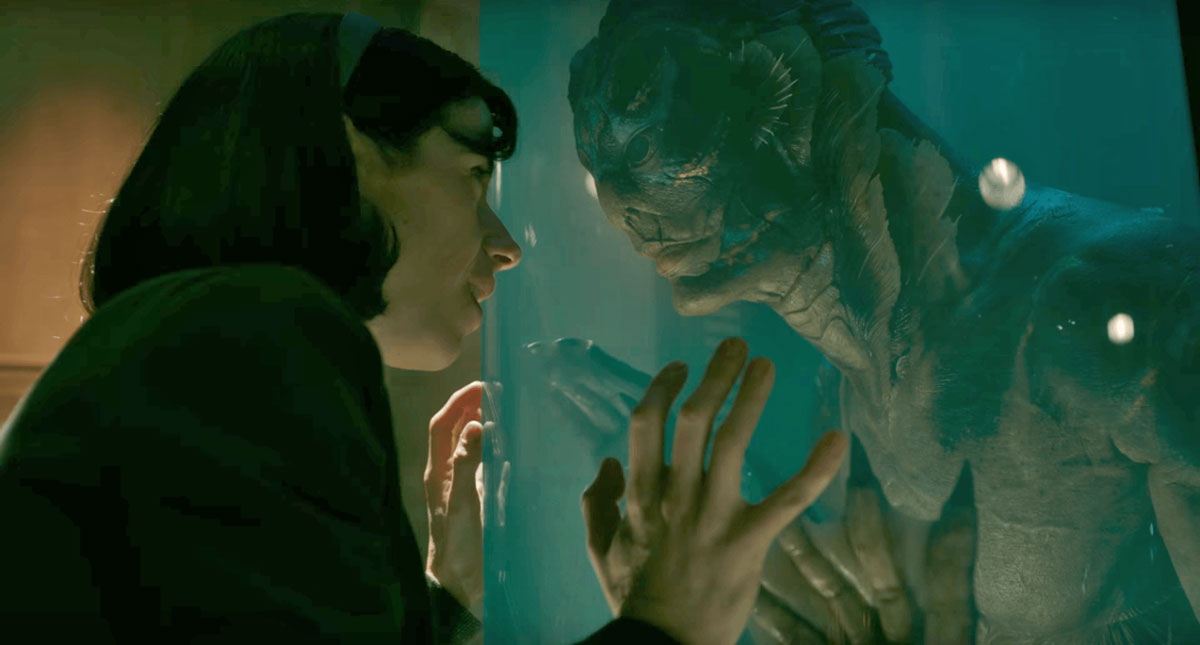
  1. The Shape of Water (dir. Guillermo del Toro, 2017)

Guillermo del Toro delivered the most unconventional best picture winner in over a decade with his monster movie romance The Shape of Water. The two leads, Sally Hawkins as custodian Elisa and del Toro costumed regular Doug Jones as the Amphibian Man, both are speechless throughout the film, and yet their interspecies love story lacks nothing. Del Toro’s fantastical set design and the whimsical acting driven by the silent protagonists create a vision so perfect that the Academy couldn’t deny the new genre classic.

071 The Shape of Water

The Best Films of the Decade: Part 3

I realize that I’m a few months late in posting this list, but I put it off trying to catch up on some films and then I felt it was too late. Three weeks into quarantine, and I’ve finally found the time and motivation to put together my list.

Part 1. Honorable Mentions 101-150 (in alphabetical order)
Part 2. 100 – 91
Part 3. 90 – 81 (below)
Part 4. 80 – 71
Part 5. 70 – 61
Part 6. 60 – 51
Part 7. 50 – 41
Part 8. 40 – 31 (coming soon)
Part 9. 30 – 21 (coming soon)
Part 10. 20 – 11 (coming soon)
Part 11. 10 – 1 (coming soon)

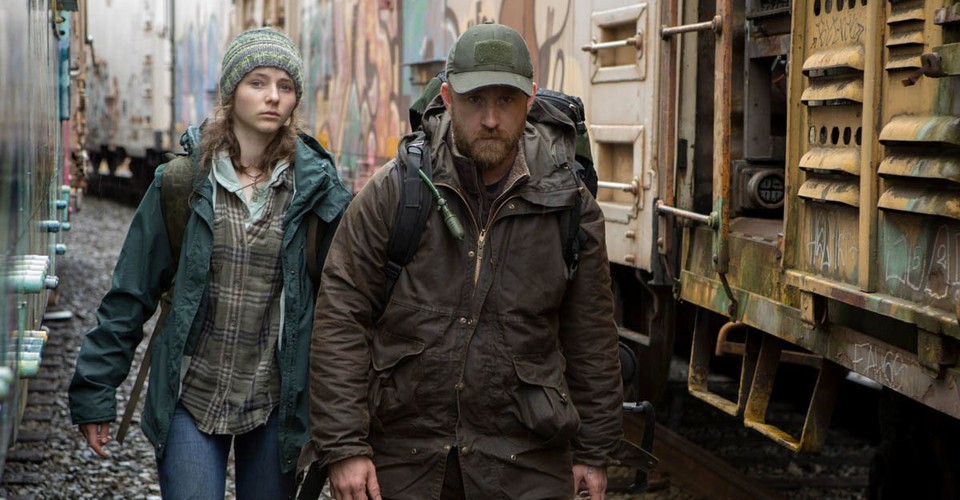
  1. Leave No Trace (dir. Debra Granik, 2018)

A movie that I really enjoyed this decade but didn’t quite make the list was Matt Ross’s Captain Fantastic (2016). That film was a comedic take on father who raised his children completely off the grid. Debra Granik’s Leave No Trace cuts the comedic scenarios to tell something more realistic and heart wrenching. Will (Ben Foster) is incapable of living in anything resembling a society, and has raised his daughter Tom (Tomasin McKenzie) similarly. After getting caught, Tom and Will are temporarily forced into a community. From that point, the film focuses on Tom as she struggles with choosing the life she’s always known, and the only life her father can life, or belonging to a community.

090 Leave No Trace

  1. You Were Never Really Here (dir. Lynne Ramsay, 2018)

The first of Lynne Ramsay’s two films of the decade to make the list, what her production lacks in frequency she makes up by packing each film with an emotional depth that almost require her films be spaced so far apart. In You Were Never Really Here, Joaquin Phoenix continues to prove that he is one of the best actors working today as he disappears into the role traumatized veteran Joe. Though Phoenix rarely speaks throughout the film, the terror of his life is palpable thanks to his visual acting and Ramsay’s immaculate direction. Essentially what Joker (2019) would be if it was any good.

089 You Were Never Really Here

  1. Burning (dir. Lee Chang-dong, 2018)

2018’s Burning is aptly named as it’s an extremely slow burn.  What appears to be a simple slice of life film slowly evolves into a thriller.  Steven Yeun plays the would-be antagonist perfectly ambiguously leaving much of the thriller components in the lead’s (Ah-in Yoo) head.  Director Le Chang-dong uses atmosphere to further enhance the uncertainty in the film.  Ah-in Yoo is frequently shot enshrouded by fog further emphasizing his confusion.  The entire film is shrouded in mystery visually, narratively, and emotionally.

088 Burning

  1. Honeyland (dir. Tamara Kotevska and Ljubomir Stefanov, 2019)

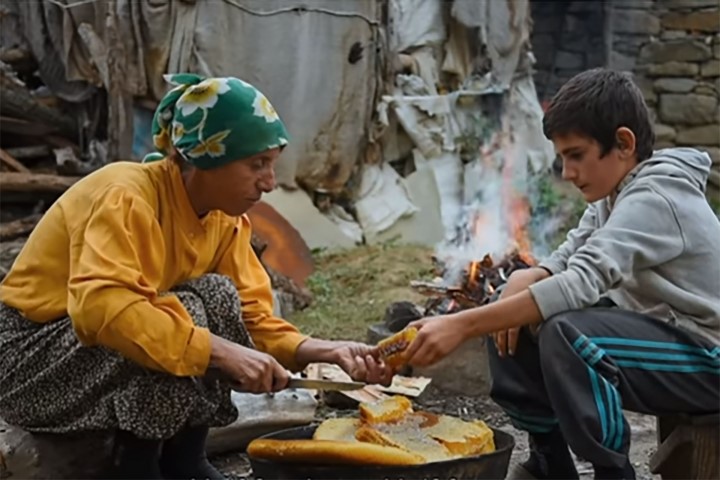
Honeyland is a devastating documentary following Hatidze Muratova, a Macedonian beekeeper whose livelihood is threatened by greedy practices. The tragedy of the tale is that it’s not her greed that threatens her life, but that of her neighbor whom she befriended and taught her business. Honeyland is immersive in its portrayal of Muratova’s pastoral life. Her seemingly banal existence lends beauty to her circumstance but proves all the more heartbreaking when capitalism’s evil takes it all away from her.

087 Honeyland

  1. Krisha (dir. Trey Edward Shults, 2016)

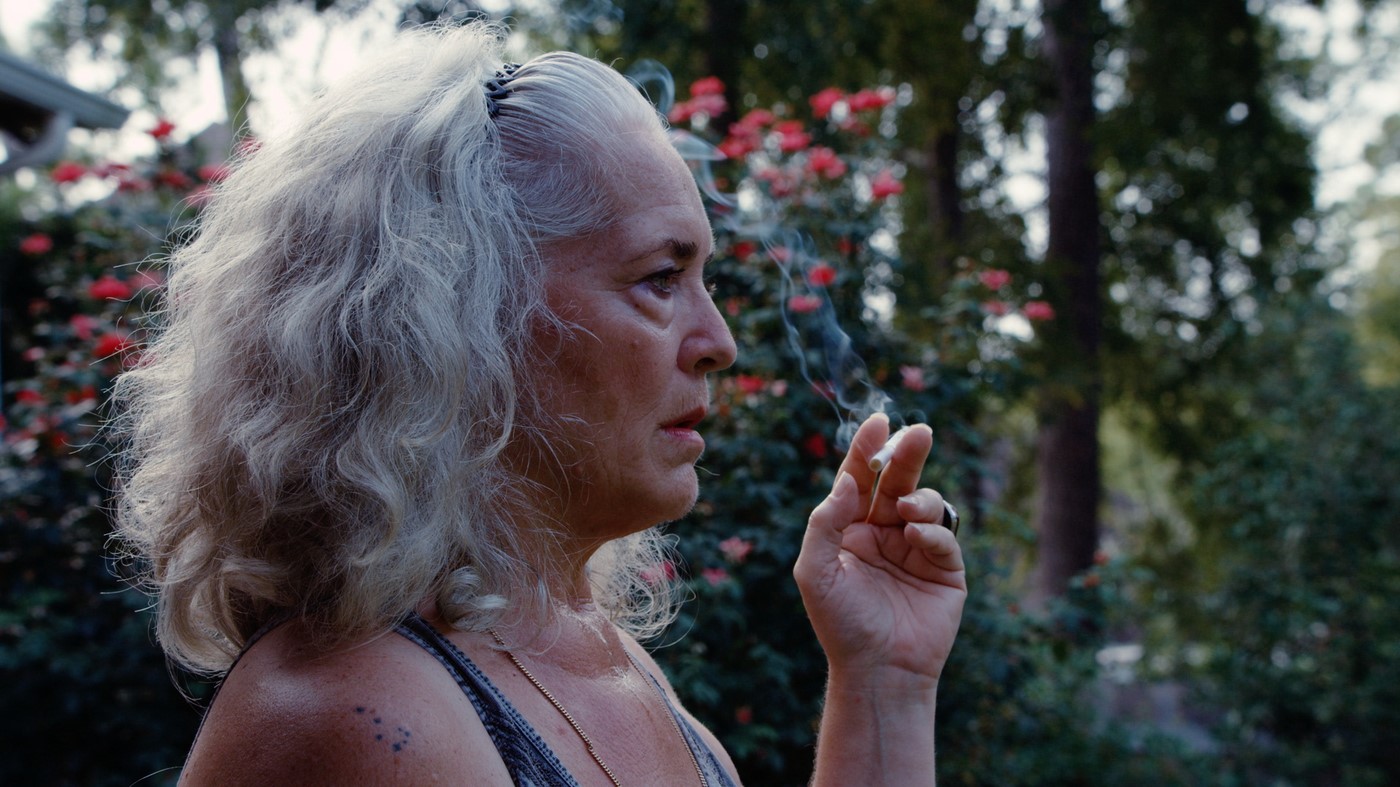
The opening long shot perfectly sets the tone for Trey Edward Shults’s debut feature Krisha. Krisha (Krisha Fairchild) is disheveled as she walks back and forth struggling to navigate the suburban streets of near identical mini mansions. This is not her world, and she is not ready for what’s to come. Meeting with family, many for the first time, after a long absence for a Thanksgiving feast is a shock that she is not ready for, and the memories that are dredged up only make things worse. Through long cuts an eerie score, and perfect sound mixing, Krisha recontextualizes a family drama and terns it into the horror movie that it can be.

086 Krisha

  1. The Kid with a Bike (dir. Jean-Pierre and Luc Dardenne, 2011)

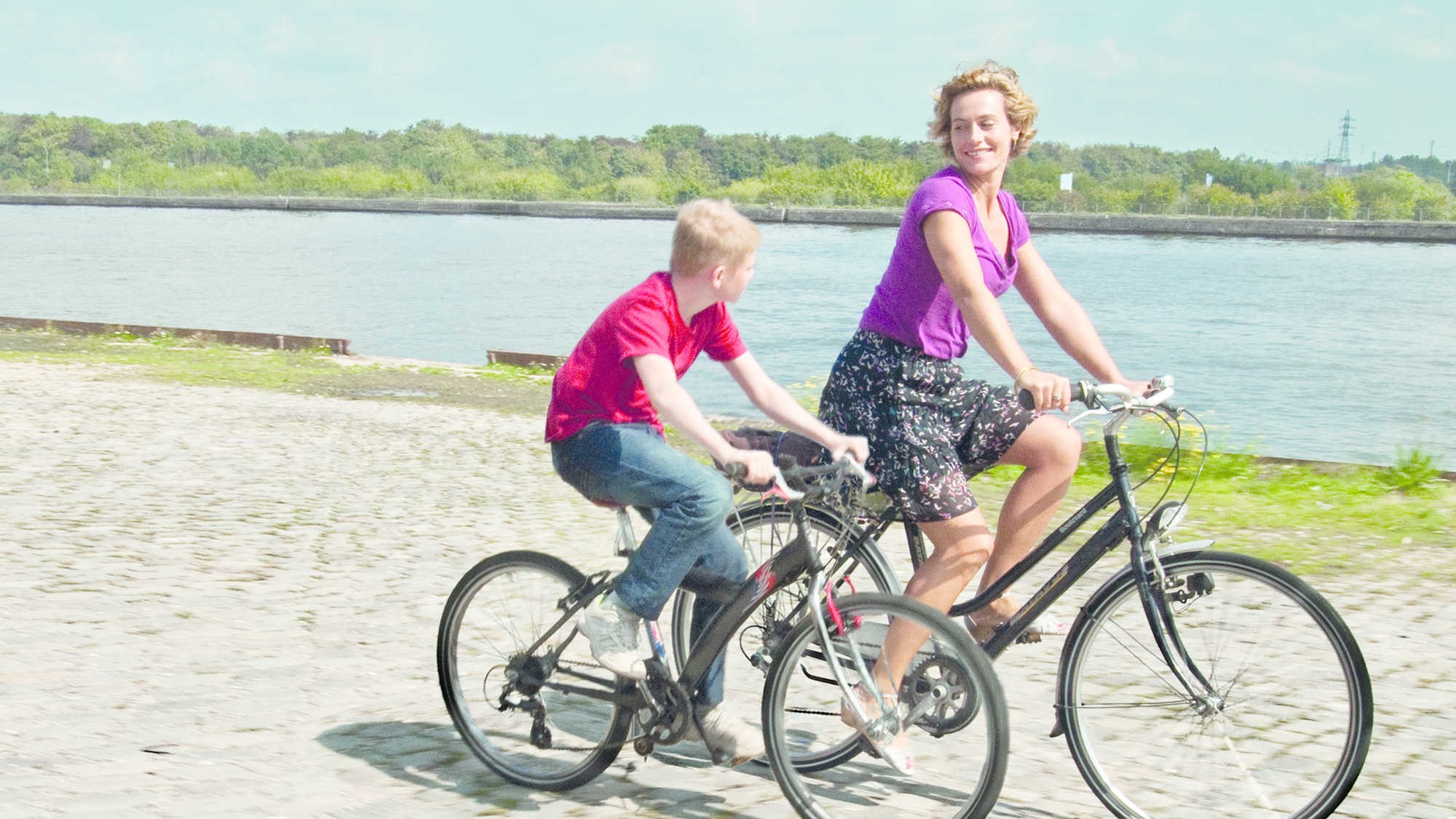
The Dardenne brother’s are masters at making stories of the working class. The Kid with a Bike continues that trend, but expands upon the brother’s motifs by introducing a 12-year-old boy who is a victim of a working class life. Cyril (Thomas Doret) was abandoned by his working class, drunk father and lives in a children’s home. The abandonment has resulted in him acting out and becoming all together difficult. Only through a chance meeting with Samantha (Cécile de France) is he able to find someone to emotionally support him. Strong acting from both leads mixed with the Dardenne’s sentiment resulted in an excellent film.

085 The Kid with a Bike

  1. Moonrise Kingdom (dir. Wes Anderson, 2012)

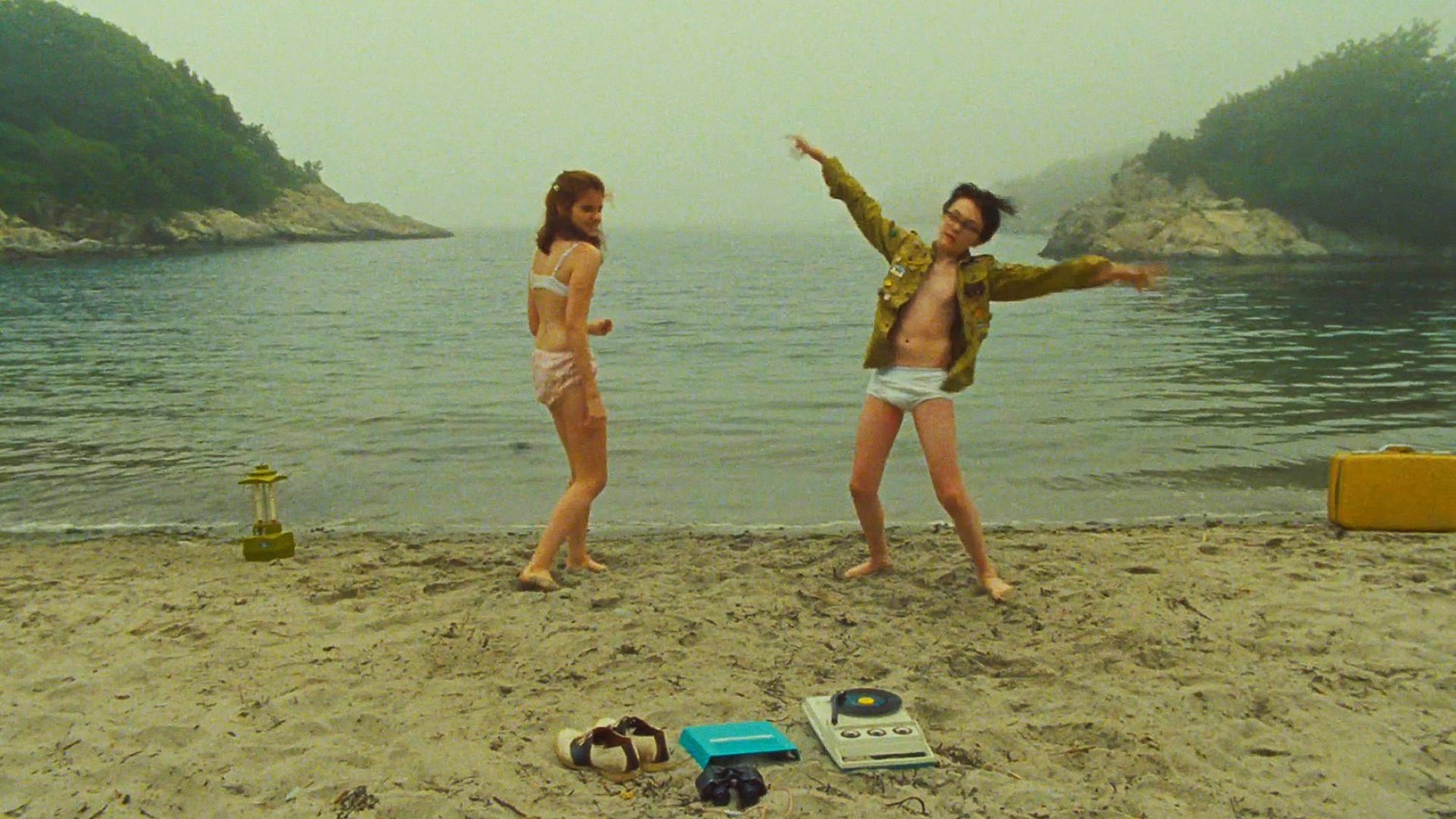
Wes Anderson is at his best when he’s working with children. His precision and whimsy can sometimes verge into the uncanny, but when the audience surrogate is a child, the style is more reminiscent of a storybook. Both child leads, Kara Hayward as Suzy and Jared Gilman as Sam, adapt to Anderson’s heightened dialogue and create an amazing love story. Their story fits perfectly into the storybook that is a Wes Anderson film world.

084 Moonrise Kingdom

  1. The Babadook (dir. Jennifer Kent, 2014)

Queer icon and grief monster Mr. Babadook got his start from the Jennifer Kent film titled for him. Horror wearing it’s allegory on it’s sleeve can be a good thing when done well, and Kent is able to effectively create a terrifying experience while still being heavy handed with said allegory. Essie Davis as Amelia perfectly captures the mindset of a woman tortured with unprocessed grief. Noah Wiseman plays her son Samuel and is the perfect creepy child in a horror film. These performances combined with a terrifying monster and immaculate horror direction create one of the best horror films of the decade.

083 The Babadook

  1. Paddington 2 (dir. Paul King, 2018)

In these trying times, I think it’s important to remember what the philosopher bear Aunt Lucy said, “If we’re kind and polite, the world will be right.” Paddington 2 is the quintessential nicecore film. The CGI bear, voiced by Ben Whishaw, is pure hearted to a fault, and even when that gets him in trouble, he reflects on his aunt’s words and solves his problems by continuing to be nice. The supporting human casts of Sally Hawkings and Hugh Bonneville as Paddington’s adoptive parents, and Hugh Grant as the high camp antagonist, further enhance the charm that oozes out of Paul King’s film. While the first Paddington (2015) is also a delight, Paddington 2 builds on the strong foundation and creates a perfect family film.

082 Paddington 2

  1. We Need to Talk About Kevin (dir. Lynne Ramsay, 2011)

For much of the decade, Tilda Swinton played idiosyncratic characters in heightened films. She became a staple of well-regarded indie comedies becoming a staple of both Wes Anderson and Jim Jarmusch. A decided outlier from the very beginning of the decade is her leading role in Lynne Ramsay’s We Need to Talk About Kevin. In it she plays the mother of the titular Kevin (Rock Duer, Jasper Newell, and Ezra Miller depending on the time period) who is all alone and is trying to recover from an unknown event. As she goes about her day receiving endless abuse, she reminisces on her experiences raising Kevin whom she saw as evil when no one else did. A dreary film that shows off Swinton’s dramatic prowess.

081 We Need to Talk About Kevin


The Best Films of the Decade: Part 2

I realize that I’m a few months late in posting this list, but I put it off trying to catch up on some films and then I felt it was too late. Three weeks into quarantine, and I’ve finally found the time and motivation to put together my list.

Part 1. Honorable Mentions 101-150 (in alphabetical order)
Part 2. 100 – 91 (below)
Part 3. 90 – 81
Part 4. 80 – 71
Part 5. 70 – 61 
Part 6. 60 – 51
Part 7. 50 – 41
Part 8. 40 – 31 (coming soon)
Part 9. 30 – 21 (coming soon)
Part 10. 20 – 11 (coming soon)
Part 11. 10 – 1 (coming soon)

100. Sorry to Bother You (dir. Boots Riley, 2018)

Boots Riley shocked the chain theater going public with his 2018 satire Sorry to Bother You. The film begins in an only slightly enhanced version of our world. Cassius and Detroit (LaKeith Stanfield and Tessa Thompson) living in a garage is quirky but is not outside the realm of a standard class struggle satire. Around a third of the way through the film, Cassius introduces his white voice (voiced by David Cross) which begins the films decent into the surreal. From there, the film spirals far from standard fair, and results in one of the most unique films of the decade.

100 Sorry to Bother You

  1. Girlhood (dir. Céline Sciamma, 2014)

“Shine bright like a diamond.” Rihanna’s song “Diamonds” is played in full for the most memorable moment of Céline Sciamma’s Girlhood, and its lyrics resonate throughout the film’s runtime. Marieme’s (Karidja Touré) abusive background leads her to search for support in a group of girls who christen her Vic. The sisterhood they create is powerful as they attempt to navigate the unfortunate circumstances that life dealt them. The last act of the film leads Vic down a depressing path, but even in such an unsavory situation, she finds a way to shine.

099 Girlhood

  1. Cameraperson (dir. Kirsten Johnson, 2017)

When a documentary is created, hundreds to thousands of hours of footage are left on the cutting room floor. The directors choose only the perfect frames that fit the narrative of their piece. Some of what’s cut are nothing but test shots, but others are extremely personal moments, many that reveal more about the director and cinematographer than the subjects. As the cinematographer of dozens of documentaries, Kirsten Johnson pieces together the scraps from the ones she’s worked on to create this unique and personal film.

098 Cameraperson

  1. Martha Marcy May Marlene (dir. Sean Durkin, 2011)

As I left the theater in 2011, I was ready to proclaim Elizabeth Olsen the breakout actress of the decade. While it’s hard to say she wasn’t successful, being an Avenger clearly qualifies as a success, she never lived up to her breakthrough performance. In Martha Marcy May Marlene, she plays a young woman who attempts to recoup at her sister’s (Sarah Paulson) home after escaping a cult. Olsen’s portrayal of the emotionally damaged woman who is incapable of expressing what’s wrong is what inspired me to make such a bold claim about her. The film builds on her performance by having it’s intensity crescendo throughout the film as the uncertainty of whether cult members are following her and if she’s safe remains through the last moment.

097 Martha Marcy May Marlene

  1. The Love Witch (dir. Anna Biller, 2016)

Neon colors, bloody murders, and women wearing gartered lingerie may sound like the makings of a 70’s sexploitation film, but Anna Biller had some decidedly different inspirations in her 2016 film The Love Witch. A direct homage to Jacques Demy’s Donkey Skin (1970) hints at the deeper motives of the film. In creating The Love Witch, Biller set out to create a movie about being a woman and a woman’s needs in love. Samantha Robinson as Elaine seduces via witchcraft and ultimately kills many men in her search for romantic fulfillment, but unlike sexploitation films, the focus is on her and her needs. Not the body parts nor body count.

096 The Love Witch

  1. A Ghost Story (dir. David Lowery, 2017)

When we die, what do we leave behind? David Lowery’s A Ghost Story reunites his Ain’t Them Bodies Saints (more on that below) stars Rooney Mara and Casey Affleck to grapple with that question. Early in the film, Affleck’s character (neither his nor Mara’s characters are named) dies, but as the title hints comes back as a ghost. The film eschews gaudy special effects and represents this in the simplest way possible, a sheet with two eye holes. As a ghost, Affleck is sentenced to witness what he left behind, and, as the main audience connection, forces a voyeuristic viewpoint on the remainder of the film. First, he watches Mara’s grieving process (including a ten-minute, two shot scene of her eating a pie while crying). Then he watches as she moves on with her life. What happens after speaks to the triviality of the initial question.

095 A Ghost Story

  1. Columbus (dir. Kogonada, 2017)

The premise has been dozens of times over. Two unconnected people in search of meaning or guidance cross each other’s path and create an intimate (though not necessarily romantic) relationship. They wander and discuss and help one another find meaning in their lives.  Columbus is another of that ilk, and yet somehow much more. By subverting the dialogue heavy standard for the genre with silence and character contemplation, Kogonada creates a cinematic experience outside of the expected.

094 Columbus

  1. Le Havre (dir. Aki Kaurismäki, 2011)

A story about n man living in poverty with his dying wife who finds a refugee child and uses his remaining means to reunite the child with his family… but make it funny. My experience with Kaurismäki is limited, the only other of his films that I’ve seen is The Other Side of Hope (2017), but between the two it seems that he is very adapt at inserting a bit of humor and joy into unpleasant situations. His characters exist somewhat in an uncanny valley, but their stories speak to the community we poses as humans that the depressing situations become heartwarming.

093 Le Havre

  1. Ain’t Them Bodies Saints (dir. David Lowery, 2013)

The second David Lowery film staring Casey Affleck and Rooney Mara in this section of my best of list may be the more conventional of the two, but Lowery’s heavily stylized tone and technique are still ever present in this crime romance. The intense jailbreak story is heavily sedated by Daniel Hart’s intoxicating score and a playful use of light and color. Through these artistic techniques, Ain’t Them Bodies Saints possess a dream-like quality. Ruth’s (Mara) love for Bob (Affleck) supersedes the conventional story and results in a beautiful film.

092 Aint Them Bodies Saints

  1. Phoenix (dir. Christian Petzold, 2015)

Quite honestly, the first 95 minutes of Phoenix are good but would not be worthy of a place on this list. The last three minutes on the other hand constitute the greatest ending scene of the decade and would be in contention for the greatest ending of all time.  Nina Hoss as Nelly Lenz singing the classic song “Speak Low” is stunning and emotional and runs a chill down my spine every time I re-watch those last few minutes.

091 Phoenix

The Best Films of the Decade: Part 1

The Best Films of the Decade

I realize that I’m a few months late in posting this list, but I put it off trying to catch up on some films and then I felt it was too late. Three weeks into quarantine, and I’ve finally found the time and motivation to put together my list.

Part 1. Honorable Mentions 101-150 (in alphabetical order) (below)
Part 2. 100 – 91
Part 3. 90 – 81
Part 4. 80 – 71
Part 5. 70 – 61
Part 6. 60 – 51
Part 7. 50 – 41
Part 8. 40 – 31 (coming soon)
Part 9. 30 – 21 (coming soon)
Part 10. 20 – 11 (coming soon)
Part 11. 10 – 1 (coming soon)

20th Century Women (dir. Mike Mills, 2016) – A sweet coming of age movie driven by the three amazing women leads (Annette Bening, Elle Fanning, and Greta Gerwig) as they together raise Bening’s character’s son (Billy Crudup).
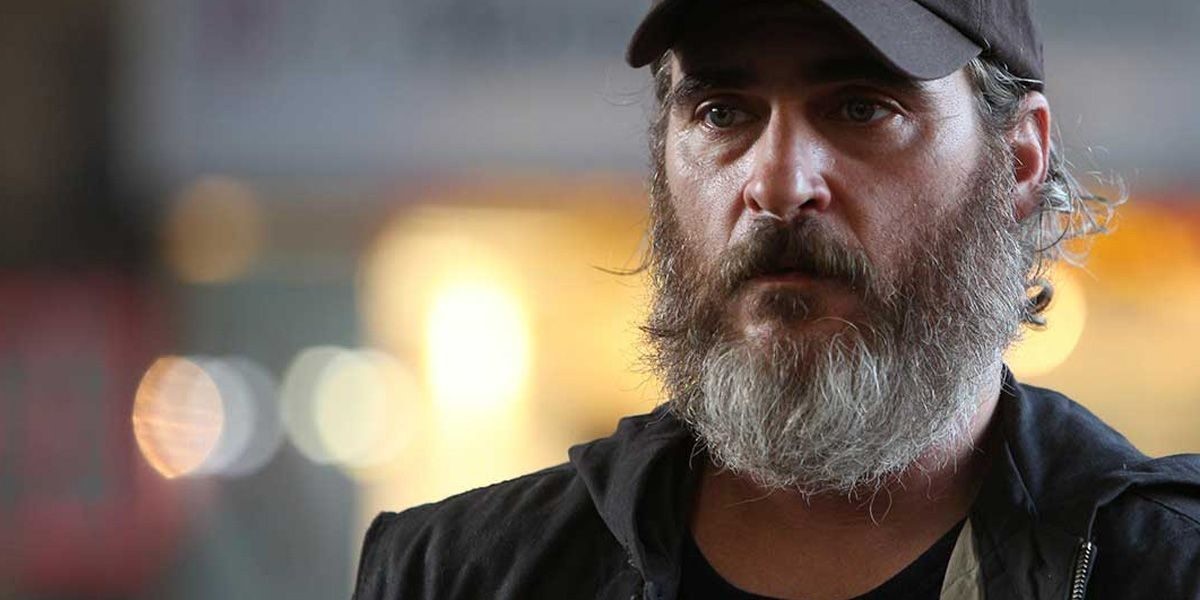
3 Faces (dir. Jafar Panahi, 2019) – One of Panahi’s illegally made films, this one focusing on the restraints put on Iranian women, and how the alure of fame can act as a respite from the overbearing system.
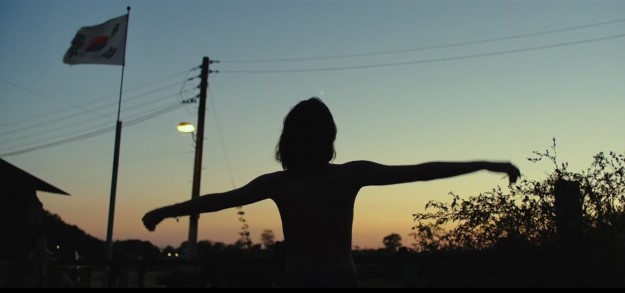
The Assassin (dir. Hou Hsiao-Hsien, 2015) – If you’re looking for non-stop kung-fu action, then The Assassin is not what you’re looking for. If you’re interested in an incredibly slow ponderous tale with some light action, then Hou Hsiao-Hsien made a film for you.

Assassin

Beach Rats (dir. Eliza Hittman, 2017) – Eliza Hittman’s coming of age story of a young queer boy (Harris Dickinson) in Brooklyn who spends his summer experimenting with substances and older men.

Black Swan (dir. Darren Aronofsky, 2010) – The film that won Natalie Portman her lone Oscar (stay tuned to the upcoming lists for the film that should have won her a second). Her performance mixed well with Aronofsky’s thriller direction.

BlacKkKlansman (dir. Spike Lee, 2018) – Potentially the best film Lee has put together since Do the Right Thing (1989). It’s a shame that it will be remembered most for losing to Green Book (2018) much like Do the Right Thing did to Driving Miss Daisy (1989).

Blade Runner 2049 (dir. Denis Villeneuve, 2017) – It is not as good as the 1982 Ridley Scott classic, but Villeneuve manages to capture enough of the classic’s ponderous atmosphere and intrigue to make it a welcome addition to the original’s legacy.

Blade Runner

Blue is the Warmest Colour (dir. Abdellatif Kechiche, 2013) – While the arguments against the film that the sex scenes are shot from a distinctly male gaze, the lead performances by Léa Seydoux and Adèle Exarchopoulos are among the best of the decade and earn Blue is the Warmest Colour a spot on this list.

Brooklyn (dir. John Crowley, 2015) – Saoirse Ronan and writer Nick Hornby are a perfect mix. She embodies his romantic sensibilities in perfect harmony.

Can You Ever Forgive Me? (dir. Marielle Heller, 2018) – The film that would be #101 on the list if I was ranking these, Marielle Heller reminds the world that Melissa McCarthy is an accomplished dramatic performer in this biopic.

Cloud Atlas (dir. Lilly and Lana Wachowski and Tom Tykwer, 2012) – Yes it’s a bit of a mess, but that’s only because it’s ambitions were so high. What remains is a great eon-spanning drama with one of the decades best scores.

The Day He Arrives (dir. Hong Sang-Soo, 2012) – A depressed, no longer working director returns to his hometown, and attempts to find meaning in a series of Groundhog Dayesque scenes, as if he is directing and re-directing real life.

The Diary of a Teenage Girl (dir. Marielle Heller, 2015) – The US version of 2009’s Fish Tank, Bel Powley stands out in the mature coming of age story.

Diary of a Teenage Girl

Ex Machina (dir. Alex Garland, 2015) – Minimalist science fiction that meditates on what it is to be human is my kink, and this won’t be Garlands last of those films on this list.

A Fantastic Woman (dir. Sebastián Lelio, 2017) – As a trans woman myself, I feel confident in saying that most films about us are exploitative bullshit. A Fantastic Woman on the other hand, is honest and moving.

The Florida Project (dir. Sean Baker, 2017) – Child actor Brooklynn Prince is a standout in the depressing depiction of poverty in the shadow of the Disney World artifice.

The Forbidden Room (dir. Guy Maddin, 2015) – A collection of stories made from fake lost footage accented by a song about Udo Kier’s unrelenting obsession with butts and a tutorial on how to take a bath. Maddin isn’t for everyone but if you’re up for something bizarre I highly recommend The Forbidden Room.

Forbidden Room

Girl Walk // All Day (dir Jacob Krupnick) – Obsessively just a 75 minute music video to Girl Talks All Day album, I don’t think any movie has given me more joy this decade than this film.

Girl Walk

Good Time (dir. Benny and Josh Safdie, 2017) – A neon tinted hellish thriller throughout New York where no one is a good person, but you can’t help but feel for their motivations anyway.

Goodbye First Love (dir. Mia Hansen-Løve, 2012) – Young love is never what it seems, but its an important part of growing up, and Mia Hansen-Løve understands those emotions and how they impact the life of a young woman.

The Grand Budapest Hotel (dir. Wes Anderson, 2014) – Wes Anderson playing with aspect ratio to differentiate time periods adds to his already iconic meticulously crafted mise-en-scène.

Grand Budapest

The Handmaiden (dir. Park Chan-wook, 2016) – Constantly shifting perspectives and lack of an omniscient camera lend an air of mystery to the lesbian thriller.

High Life (dir. Clare Denis, 2019) – Claire Denis’s low-concept science fiction film relies on strong performances from Robert Pattinson and Juliette Binoche to create an eerie isolating experience.

Hustlers (dir. Lorene Scafaria, 2019) – Through what could be a straightforward Scorsese crime film homage, Lorene Scafaria tells a story about the power of female friendship set atop the glitz and glam and a New York strip club.

Inside Out (dir. Pete Doctor and Ronnie Del Carmen, 2015) – The best Pixar film of the decade does what most Pixar films do best: present a mature emotional core behind a film that can be consumed by all ages.

Kate Plays Christine (dir. Robert Greene, 2016) – A film that stretches the definition of what a documentary is and can be, the story of an actress preparing for a role that doesn’t exist in order to personalize a near forgotten story is innovative and memorable.

Kubo and the Two Strings (dir. Travis Knight, 2016) – Animation studio Laika Entertainment’s masterpiece, Kubo and the Two Strings mixes great voice acting, a strong story, and breathtaking stop motion.

Kubo

The Lobster (dir. Yorgos Lanthimos, 2015) – A very dark comedy that introduced Yorgos Lanthimos to a wider audience than his prior Greek films is fascinating in its straight-faced absurdness.

Love & Friendship (dir Whit Stillman, 2016) – Whit Stillman’s heightened style mixes perfectly with Jane Austen’s writing, and reuniting with his Last Days of Disco leads Kate Beckinsale and Chloë Sevigny is a joy.

The Lure (dir. Agnieszka Smoczynska, 2017) – A Polish, cannibal, mermaid, musical and if that’s not enough to pique your interest, I don’t know what’s wrong with you.

Lure

Manchester by the Sea (dir. Kenneth Lonergan, 2016) – A trio of great performances (Casey Affleck, Michelle Williams, and Lucas Hedges) highlight this emotional tale of loss and isolation.

Margaret (dir. Kenneth Lonergan, 2011) – The studio’s lack of faith in Lonergan’s two and a half plus magnum opus is the only reason it qualifies for this decades list, but the meandering search for meaning is amazing if not commercially viable.

The Miseducation of Cameron Post (dir. Desiree Akhavan, 2018) – Essentially a dramatic retelling of But I’m a Cheerleader (1999), The Miseducation of Cameron Post tells the story of a girl at a conversion therapy camp in a way that’s more complex than just stating that it’s wrong.

Miss Stevens (dir. Julia Hart, 2016) – Criminally looked over, this early performance from Timothée Chalamet mixes comedy with emotional depth in a way that it’s one sentence blurb undermines.

Miss Stevens

Mistress America (dir. Noah Baumbach) – This movie is just fun. Greta Gerwig as a 30-something who doesn’t have her life together is a welcome character for this 30-something who doesn’t have her life together.

Moneyball (dir. Bennett Miller, 2011) – Sports movies are not the type that are likely to end up on my best of list, but a solid screenplay coupled with great acting performances makes this one to watch.

Mr. Turner (dir. Mike Leigh, 2014) – Timothy Spall embodies the eccentricity of painter J.M.W. Turner and portrays a deeply unpleasant painter who is still fascinating in the lengths he goes to for his passion.

Obvious Child (dir. Gillian Robespierre, 2014) – Jenny Slate stars in this answer to the standard rom-com. The matter-of fact discussion of Slate’s character’s decision to have an abortion is a welcome stance on a common occurrence that is still relegated to taboo.

Paint it Black (dir. Amber Tamblyn, 2016) – Amber Tamblyn’s directorial debut is an intense character drama exploring the emotional struggles of grief.

Samsara (dir. Ron Fricke – 2011) – The cinematographer of the Qatsi trilogy, makes his own entry into the emotionally stirring, beautifully shot, non-narrative documentary.

Samsara

Scott Pilgrim vs. the World (dir. Edgar Wright, 2010) – The only comic book movie to make my list (save your hate mail, I don’t care) Edgar Wright’s frenetic style mixes so well with the source material that I do feel bad we missed out the potential of an Edgar Wright Ant-Man.

Sing Street (dir. John Carney, 2016) – A blast of a musical. The story is lovely and heartwarming, the young actors well performed, and the soundtrack absolutely slaps.

The Square (dir. Ruben Östlund, 2017) – A film that examines the meanings behind modern and performance are and the rich members of society who consume it without understanding.

Suspiria (dir. Luc Guadagnino, 2018) – As a remake of a classic, Guadagnino differentiates his version of Suspiria by foregoing the original’s trademark color scheme and classic score allowing it to stand on its own.

Suspiria

The Tale (dir. Jennifer Fox, 2018) – Jennifer Fox’s visual memoir is an emotionally difficult watch. One which becomes all the more devastating when you remember that it’s a true story.

Tiny Furniture (dir. Lena Dunham, 2010) – Before she made the TV show Girls Lena Dunham made on of the most important films of the mumblecore movement staring her real-life family and Girls costar Jemima Kirke.

Uncle Boonmee Who Can Recall His Past Lives (dir. Apichatpong Weerasethakul, 2010) – The utterly bizarre Palme d’Or winner examines mortality, not through a melancholic tone, but one accepting of the final stage of life.

Upstream Color (dir. Shane Carruth, 2013) – Shane Carruth follows up Primer (2005), one of the driest and science heavy science fiction films of all time, with the exact opposite in the contemplative and fantastical Upstream Color.

Winter’s Bone (dir. Debra Granik, 2010) – What if Jennifer Lawrence’s Katniss Everdeen was transported to present day Missouri, and her story was not written for children? Then you’d have Winter’s Bone.

The Witch (dir. Robert Eggers, 2016) – The films that arguably set off the A24 horror movement, The Witch exemplifies the A24 horror trademark, a slow burn that cressendos throughout the film without release.

Witch